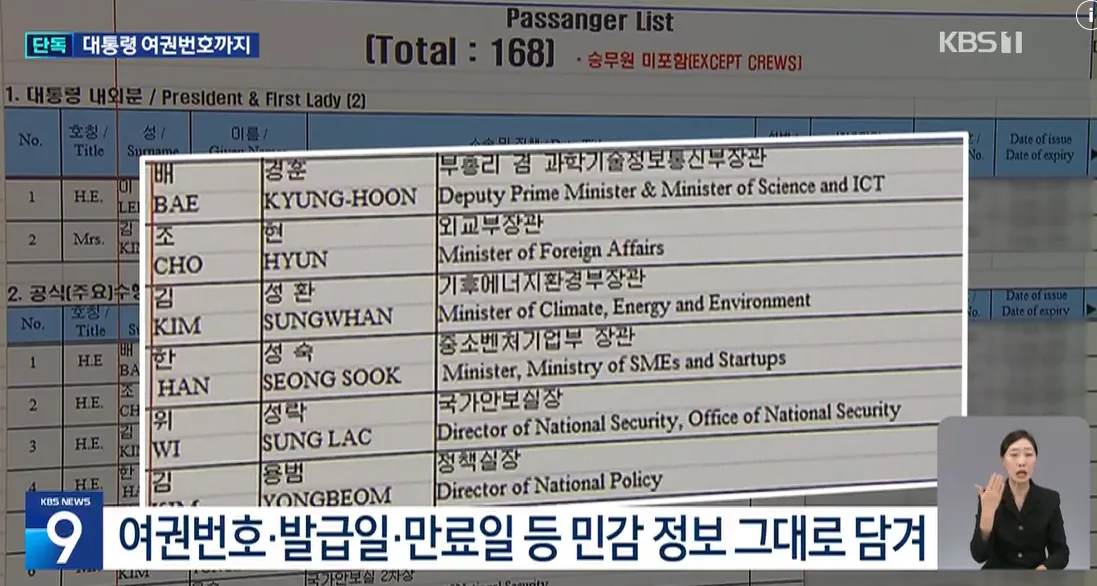
A spreadsheet containing the passport numbers and personal details of South Korean President Lee Jae-myung, his wife, and 166 other passengers aboard the presidential aircraft was publicly accessible on a malware-scanning website for roughly five months before authorities acted.
What happened
In early June 2026 — approximately one week before President Lee departed for Belgium on June 9 — an Excel file titled ‘Air Force One passenger list (total 168 people)’ was uploaded to a paid website that scans files for malware. The file sat there, searchable and downloadable, until the matter was reported by KBS (Korea’s public broadcaster, the equivalent of the BBC) on November 2, 2026.
The spreadsheet’s top row listed “The President and First Lady.” It contained President Lee Jae-myung and First Lady Kim Hea-kyung’s dates of birth, passport numbers, and passport issuance and expiration dates. Six senior cabinet members and presidential aides were also named, including Foreign Affairs Minister Cho Hyun, Science and ICT Minister Bae Kyung-hoon, Climate Minister Kim Sung-hwan, and Han Sung-sook — then Minister of SMEs (small and medium-sized enterprises) and Startups, now Prime Minister. Security personnel, medical staff, a presidential food taster, and wardrobe handlers were also on the list.
Cheong Wa Dae (청와대, the Korean presidential office — equivalent to the White House) issued a statement saying: “We became aware in advance and took response measures,” adding that the Ministry of Foreign Affairs would take further steps. No details were given on what those measures were or when awareness was first gained.
Why Korea does it this way
Presidential travel manifests are highly sensitive security documents in any country; they are typically classified and circulated only on a strict need-to-know basis. Passport numbers, when combined with biographical data, are a primary target for state intelligence services seeking to track officials’ movements, clone travel documents, or build dossiers for targeted influence operations. South Korea’s National Intelligence Service and security community have long flagged the risk of insider leaks and poor document-handling discipline within government agencies. The use of a commercial, internet-connected malware-scanning service to check a file of this sensitivity points to a procedural failure at the source — whoever uploaded the file did so in violation of basic operational security protocols.
What it means for you
For most residents and investors, this incident has no immediate financial impact. But several groups should take note:
- Foreign diplomats and expats with government access: This breach is a reminder that South Korean government agencies can mishandle personal data. If you have submitted passport details to any Korean government body, those records may be stored and handled with less rigor than assumed. Check whether you have active notifications from the Ministry of Foreign Affairs — the ministry has indicated it will contact affected parties.
- Business travelers and corporate security teams: Security officials quoted by KBS warned the exposed data is sufficient for hostile intelligence services to conduct identity theft or targeted attacks against the named individuals. Companies whose executives travel alongside Korean government delegations should review their own exposure.
- Korea-watchers and policy investors: A data security scandal of this scale — touching the president’s own passport — creates political pressure on the Lee administration. If opposition parties escalate it into a full parliamentary inquiry, legislative bandwidth for economic legislation could narrow in Q4 2026.
If this incident has not yet reached you directly, that is consistent with its nature: this is a government security failure, not a consumer data event. No bank accounts, tax records, or financial platforms are reported to be affected.
Watch next
- The Ministry of Foreign Affairs has said it will take “additional steps” — watch for an official statement specifying whether affected passport numbers will be cancelled and reissued; no date has been set, but Foreign Affairs press briefings are held on weekdays at 2:30 p.m. KST.
- The National Assembly (Korea’s parliament) opposition may call for an audit or hearing; watch for a formal motion filed by the People Power Party — if filed, a committee vote would be scheduled within 30 days under National Assembly procedural rules.
- KBS reported the file was accessible for roughly five months; if prosecutors open an investigation into who uploaded it, an indictment timeline would typically be set within 90 days of a formal complaint — watch for any announcement from the Supreme Prosecutors’ Service.
FAQ
Was President Lee Jae-myung’s passport number actually exposed in the Air Force One leak?
Yes. According to the KBS report, the Excel file listed President Lee and First Lady Kim Hea-kyung’s dates of birth, passport numbers, and passport issuance and expiration dates in the top row, labeled “The President and First Lady.” Cheong Wa Dae confirmed the breach and said response measures had been taken, but did not state whether the passport was cancelled.
How long was the Air Force One passenger list exposed online?
The file was uploaded to the malware-scanning website approximately one week before President Lee’s June 9, 2026 departure for Belgium, meaning it was accessible for roughly five months before KBS reported on it on November 2, 2026.
Source: The Kyunghyang Shinmun (경향신문)
Was this useful?
What made the difference? Pick one.
What made the difference? Pick one.
Thanks. We read every answer.