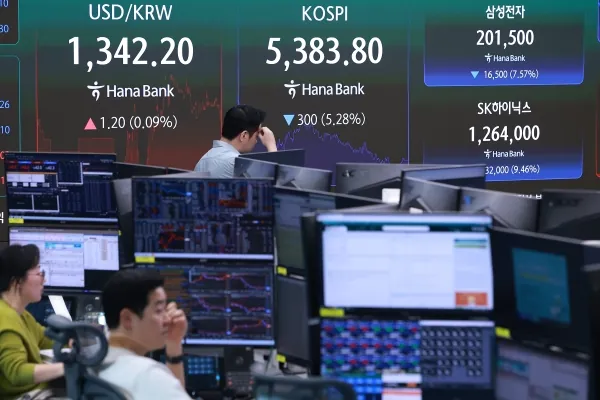
South Korea’s two main stock indexes lost more than five percent in a single session on Thursday after a sweeping Democratic victory in U.S. elections raised fears of tighter American regulation of artificial intelligence and data centers — sectors that anchor Korea’s export economy.
What happened
On November 5, 2026, the KOSPI (Korea Composite Stock Price Index, the main board of the Korea Exchange tracking roughly 800 large- and mid-cap companies) and the KOSDAQ (Korea’s tech-heavy second board, home to many chip-design and display firms) both closed down more than five percent, according to the Korea Exchange. The selloff was attributed directly to the outcome of U.S. midterm elections, where Democrats swept both chambers of Congress — a result widely called a “blue wave.” Investors sold Korean tech and semiconductor stocks on the assumption that a unified Democratic Congress is more likely to pass stricter rules governing AI model training, data-center construction, and energy use, all of which feed demand for Korean memory chips and server components. Specific closing index levels had not been confirmed in the article at time of writing.
Why Korea does it this way
Korea’s stock market is unusually sensitive to U.S. policy shifts because semiconductors — led by Samsung Electronics and SK Hynix — account for a large share of KOSPI’s total market capitalisation and of Korea’s total goods exports. When U.S. legislators signal they may slow AI infrastructure buildout, the order books of Korean memory and logic chip makers are directly in scope. Korea has historically built its economic model around supplying the global technology stack rather than owning the end platforms, so regulatory headwinds in the United States travel quickly down the supply chain to Seoul trading floors. The KOSPI is also heavily traded by foreign institutional investors, who tend to exit emerging-market tech exposure fast when U.S. policy risk rises.
What it means for you
Investors in Korean equities: A 5%-plus single-day drop in KOSPI is a significant move; for context, a fund tracking the KOSPI index would have lost roughly five won in value for every hundred won invested on this day alone. Semiconductor-heavy ETFs (exchange-traded funds) listed in Korea or abroad that hold Samsung Electronics and SK Hynix would have been among the hardest hit. No specific company figures were confirmed in the source article — check live prices at the Korea Exchange (krx.co.kr).
Foreign residents and expats: A sharp equity selloff can weaken the Korean won (KRW) against the U.S. dollar, raising the cost of dollar-denominated expenses such as international school fees, overseas transfers, or imported goods. Whether the won moved significantly on November 5 was not confirmed in the source article.
Workers in the chip and data-center supply chain: If U.S. AI regulation tightens and data-center orders slow, Korean component makers could face lower-volume contracts — but no layoffs or order cancellations had been announced as of this report.
Borrowers and savers: A stock-market shock of this size can influence the Bank of Korea’s (the central bank) thinking about financial stability, though a single-day equity move does not automatically trigger a policy rate change. Check the current policy rate at bok.or.kr.
Watch next
- U.S. Congressional calendar: Watch for the first AI or data-center regulation bill introduced in the new Congress — the trigger is a committee markup date, which will be announced on congress.gov. No date set yet as of November 5, 2026.
- Korea Exchange weekly foreign net buying/selling data: Released every Friday by the Korea Exchange (krx.co.kr); if foreign investors continue net-selling Korean equities for two or more consecutive weeks, it signals sustained pressure rather than a one-day reaction.
- Bank of Korea Monetary Policy Committee meeting: The next scheduled meeting date is set by the Bank of Korea (bok.or.kr); if KOSPI remains down more than 10% from its pre-election level by that date, financial stability language in the statement will be the key signal to watch.
FAQ
Why did KOSPI fall after the US blue wave election result?
KOSPI dropped more than 5% on November 5, 2026, because investors feared a Democrat-controlled U.S. Congress would pass stricter regulations on AI and data centers, reducing demand for Korean semiconductors and server components that power those facilities.
Which Korean stocks were most affected by the US election blue wave?
The article does not name specific companies, but Korean semiconductor and tech stocks — the largest constituents of both KOSPI and KOSDAQ — were the focus of the selloff; check live data at the Korea Exchange (krx.co.kr) for current figures.
Source: KBS World Radio
Was this useful?
What made the difference? Pick one.
What made the difference? Pick one.
Thanks. We read every answer.