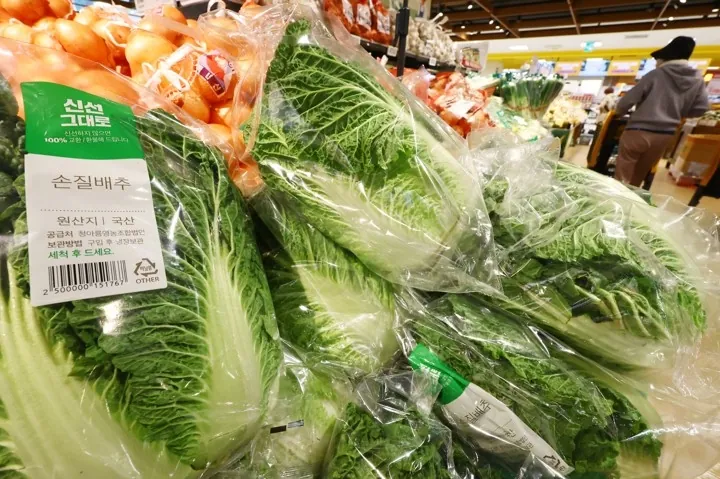
South Korea’s government has launched a 64 billion won (≈ US$46 million) subsidy programme to ease costs during the annual kimjang (kimchi-making) season, as lower cabbage and radish harvests push most ingredient prices below last year’s levels — though salted shrimp bucks that trend sharply.
What happened
On November 3, 2026, the Ministry of Agriculture, Food and Rural Affairs and the Ministry of Oceans and Fisheries jointly announced the “2026 Kimchi Ingredient Supply Stabilization Measures.” The programme runs from November 9 through December 6 and commits a record 64 billion won in discount support — 28% more than the 50 billion won spent in 2025.
Prices as of October 30 tell most of the story. One head of cabbage averaged 3,969 won (≈ US$2.90), down 23.5% year-on-year. Radish fell 9.2% to 2,038 won each. Onions dropped 14.9% to 1,890 won per kg; green onions plunged 30% to 2,274 won per kg. The one outlier: salted shrimp (saeujeot, fermented shrimp paste essential to traditional kimchi) jumped 25.8% to 19,025 won per kg. The government has pre-positioned reserves of 46,500 t of cabbage and 9,000 t of radish, plus stockpiled chili peppers, garlic and onions, to smooth out any spot shortages.
The good harvest reflects a supply surge: fall cabbage production is projected at 1,214,000 tonnes, up 18.5%, and radish at 372,000 tonnes, up 11.1%.
Why Korea does it this way
Kimjang — the communal autumn kimchi-making tradition — is listed as a UNESCO Intangible Cultural Heritage and remains a practical food-security ritual for millions of households. Because kimchi is a dietary staple eaten year-round, a spike in cabbage prices during the brief harvest window hits household food budgets directly and visibly, making it politically sensitive. The government has for decades intervened with strategic reserves and discount vouchers each autumn to dampen price volatility. Participation in home kimchi-making has been declining steadily — this year only 58.6% of households make their own, down 5.6 percentage points — but the scale for those who do remains substantial, averaging 23.4 heads per four-person household.
What it means for you
Households making kimchi at home: The headline saving is real. At 3,969 won per head versus roughly 5,190 won last year, a typical four-person household buying 23.4 heads saves approximately 28,500 won (≈ US$21) on cabbage alone compared with 2025. On top of that, the government’s discount programme (running November 9–December 6) offers up to 50% off select agri-fishery products at participating retailers, so timing your purchases within that window captures the largest discounts.
Consumers relying on fermented seafood ingredients: Salted shrimp’s 25.8% price rise offsets some savings. A household buying 1 kg of saeujeot now pays about 3,900 won more than a year ago — a cost the subsidy programme does not fully neutralise.
Foreign residents: If you shop at major supermarkets (Emart, Homeplus, Lotte Mart), those chains typically participate in government-backed discount events; look for kimjang promotional banners from November 9 onward.
Agri-food investors: The 64 billion won injection flows primarily into retailer discount reimbursements and strategic reserve purchases, not direct producer subsidies. This is a demand-support and buffer-stock mechanism, not a farm-gate price floor. Korean listed agri-distributors and cold-chain logistics firms (check current index constituents on the Korea Exchange) may see volume benefits during the November 9–December 6 window.
Watch next
- December 6, 2026 — End of the government’s kimjang discount programme. Post-programme retail prices will reveal whether the supply surplus is sufficient to hold cabbage and radish prices down without subsidy support.
- Statistics Korea’s Consumer Price Index (CPI) release for November — scheduled for early December 2026. Fresh food and vegetable sub-indices will show whether the kimjang price drop feeds through to the headline inflation print; watch for “agricultural products” CPI sub-category.
- Korea Rural Economic Institute (KREI) monthly price monitor — if salted shrimp (saeujeot) prices remain above 19,000 won/kg through November, expect political pressure on the fisheries ministry to extend seafood discount support beyond December 6.
FAQ
How much does kimchi-making cost in Korea in 2026?
For a four-person household buying 23.4 heads of cabbage, the cabbage bill alone runs approximately 92,900 won at current retail prices (3,969 won per head), roughly 28,500 won less than in 2025 — though the cost of salted shrimp has risen 25.8% to 19,025 won per kg, partially offsetting the saving. Government discounts of up to 50% apply at participating stores from November 9 to December 6, 2026.
Why is salted shrimp (saeujeot) more expensive in Korea this year?
The article does not state the specific cause of the 25.8% price increase for salted shrimp; it notes only that saeujeot rose to 19,025 won per kg as of October 30, 2026, while all major vegetable kimchi ingredients fell. The reason for the shrimp price divergence is not settled by this report.
Source: The Kyunghyang Shinmun
Was this useful?
What made the difference? Pick one.
What made the difference? Pick one.
Thanks. We read every answer.