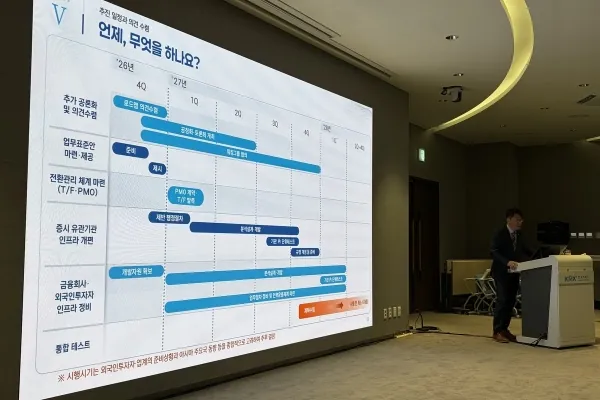
South Korea’s financial market infrastructure bodies have unveiled a roadmap to shorten stock settlement from two business days (T+2) to one business day (T+1) by 2028, bringing Korea in line with the direction major global markets are heading.
What happened
On Monday, November 3, 2026, four institutions — the Korea Exchange (KRX, the main bourse operator), Korea Securities Depository (KSD, which holds and transfers securities), Korea Securities Finance Corporation (KSFC, which provides settlement financing), and the Korea Financial Investment Association (KOFIA, the industry body) — jointly released a draft roadmap for compressing the settlement cycle from T+2 to T+1. The target completion year is 2028. The draft is open for industry consultation before being finalised.
Why Korea does it this way
Korea has run a T+2 settlement cycle (two business days after a trade to actually exchange cash and shares) since it harmonised with global norms in the early 2000s. Shorter settlement reduces counterparty risk — the chance one side of a trade fails to deliver before the deal closes — and frees up capital tied up as collateral during the waiting period. The United States moved from T+2 to T+1 in May 2024, creating pressure on markets that trade with US investors to follow, because mismatched settlement windows complicate foreign-exchange timing and post-trade reconciliation. India completed a phased T+1 rollout for all stocks by 2023. Korea’s move is therefore partly a response to a shifting global standard rather than a standalone domestic reform.
What it means for you
Retail investors in Korea: Proceeds from a stock sale will hit your account one business day sooner — useful for anyone who trades frequently or needs liquidity quickly. No action is required from individual investors; brokers will absorb the back-office changes.
Foreign investors: Foreign funds hold roughly one-third of the KOSPI (Korea’s main large-cap index) by value. T+1 creates a tighter window to arrange the Korean won needed to fund a purchase before settlement — foreign-exchange desks typically need to source currency on the same day the trade is placed. Large institutional investors will need to pre-fund won positions or adjust their trading workflows; some global funds that missed the US T+1 transition already have procedures in place. Expect brokers to issue updated settlement guides well before the 2028 deadline.
Investors in KOSPI-listed companies (especially semiconductors, which dominate the index): the reform itself does not change company fundamentals, but smoother and faster settlement generally supports market liquidity and can modestly reduce bid-ask spreads over time, benefiting anyone trading Korean equities.
Timeline: The 2028 target gives market participants roughly two years from now to adapt systems. The roadmap is still in draft form as of today (November 2, 2026); a finalised schedule has not yet been published.
Watch next
- Finalisation of the roadmap: The four institutions have not yet set a public comment deadline — watch for a KOFIA or KRX announcement confirming the final schedule and any phased go-live dates for different market segments.
- FSC/FSS regulatory approval: The Financial Services Commission (FSC) and Financial Supervisory Service (FSS) will need to endorse rule changes; a formal regulatory notice (date not yet set — decided by the FSC) is the next binding milestone.
- Broker and CSD system readiness reports: KSD typically publishes market infrastructure readiness updates ahead of major settlement changes; watch for a KSD progress report in the first half of 2027 confirming whether custodian banks and foreign brokers are on track.
FAQ
When will South Korea switch to T+1 stock settlement?
The target year is 2028, according to the draft roadmap released on November 3, 2026 by the Korea Exchange, Korea Securities Depository, Korea Securities Finance Corporation, and the Korea Financial Investment Association; a precise go-live date has not yet been set.
Will the T+1 settlement change affect foreign investors buying Korean stocks?
Yes — foreign investors will have a shorter window to arrange Korean won for settlement, requiring same-day or pre-funded currency positions; brokers and custodians are expected to provide updated guidance before the 2028 deadline, but specific new requirements have not yet been announced.
Source: KBS World Radio
Was this useful?
What made the difference? Pick one.
What made the difference? Pick one.
Thanks. We read every answer.