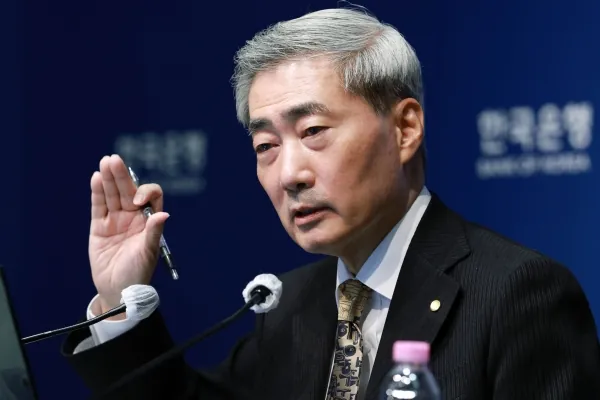
The Bank of Korea (BOK, South Korea’s central bank) left its benchmark policy rate unchanged at its October 2026 meeting, with Governor Shin Hyun-song signalling that July and August hikes have already done enough heavy lifting to justify a slower pace — for now.
What happened
The BOK’s Monetary Policy Board met on 22 October 2026 and voted to keep the base rate on hold. Governor Shin Hyun-song told reporters that the two consecutive rate increases in July and August gave the board room to pause. He stressed the central bank’s intention to maintain a tight monetary policy stance, meaning rates will stay restrictive — above neutral — rather than easing toward stimulus territory. The exact current rate level was not disclosed in the wire summary; check the current figure at Bank of Korea.
Why Korea does it this way
The BOK sets its base rate eight times a year, a relatively frequent schedule that lets it fine-tune policy in smaller steps rather than making large, infrequent moves. South Korea’s mortgage market is dominated by variable-rate loans, so any change in the base rate feeds through to household borrowing costs within months — making the BOK’s decisions unusually direct in their impact on family finances compared with countries where fixed-rate mortgages are the norm. The central bank gained formal independence in 1998 after the Asian financial crisis and now targets price stability as its primary mandate, with financial stability as a secondary concern. Back-to-back hikes in consecutive meetings are relatively unusual and signal that inflation or financial-stability concerns were acute enough to override a preference for gradualism.
What it means for you
Variable-rate mortgage holders (borrowers): The hold means your monthly payment does not rise this cycle. Because Korean home loans reprice against the base rate within months, the July and August hikes will already be showing up in bills; no further increase this meeting. For reference, a 0.25 percentage-point hike typically adds roughly 62,000 won per month to a 300 million won variable-rate mortgage — the two prior hikes together could therefore already be costing you around 124,000 won more each month.
Renters (jeonse and monthly): Jeonse (a uniquely Korean rental system where a tenant pays a large lump-sum deposit — often hundreds of millions of won — instead of monthly rent, and the landlord invests it) deposits are sensitive to interest rates because landlords often finance them with loans. A prolonged tight stance keeps jeonse loan costs elevated, which can suppress new jeonse contracts and push more renters toward monthly rent arrangements.
Savers: High-street deposit rates typically track the base rate with a short lag. The hold means savings rates are unlikely to fall in the near term, so term deposits opened now should still offer relatively attractive yields.
Foreign residents and expats: A tight BOK stance tends to support the Korean won (KRW) by keeping Korea’s rate differential attractive to foreign capital. A stronger or stable won lowers the cost of remitting money abroad or importing foreign goods.
Investors: The BOK’s hold, framed as a pause rather than an end to tightening, signals that further hikes remain on the table if inflation warrants. Check the current base rate and upcoming meeting dates at bok.or.kr.
Watch next
- Next BOK Monetary Policy Board meeting: The BOK meets eight times a year; the next scheduled meeting date has not been confirmed in this report — check bok.or.kr for the official 2026 calendar. The trigger to watch: any CPI (Consumer Price Index, South Korea’s main inflation measure) print that deviates significantly from the BOK’s target, which would pressure the board toward another hike or an earlier pivot.
- South Korea CPI release (Statistics Korea, monthly): The next monthly inflation reading will be published by Statistics Korea (Kostat) on its standard release schedule — typically in the first week of the following month. If headline CPI rises above the BOK’s price-stability target, expect renewed hike talk; if it falls toward or below target, the case for a pause turning into a cut strengthens.
- Household debt data (BOK Financial Stability Report): Governor Shin’s reference to maintaining tight policy likely reflects concern about household leverage. Watch the BOK’s next financial stability update for any change in the household debt-to-GDP ratio threshold that would alter the board’s risk calculus.
FAQ
Did the Bank of Korea raise or cut rates at its October 2026 meeting?
The Bank of Korea held its policy rate unchanged at the October 22, 2026 meeting — it neither raised nor cut. Governor Shin cited the two back-to-back hikes in July and August as justification for pausing, while maintaining an overall tight policy stance.
How do Bank of Korea rate decisions affect my mortgage in Korea?
Most Korean mortgages are variable-rate and reprice against the BOK base rate within months; the two prior hikes (July and August 2026) are already raising monthly payments, and the October hold means no additional increase from this meeting. A single 0.25 percentage-point move typically shifts a 300 million won mortgage payment by roughly 62,000 won per month.
Source: KBS World Radio
Was this useful?
What made the difference? Pick one.
What made the difference? Pick one.
Thanks. We read every answer.