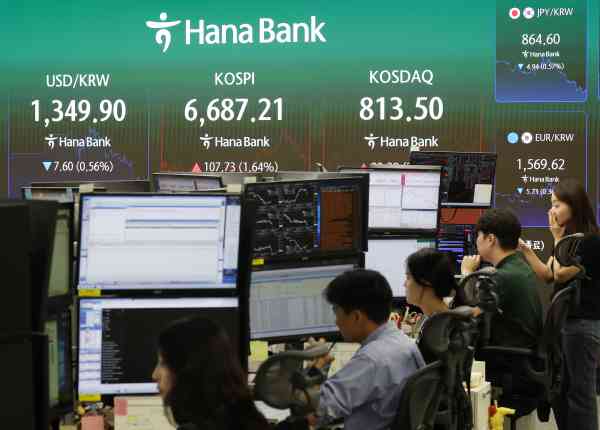
The South Korean won strengthened to the 1,340-per-dollar range on Friday — its strongest level in 14 months — as the currency extended a broader rally against a weakening U.S. dollar.
What happened
On Friday, the won-dollar exchange rate dipped into the 1,340 range during intraday trading, a level not seen since July 2024. The session closed at 1,350.4 won per dollar at 3:30 p.m. local time, a gain of 8.9 won for the day. A lower number means the won is stronger: fewer won are needed to buy one U.S. dollar. The move reflects both improving sentiment toward Asian emerging-market currencies and continued pressure on the dollar from global investors reassessing U.S. economic prospects.
Why Korea does it this way
South Korea runs a heavily trade-dependent economy — exports account for roughly half of GDP — so the won’s value against the dollar matters enormously to companies, importers, and households alike. Korea imports nearly all of its energy (crude oil, liquefied natural gas, and coal), and those purchases are priced in dollars. When the won weakens, energy import costs rise in won terms, pushing up fuel prices and utility bills across the economy. Conversely, a stronger won cuts those import costs, giving the government fiscal room to ease fuel-tax surcharges (temporary reductions in the consumption tax on gasoline and diesel) or hold utility tariffs (government-regulated electricity and gas prices) steady. Korea’s energy pricing system is unusually centralized: electricity rates are set by KEPCO (Korea Electric Power Corporation, the state-run monopoly), and the government adjusts fuel taxes by decree, so exchange-rate gains can be passed through to consumers relatively quickly when policymakers choose to act.
What it means for you
Foreign residents and expats: If you receive income in dollars, euros, or another major currency and convert to won, a stronger won means less purchasing power in won terms. Now is a relatively unfavorable time to convert large lump sums if you expect the won to weaken again. Conversely, remitting money out of Korea becomes cheaper in foreign-currency terms.
Drivers and households: A sustained won strengthening tends to reduce gasoline and diesel prices at the pump within weeks, because oil is priced in dollars and the importer’s cost falls. Electricity and gas bill relief depends on a separate government decision to pass savings through KEPCO tariffs.
Importers and consumers: Goods priced in dollars — electronics components, food commodities, pharmaceuticals — become marginally cheaper to import, which can ease broader consumer price inflation over time.
Exporters and investors: Korean exporters (automakers, chipmakers, shipbuilders) earn dollars abroad and convert them to won; a stronger won compresses their won-denominated revenues and profits, which can weigh on their stock prices on the KOSPI (Korea Composite Stock Price Index, the main South Korean stock market benchmark).
Borrowers: Exchange-rate moves alone do not directly change domestic interest rates, which remain under the control of the Bank of Korea (BOK, South Korea’s central bank). However, a stronger won reduces imported inflation, which could give the BOK more room to consider rate cuts if other conditions align.
Watch next
- Bank of Korea monetary policy meeting: The BOK’s next rate decision will signal whether easing inflation from a stronger won influences the policy path.
- U.S. dollar index and Federal Reserve signals: The won’s rally is partly driven by dollar weakness; any shift in Fed rate expectations could reverse the move quickly.
- Government fuel-tax and utility-tariff announcements: Watch for Ministry of Economy and Finance statements on whether the stronger won will be used to extend or deepen fuel-tax cuts for consumers.
Source: KBS World Radio
Was this useful?
What made the difference? Pick one.
What made the difference? Pick one.
Thanks. We read every answer.



