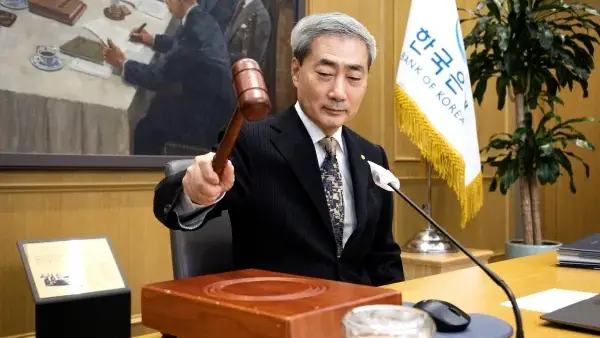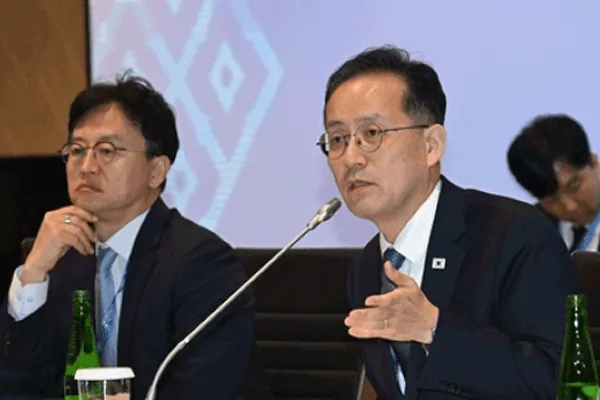
South Korea’s Finance Minister projected mid-three-percent GDP growth for 2026, citing a surging AI-driven semiconductor cycle that is lifting the country’s export engine.
What happened
Deputy Prime Minister and Finance Minister Lee Hyoung-il (이형일) — South Korea’s top economic official, a role that combines finance ministry leadership with macroeconomic coordination — told South Korean reporters on the sidelines of the 2026 IMF and World Bank Group Annual Meetings that he expects the South Korean economy to grow at a mid-three-percent pace this year. The statement, made on 19 October 2026, positions the government’s own outlook above whatever the IMF or World Bank independently published at those meetings. Lee attributed the growth momentum to an ongoing AI-driven semiconductor supercycle — a prolonged period of outsized demand for advanced chips powering AI data centers worldwide — which is boosting South Korea’s two largest export earners, memory chips and logic semiconductors.
Why Korea does it this way
South Korea is one of the world’s most trade-dependent large economies; exports routinely account for roughly 40–50 percent of GDP, with semiconductors alone making up around 20 percent of total goods exports in recent years. Because of this concentration, global tech spending cycles translate directly into Korean GDP swings. The Finance Minister’s appearance at IMF/World Bank sideline briefings is a standing practice: Korean economic chiefs use the annual meetings to signal the government’s own forecast, sometimes diverging from multilateral projections, in order to manage market expectations and reassure foreign investors before the data is officially published.
What it means for you
Investors in Korean equities: The semiconductor-heavy KOSPI (Korea Composite Stock Price Index, South Korea’s main stock benchmark) is directly exposed to the supercycle thesis. Samsung Electronics and SK Hynix together account for a substantial share of KOSPI’s market capitalisation; a government endorsement of continued chip momentum is a positive signal for those positions — but the minister did not name specific companies or contracts, so no single stock call follows from this statement.
Workers and job-seekers: A mid-3% growth year is solidly above South Korea’s estimated potential growth rate of around 2%, which historically correlates with tighter labour markets, particularly in the semiconductor fabrication, equipment, and engineering sectors. If the projection holds, hiring in those fields should remain active through end-2026.
Foreign residents and expats: Stronger growth generally supports the Korean won (KRW). A firmer KRW means your home-currency remittances or foreign-currency income buy fewer won — but it also means imported goods and overseas travel cost less in won terms. Watch the USD/KRW rate; at the time of this writing the minister gave no specific exchange-rate target.
Borrowers: The growth projection itself does not change interest rates directly. Rate decisions rest with the Bank of Korea’s (BOK) Monetary Policy Board. A stronger-than-expected growth print could, however, reduce the board’s urgency to cut rates further — meaning variable-rate mortgage holders should not assume additional relief is imminent. Check the current benchmark rate at the Bank of Korea website.
Watch next
- Bank of Korea Monetary Policy Board meeting (next scheduled date — check bok.or.kr for the exact date): If Q3 2026 GDP data, due from Statistics Korea in late October 2026, prints at or above the mid-3% annualised pace, the BOK board is less likely to cut rates. Trigger: GDP flash estimate above 3.0% year-on-year.
- Statistics Korea Q3 2026 GDP advance estimate (expected late October 2026): This is the first hard data point that will confirm or challenge the minister’s projection. Trigger: release date set by Statistics Korea — monitor their official calendar at kostat.go.kr.
- Global AI capex announcements (ongoing): The supercycle narrative depends on sustained data-centre investment by hyperscalers (large cloud-computing companies such as major US tech firms). Trigger: any major hyperscaler announcing a reduction in AI infrastructure spending, or HBM (High Bandwidth Memory — the specialised chip used in AI accelerators) contract renegotiations becoming public.
FAQ
What is South Korea’s 2026 GDP growth forecast according to the Finance Minister?
Finance Minister Lee Hyoung-il projected mid-three-percent growth for South Korea in 2026, citing the AI-driven semiconductor supercycle; he made the statement on 19 October 2026 at the IMF and World Bank Annual Meetings. The IMF’s own independent figure for South Korea was not specified in the source article.
What is an AI-driven semiconductor supercycle and why does it matter for South Korea?
A semiconductor supercycle is a prolonged surge in chip demand that lifts prices and production volumes well above the long-run average; the current cycle is powered by explosive global investment in AI data centres. It matters for South Korea because semiconductors are the country’s single largest export category, meaning the supercycle feeds directly into Korean factory output, corporate profits, and GDP growth.
Source: KBS World Radio
Was this useful?
What made the difference? Pick one.
What made the difference? Pick one.
Thanks. We read every answer.