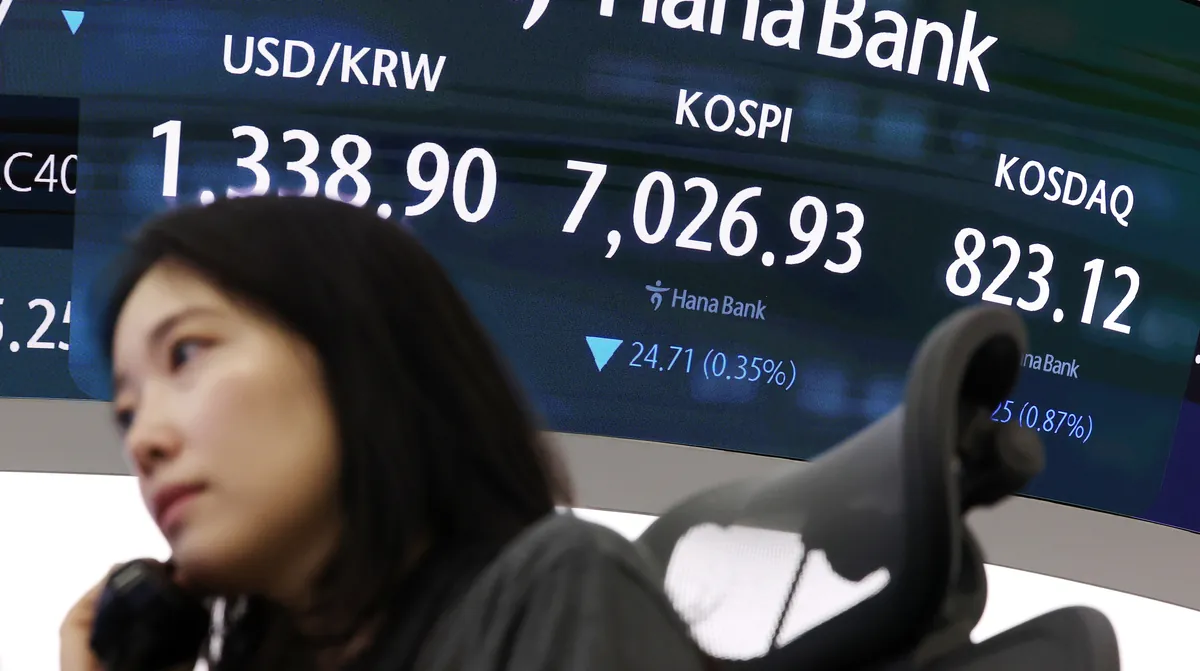
The Bank of Korea’s September 10 policy report named the extreme concentration of Samsung Electronics and SK hynix in the KOSPI (Korea Composite Stock Price Index, South Korea’s benchmark stock exchange) as the single biggest reason the index swung wildly in the first half of 2026 — a phenomenon local media nicknamed “Roller KOSPI.”
What happened
In its Monetary and Credit Policy Report released September 10, the Bank of Korea (BOK, South Korea’s central bank) ranked the causes of first-half KOSPI volatility in order. The top cause was semiconductor concentration: when the KOSPI climbed from 8,000 to 9,000 points, Samsung Electronics and SK hynix together accounted for 99.0% of that entire rise. When the index later collapsed from 9,100 down to the 5,500 level, the two companies explained 69.3% of the fall (Samsung 29.8%, SK hynix 39.6%). Koreans coined the term Samjeon-nix — a portmanteau of the two companies’ Korean names — to describe their chokehold on the index.
The second cause was foreign investor profit-taking and portfolio rebalancing. Third was the surge in single-stock leveraged ETFs (exchange-traded funds that use borrowed money to deliver two or three times an underlying stock’s daily return), which clustered their rebalancing trades late in each session and amplified intraday swings. Fourth was borrowing-fueled investing by individual retail investors.
The BOK’s stance on leveraged ETFs hardened noticeably: its June 2026 Financial Stability Report had said the impact of single-stock leveraged ETFs was “limited,” but the September report elevated them to an official volatility driver.
Why Korea does it this way
South Korea deliberately built a semiconductor-export economy over several decades, and Samsung Electronics and SK hynix became the world’s two largest memory chip makers. Because the KOSPI is a market-cap-weighted index, their combined weight dwarfs any other sector. The BOK noted that the U.S. and Japan also saw wide swings in memory-chip share prices in the same period — but because those companies carry far smaller weights in American and Japanese indices, the volatility barely registered at the index level. Korea has no equivalent diversification buffer.
Single-stock leveraged ETFs are a relatively recent retail product in Korea. Regulations allow them but require daily rebalancing; because individual Korean investors (known for high equity participation) piled into semiconductor-linked versions, the mechanical rebalancing amplified moves that were already large.
What it means for you
Equity investors holding KOSPI-tracking funds: Two tickers effectively drive your returns. If Samsung or SK hynix hits a downcycle — which memory chips do regularly — the whole index can drop sharply even if every other sector is flat. This is not new risk, but the BOK has now formally quantified it at 69–99% of recent index moves.
Investors in semiconductor-leveraged ETFs: The BOK has flagged these products as a systemic volatility amplifier. Regulatory scrutiny typically follows such a report; check the current product terms and position-limit rules at the Financial Services Commission (FSC) for any changes announced after September 10.
Foreign residents and expats with Korean brokerage accounts: Late-session volatility (identified as a structural feature of leveraged-ETF rebalancing) means prices in the final 30 minutes of the KRX (Korea Exchange) trading day can move sharply in the same direction as the day’s trend — something to factor into any limit-order timing.
Workers in the semiconductor supply chain: The report implicitly confirms how tightly Korea’s economic fortunes track chip prices. A sustained KOSPI recovery depends heavily on the next memory-chip upcycle, which affects hiring and capital investment across the sector.
Watch next
- The BOK’s next Monetary and Credit Policy Report is published roughly every six months — check the BOK website (bok.or.kr) for the scheduled release date, and watch whether semiconductor index weight and leveraged ETF rules are addressed with new thresholds or caps.
- Financial Services Commission (FSC) regulatory response: after a BOK report names a specific product as a volatility driver, the FSC typically reviews position limits or disclosure rules within weeks — look for an FSC announcement before end of October 2026 (date not yet set — decided by the FSC).
- Samsung Electronics and SK hynix Q3 2026 earnings: both companies are expected to report in late October 2026 (exact dates not yet announced — check each company’s investor relations page). If combined earnings guidance moves the KOSPI by more than 3–4%, it would validate the BOK’s concentration thesis in real time.
Source: The Kyunghyang Shinmun (Khan.co.kr)
Was this useful?
What made the difference? Pick one.
What made the difference? Pick one.
Thanks. We read every answer.