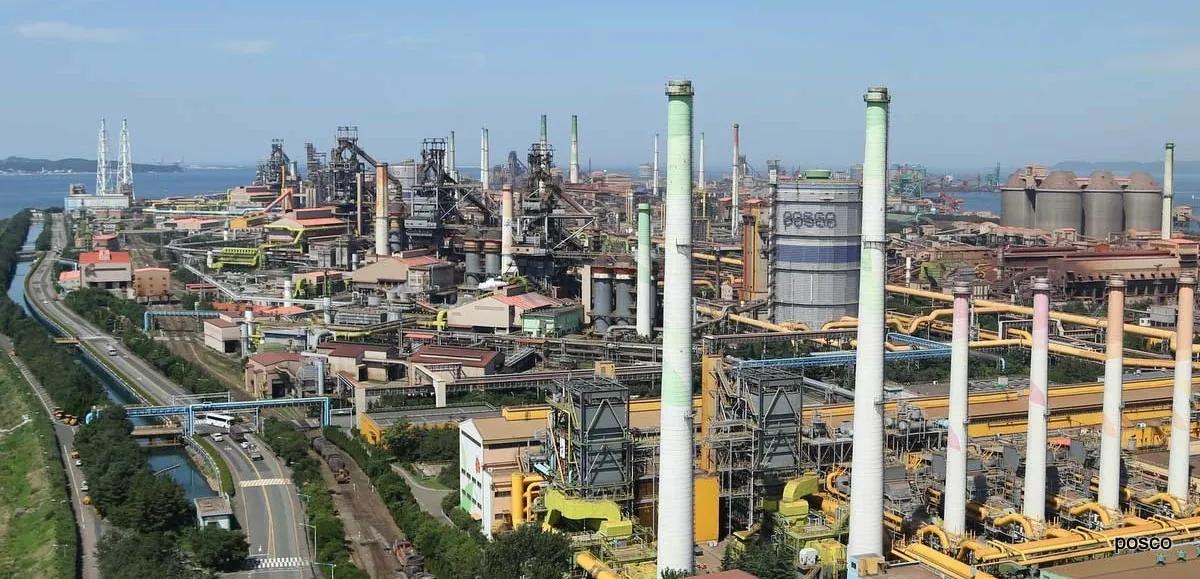
South Korea’s largest steelmaker, Posco, is facing its first labour action in nearly six decades after wage negotiations collapsed — a partial strike that reveals deeper tensions inside one of Asia’s most iconic industrial companies.
What happened
On September 9, 2026, the Posco Labour Union (affiliated with the Metalworkers Federation of the Federation of Korean Trade Unions (FKTU), Korea’s largest mainstream union umbrella) launched a 48-hour partial strike at both the Pohang and Gwangyang steelworks. The union claims roughly 90–100 workers per site are participating; Posco’s own count puts total strikers at about 90 out of a workforce of approximately 15,000 employees (the union has around 10,000 members). Core processes — including molten iron production — are continuing under the essential-work provisions (a clause in Korean collective agreements that keeps safety-critical lines running even during strikes) of the collective agreement, so the company says production is unaffected.
The last time Posco saw a strike was in 1968 — the year the company was founded.
Talks broke down on September 3. The union demanded a 7.1% base pay increase, a 600% incentive bonus, 50 shares under the employee stock ownership plan, and a 200% holiday bonus. Posco counter-offered a 2.0% base pay raise, a 3.5 million won (≈ US$2,500) goal-achievement bonus, and a 500,000 won (≈ US$360) local gift certificate. Posco estimates that meeting the union’s full package would cost roughly 1.4 trillion won — about 80% of last year’s operating profit of 1.8 trillion won. With first-half 2026 operating profit down 43% year-on-year, management says it cannot afford the package.
Why Korea does it this way
Korea’s industrial relations system dates from the rapid heavy-industry build-out of the 1970s, when state-backed conglomerates (chaebol) and steelmakers like Posco operated under tight government oversight and labour was largely suppressed. Independent unions became legal and active only after Korea’s democratic transition in the late 1980s, which is why multi-decade gaps between strikes are not unusual at older state-linked firms. Under Korean labour law, unions must give notice before striking and must maintain essential services — hence the partial, department-limited nature of this action. Wage bargaining in Korea typically happens in a single annual round, so a breakdown in any given year can quickly become a symbolic flashpoint.
What it means for you
Workers and union members: With roughly 90 strikers out of 10,000 union members participating, the immediate impact on individual workers is limited — but if the union escalates (it has signalled it will expand the strike if talks stall), more workers could face lost daily wages. The union’s framing — staffing shortages, long hours, safety — suggests grievances beyond pay that could prolong the dispute.
Investors in Posco Holdings (KRX: 005490): The company’s first-half 2026 operating profit fell 43% year-on-year to a level that already has analysts watching margin pressure. A prolonged or widening strike that disrupts the Pohang or Gwangyang facilities — which together account for the vast majority of Posco’s domestic steel output — would add further cost pressure. As of now, production is unaffected; the trigger to watch is any escalation beyond essential-work boundaries.
Downstream manufacturers (auto, shipbuilding, construction): Posco supplies steel to Korea’s car and shipbuilding sectors. A short 48-hour partial strike with core processes intact poses no immediate supply risk. A full strike or a shutdown of hot-rolling lines would be a different matter — but that has not happened.
Foreign residents and expats: No direct effect on consumer prices or daily life at this stage.
Watch next
- Strike escalation decision (no fixed date — decided by the union leadership after the 48-hour window closes on September 11, 2026): The union has explicitly stated it will expand the scale and scope of the strike if negotiations do not progress. Watch for any union announcement on September 11.
- Next formal wage negotiation session (date not yet set — to be announced by Posco and the union jointly): Both sides have agreed to continue talks separately from the strike. A resumed session with a revised company offer would be the clearest de-escalation signal.
- Posco Q3 2026 earnings (typically released in late October): If the dispute drags into October, watch whether management flags any production or cost impact in its guidance — a quantified figure there would be the first hard data point on strike damage.
Source: Kyunghyang Shinmun (Khan.co.kr)
Was this useful?
What made the difference? Pick one.
What made the difference? Pick one.
Thanks. We read every answer.