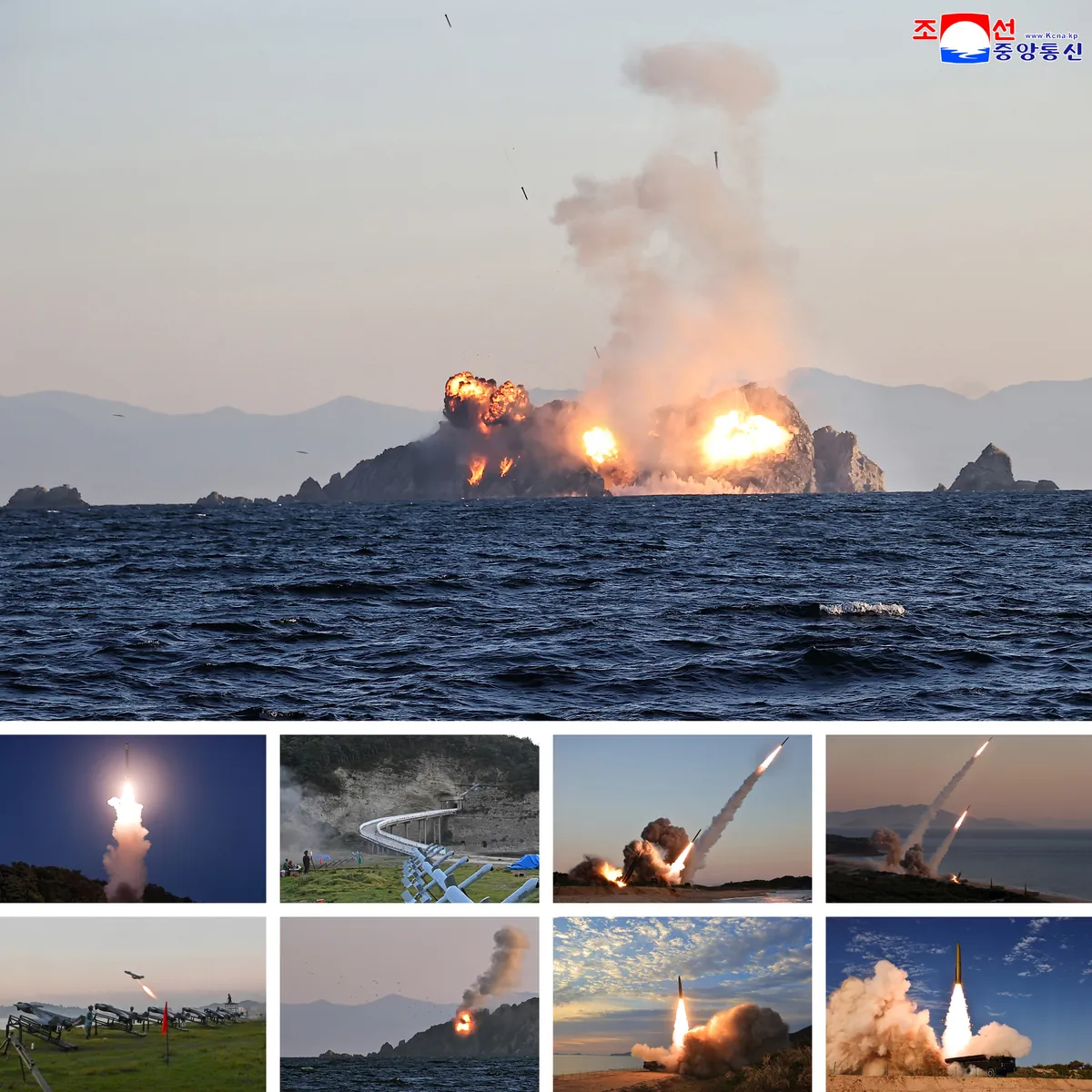
North Korea launched two short-range ballistic missiles toward the East Sea on September 20, hours before a scheduled U.S.-China summit — rattling nerves in Seoul just as Korean exporters and investors are watching Washington and Beijing for trade signals that directly affect the Korean economy.
What happened
South Korea’s JCS (Joint Chiefs of Staff, the top military command body) confirmed that North Korea fired one Hwasong-11 series SRBM (short-range ballistic missile, capable of striking targets across the Korean peninsula) from the Wonsan area at approximately 3:00 p.m. KST, followed by a second at 5:50 p.m. The first flew roughly 450 km; the second exceeded 600 km. Both splashed into the East Sea. The launches came two days after Kim Yo-jong — sister of Kim Jong-un and head of the Workers’ Party Secretariat — issued a statement threatening “a responsive action marked by proportionality or even greater offensiveness” against U.S.-led Pacific Vanguard exercises. The JCS said South Korean and U.S. forces are maintaining full combined readiness.
Why Korea does it this way
North Korea has long used timed missile launches as diplomatic signaling — calibrating range and type to communicate a specific message rather than trigger all-out conflict. The Hwasong-11 series is North Korea’s workhorse SRBM, optimized for peninsula-range strikes against South Korean and U.S. Forces Korea (USFK) bases. Analysts at the Korea Institute for National Unification note the pattern of single launches at varying ranges often marks a late-stage weapon test just before field deployment. Crucially, the September 20 launches fell two days before the UN General Assembly opened (September 22) and four days before a scheduled U.S.-China summit (September 24) — windows Pyongyang has repeatedly used to maximize diplomatic leverage.
What it means for you
South Korea exports around 40% of its GDP, making it acutely sensitive to U.S.-China relations. A missile provocation that complicates the U.S.-China summit — or spooks markets — can nudge the Korean won (KRW) weaker within hours; check the current USD/KRW rate at the Bank of Korea (bok.or.kr) against the pre-launch close on September 19 to gauge the immediate impact. For investors in Korean equities, defense-related names on the KOSPI (Korea Composite Stock Price Index, the main Korean stock exchange) tend to spike on provocation days while exporters and consumer stocks soften; this is a one-session pattern, not a structural shift unless diplomatic talks collapse entirely. Foreign residents and expats: day-to-day life is unaffected — South Korea has robust civil-defense infrastructure and the JCS statement signals no elevated alert level beyond standard readiness. Workers in export industries (semiconductors, shipbuilding, autos) should watch whether the U.S.-China summit on September 24 produces any tariff or trade communiqué, since that — not the missiles themselves — determines near-term order books and employment. If you remit money out of Korea regularly, a won weakened by risk-off sentiment means fewer dollars or euros per won transferred; the effect is typically modest (0.5–1.5% on spike days) but worth timing if you have flexibility.
Watch next
- U.S.-China summit — September 24: Any joint statement or side-channel agreement on Korean peninsula policy will move Korean markets and set the tone for potential U.S.-North Korea talks; trigger to watch is whether the joint communiqué mentions “denuclearization” or “sanctions relief.”
- UN General Assembly — week of September 22: Watch whether the U.S. or South Korean foreign minister requests an emergency UN Security Council session on the launches; a formal resolution attempt (or veto) signals whether diplomatic off-ramps remain open.
- Bank of Korea next rate decision — date not yet set, decided by the BOK Monetary Policy Board: If the won weakens sharply on sustained geopolitical risk, the BOK may pause any planned rate cut; check bok.or.kr for the next MPC meeting date and the current policy rate level.
Source: The Kyunghyang Shinmun (경향신문)
Was this useful?
What made the difference? Pick one.
What made the difference? Pick one.
Thanks. We read every answer.