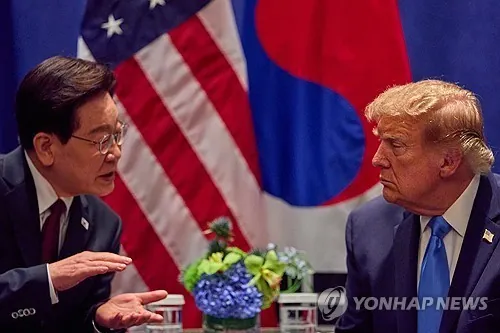
South Korean President Lee Jae-myung completed a two-nation foreign trip — visiting New York for the UN General Assembly and then Mexico City for a state visit — focused on resetting the U.S.-North Korea diplomatic track and deepening trade ties with Latin America’s largest economy.
What happened
President Lee addressed the 81st UN General Assembly in New York on Tuesday, September 22, 2026, outlining a phased denuclearization roadmap for North Korea that would begin with a halt and gradual reduction of its nuclear and missile programs. That same day, he held a bilateral summit with U.S. President Donald Trump, after which South Korean officials said Trump reaffirmed his commitment to engaging North Korea in dialogue. Lee then flew to Mexico City, where on September 24 he met Mexican President Claudia Sheinbaum. The two leaders adopted a joint action plan to deepen economic cooperation and expand collaboration in artificial intelligence, the defense industry, and other sectors. Lee departed Mexico on Saturday, September 26, and is scheduled to arrive home on Sunday, September 27.
Why Korea does it this way
South Korea’s constitution limits the president to a single five-year term, making foreign-policy agenda-setting in the early years crucial — there is no re-election incentive to delay bold moves. On North Korea, Seoul has historically acted as an intermediary (the so-called “facilitator” or “pacemaker” role) between Washington and Pyongyang, because any U.S.-North Korea nuclear deal directly determines the security and economic environment on the Korean Peninsula. Expanding trade with Mexico matters because it is South Korea’s second-largest trading partner in Latin America and a gateway to supply chains reshaping under U.S.-China decoupling pressures.
What it means for you
Investors in Korean defense stocks: The joint action plan explicitly names the defense industry as a new bilateral cooperation sector; Korean defense exporters listed on the KOSPI (Korea’s main stock index) could see incremental contract newsflow from Latin America — check current index weights and company disclosures before drawing conclusions.
Expats and foreign residents: A sustained U.S.-North Korea dialogue track, if it advances, historically reduces the geopolitical risk premium embedded in Korean assets and the won (KRW). No timeline or threshold has been confirmed yet; the Trump commitment is a political signal, not a signed agreement.
Workers in AI and tech: The Mexico joint action plan names AI as a cooperation sector, which could open new export channels for Korean AI and semiconductor firms — but no contracts or figures were announced; this is a framework commitment at this stage.
If nothing is formally agreed between Washington and Pyongyang, the domestic policy and market impact of this trip remains limited to trade-relationship groundwork.
Watch next
- U.S.-North Korea contact: Watch for any statement from the U.S. State Department or North Korean KCNA (state news agency) confirming a meeting date or format — no date has been set; the trigger is an official announcement from either government.
- Korea-Mexico trade follow-through: The joint action plan calls for follow-up working-group meetings; check the Korean Ministry of Trade, Industry and Energy (MOTIE) for a scheduled negotiating round — date not yet set, decided by both governments.
- National Assembly reaction: South Korea’s National Assembly (parliament) may hold a foreign affairs committee briefing on the trip outcomes; watch the Assembly’s published schedule for a hearing date, which would clarify whether the denuclearization phased plan has domestic political backing.
Source: Yonhap News Agency
Was this useful?
What made the difference? Pick one.
What made the difference? Pick one.
Thanks. We read every answer.



