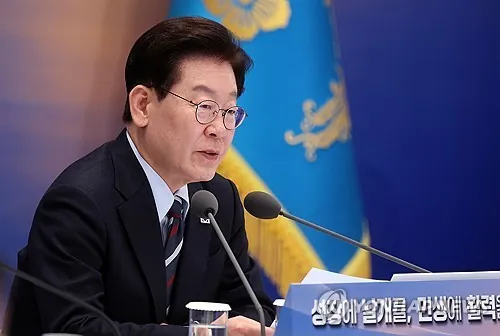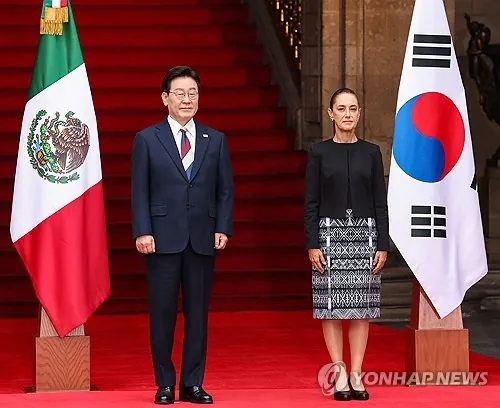
South Korean President Lee Jae Myung met with Mexican President Claudia Sheinbaum in Mexico City on September 24, 2026, pledging deeper cooperation in semiconductors, electric vehicles, artificial intelligence, and supply chains during the first South Korean presidential state visit to Mexico in 16 years.
What happened
President Lee arrived in Mexico City on Wednesday, September 23, for a three-day state visit — the first by a South Korean head of state since 2010. On Thursday, he held formal summit talks with President Sheinbaum at the Mexican presidential palace, preceded by a welcoming ceremony and a wreath-laying at the Altar a la Patria (a national monument in Chapultepec Park honoring Mexico’s military heroes). Following the summit, both leaders attended a signing ceremony for bilateral agreements and delivered a joint press statement. Lee, in a pre-summit interview with Mexican newspaper El Universal, named semiconductors, aerospace, electric vehicles, and AI as priority sectors for cooperation, framing the partnership as a combination of South Korea’s technology base and Mexico’s industrial manufacturing capacity.
Why Korea does it this way
South Korea’s economic model is heavily export-driven, meaning the government actively cultivates bilateral partnerships to secure supply chains and market access abroad. Mexico has become strategically important because of its proximity to the United States and its role as a major manufacturing hub under trade agreements like the USMCA (United States–Mexico–Canada Agreement), which gives goods produced in Mexico preferential access to the US market. Korean conglomerates (known as chaebol, large family-controlled industrial groups) have expanded manufacturing into Mexico partly to benefit from that US access. Presidential state visits are a standard tool for formalizing these economic relationships at the governmental level, often unlocking bilateral investment protections and cooperation frameworks that individual companies build on.
What it means for you
Investors: Korean companies with existing or planned Mexico operations — particularly in the automotive parts, battery, and semiconductor sectors — may benefit from any government-to-government agreements signed during this visit. Check filings and announcements from relevant listed firms for specifics; no contract values were disclosed in this report.
Supply chain watchers: If formal cooperation agreements cover semiconductor or EV battery supply chains, Korean component suppliers serving US-bound Mexican factories could see expanded order pipelines. The specific agreements signed were not yet detailed in this report; watch for the official joint statement text.
Expats and workers in Korea: No direct short-term impact on wages, rents, or borrowing costs. Longer-term, successful export diversification supports Korea’s growth outlook, which influences Bank of Korea (Korea’s central monetary authority) rate decisions — check the current policy rate at bok.or.kr.
Watch next
- The full text of bilateral agreements signed during the September 24 summit — not yet published; expected via Korea’s Ministry of Foreign Affairs (mofa.go.kr) within days of the visit’s conclusion on September 25, 2026.
- Follow-up legislative or budget action: any cooperation framework requiring Korean public funding must pass through the National Assembly (Korea’s parliament); the next regular budget session opens in early October 2026 — date to be confirmed by the Assembly’s official schedule.
- Korean corporate investment announcements in Mexico: if chaebol announce new factory commitments citing this summit, watch for disclosures to the Korea Exchange (KRX) — listed companies must file material investment decisions within a regulated window after the decision is made.
This is a diplomatic and trade-framework story; no immediate changes to rates, taxes, or household costs have been announced.
Source: Yonhap News Agency
Was this useful?
What made the difference? Pick one.
What made the difference? Pick one.
Thanks. We read every answer.