Korea’s benchmark stock index fell sharply on September 11, 2026, pulled down by surging US Treasury yields and a spike in global oil prices — both bad news for Korean exporters and the two chipmakers that anchor the index.
What happened
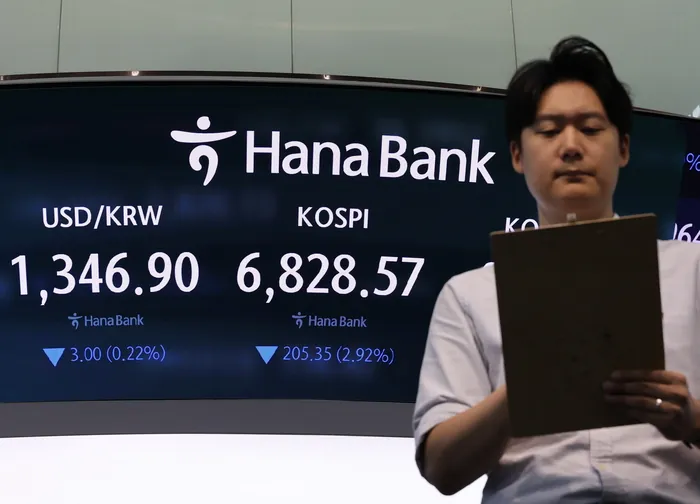
The KOSPI (Korea Composite Stock Price Index, the main Seoul bourse) opened down 2.02% at 6,891.72 as of 9:30 a.m. on September 11. The KOSDAQ (the smaller-cap, tech-heavy exchange) fell 1.41% to 825.15. The two biggest drivers of the selloff were Wall Street’s overnight decline and a surge in US government borrowing costs.
On September 10 (US time), the Dow Jones fell 0.60%, the S&P 500 dropped 0.58%, and the Nasdaq shed 0.65%. The US 10-year Treasury yield jumped 12.36 basis points to 4.9610% — its highest level since 2023 — while the 30-year yield rose 8.02 bp to 5.3660%, a level not seen since 2007. August US producer prices (PPI) rose 5.4% year-on-year, slightly above some estimates, and sub-components that feed into the Federal Reserve’s preferred inflation gauge, PCE (Personal Consumption Expenditures), rose more sharply than expected. Separately, the European Central Bank raised its benchmark rate by 0.25 percentage points to 2.65%.
Oil added to the pressure: WTI crude surged 6.69% to $102.48 per barrel and Brent crude rose 6.34% to $107.63, driven by news that Saudi Arabia’s August oil output fell to its lowest since 1990 and by the ongoing US-Iran conflict.
Among individual stocks, Samsung Electronics fell 2.97% to 261,000 won and SK Hynix — the world’s leading producer of HBM (High Bandwidth Memory, the specialised stacked chips that power AI accelerators) — dropped 3.18% to 1,794,000 won.
Why Korea does it this way
The KOSPI is heavily concentrated in export-oriented manufacturers — semiconductors, autos, and petrochemicals collectively make up a large share of the index. This means Korean equities are unusually sensitive to two global variables: the US dollar funding rate (which rises when Treasury yields rise, tightening conditions for Korean corporate borrowers) and oil prices (South Korea imports nearly all of its crude). When both spike simultaneously, the market reprices quickly. Samsung and SK Hynix alone account for a substantial portion of KOSPI market capitalisation, so their moves amplify the headline index move.
What it means for you
Investors in Korean equities: SK Hynix is the dominant supplier of HBM chips used in Nvidia’s AI accelerators; its share price is a real-time proxy for global AI infrastructure spending appetite. A 3.18% single-session drop reflects investor concern that higher US borrowing costs will slow corporate AI capital expenditure — which would delay new HBM orders. Samsung Electronics, also a major DRAM and HBM supplier, fell nearly 3%. Both stocks are major components of the KOSPI and of EM (emerging-market) index funds; foreign investors tracking those indices faced automatic exposure.
Borrowers in Korea: Rising US yields tend to push Korean government bond yields higher too, which eventually feeds into variable-rate mortgage and business loan benchmarks. The mechanism is not immediate, but a sustained move toward 5% on the US 10-year has historically led Korean lenders to revise their reference rates within weeks.
Fuel and utility costs: WTI above $100 directly raises Korea’s import bill. Korea Electric Power Corporation (KEPCO) passes some fuel-cost increases through to electricity tariffs on a quarterly lag, so a sustained oil spike above $100 could lift household and factory electricity bills in the next quarterly adjustment cycle.
Foreign residents with won-denominated assets: When yields rise in the US, capital tends to flow toward dollar assets; that pressure can weaken the Korean won (KRW), raising the cost of living for those converting foreign earnings into won or sending remittances home.
Watch next
- US August CPI release — September 11, 2026 (US time): The article flags this as the day’s key risk event. If the print comes in above expectations, expect additional KOSPI pressure in the afternoon session and the following morning open. A print below 3.0% year-on-year would likely ease yield pressure.
- US Federal Reserve policy meeting (date not yet set — check the Fed’s published FOMC calendar): With the 10-year yield at 4.96%, markets will reassess rate-cut timing. If the Fed signals a hold or further hike at its next meeting, Korean rate-sensitive sectors (banks, real estate) will reprice.
- KEPCO quarterly tariff review (next scheduled adjustment — check KEPCO’s official announcements): If Brent stays above $100 through the end of September, the Q4 electricity tariff adjustment is likely to reflect higher fuel costs. Watch for KEPCO’s announcement, which typically precedes the quarter by 2–4 weeks.
Source: 전자신문 (Electronic Times)
Was this useful?
What made the difference? Pick one.
What made the difference? Pick one.
Thanks. We read every answer.