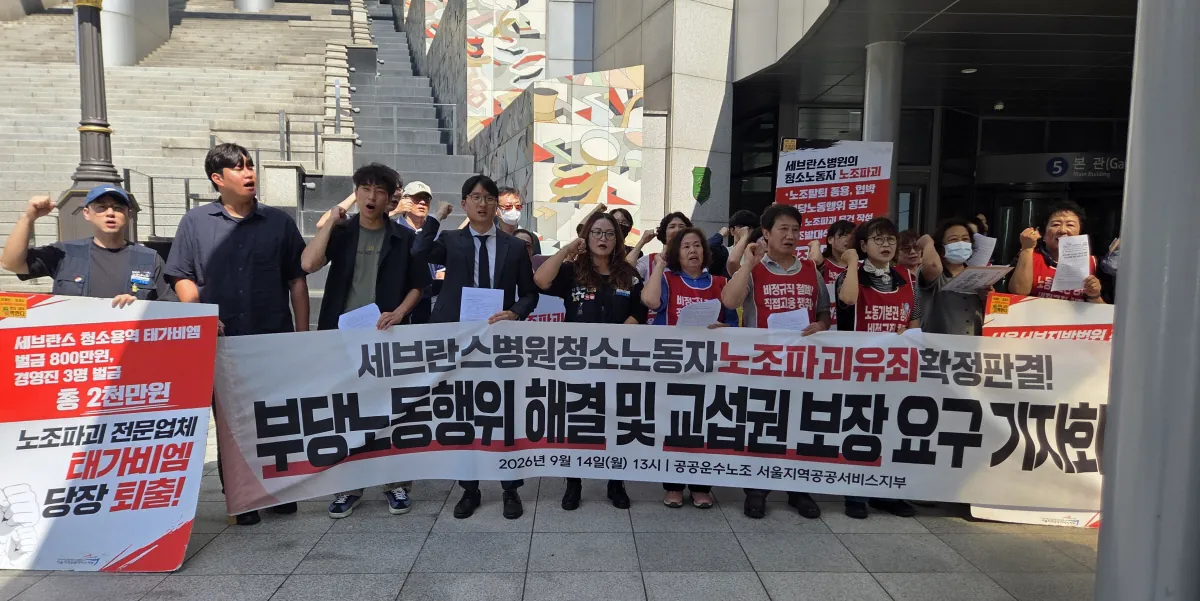
South Korea’s Supreme Court has finalized guilty verdicts against Severance Hospital and its cleaning subcontractor for systematically dismantling a janitors’ union — a case that took ten years to conclude and saw membership collapse from 140 workers to just 2.
What happened
In 2016, roughly 140 cleaning workers at Severance Hospital (a major university hospital in Seodaemun-gu, Seoul, affiliated with Yonsei University) joined a union under the KCTU (Korean Confederation of Trade Unions, Korea’s more militant of two main labor federations). The hospital’s general affairs director and officials at its subcontractor, Taegabm, responded by pressuring union leaders to resign, collecting withdrawal forms from 107 of the 140 members, disrupting the union’s inauguration ceremony, and assigning remaining members to punitive “floating shifts” with no fixed work area — including relocating female workers to underground parking lots. They also repeatedly issued three-month short-term contracts to maximize job insecurity, and funneled welfare funds to a rival union affiliated with the FKTU (Federation of Korean Trade Unions, the more moderate federation).
The union filed an unfair labor practice complaint in October 2016. Prosecutors initially declined to indict (2017), but reversed course in 2021. A lower court issued fines in February 2024. In August 2026, the Supreme Court upheld those verdicts. The hospital’s former general affairs director and Taegabm’s vice president were each fined 12 million won (roughly $9,000 USD at current rates); six other officials received fines of 2–4 million won each; Taegabm as a corporation was fined 8 million won. No prison sentences were handed down.
Why Korea does it this way
Korean labor law distinguishes between a primary employer (the hospital) and a subcontractor (Taegabm), which historically shielded principal firms from union obligations toward outsourced workers. This arrangement — common in hospitals, factories, and logistics — has long been criticized as enabling wage suppression and union avoidance at arm’s length. A 2021 revision to the Trade Union and Labor Relations Adjustment Act introduced a “principal-employer bargaining” (원청교섭, wonchong gyoseop) mechanism allowing subcontracted workers to demand talks directly with the company that controls their real working conditions, even if they are nominally employed by a subcontractor. That provision is central to what the surviving union members plan to invoke next.
What it means for you
Outsourced and service-sector workers (hospital cleaners, security guards, cafeteria staff) now have a confirmed legal precedent that coordinated union suppression across a principal-employer/subcontractor chain is a criminal offense, not just a civil matter — though fines in this case were modest. Foreign residents working in Korea on service contracts should note that the same principal-employer bargaining rules apply regardless of nationality; eligibility depends on whether your real working conditions are controlled by the principal firm. Investors in Korean healthcare or facility-management companies: this verdict raises the compliance bar for outsourced labor arrangements — companies using subcontracting to insulate themselves from union bargaining may now face greater legal exposure; check the current disclosure filings of any listed facility-services firm you hold. Multinationals with Korean operations that use tiered subcontracting for cleaning, security, or logistics should review whether their vendor-management practices could be read as coordinated union interference under the 2021 Act.
Watch next
- The union has formally requested bargaining with Severance Hospital’s director — watch for the hospital’s response within the statutory reply window (date not yet set publicly; the hospital’s acceptance or refusal triggers the next legal step under the Trade Union Act).
- The union has filed a separate civil damages suit of approximately 100 million won (~$75,000) against hospital and contractor officials — a lower court hearing date has not yet been announced; check Seoul court scheduling for case updates.
- Korea’s Ministry of Employment and Labor is reviewing principal-employer bargaining enforcement guidelines; any new administrative directive would be announced via the ministry’s official bulletin (no date set — triggered by the ministry’s internal review schedule).
Source: The Kyunghyang Shinmun (경향신문)
Was this useful?
What made the difference? Pick one.
What made the difference? Pick one.
Thanks. We read every answer.



