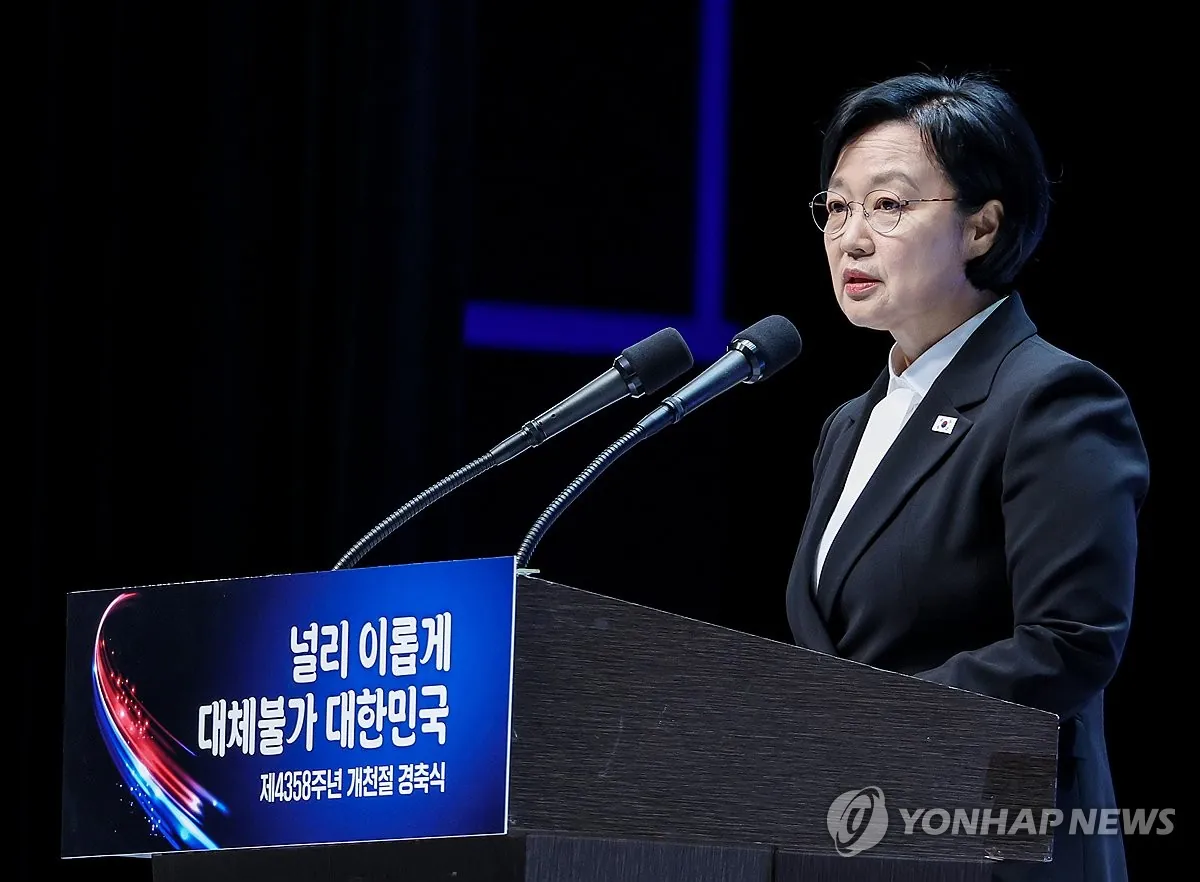
South Korea’s Prime Minister Han Seong-sook used the country’s National Foundation Day (a national holiday on October 3 marking the legendary founding of Gojoseon, Korea’s first kingdom) to pledge an “AI-basic society” and broader economic relief measures for ordinary citizens.
What happened
Speaking at the National Foundation Day ceremony on October 3, 2026, Prime Minister Han Seong-sook delivered a keynote address committing the Lee Jae-myung government to two broad goals: making AI services universally accessible, and improving everyday livelihoods through housing, jobs, and direct financial support. Han framed both pledges as expressions of hongik ingan (홍익인간, the founding philosophy of Gojoseon meaning “broadly benefiting humanity”), the ancient ideal invoked every year on this date. She also called for international cultural and technological cooperation to address shared global challenges.
Why Korea does it this way
National Foundation Day speeches carry policy weight in Korea because they are one of the few occasions when the prime minister speaks directly to the entire nation with a prepared address, making them a traditional venue for announcing or reinforcing government priorities. The Lee Jae-myung administration, which took office in 2025, has centered its domestic agenda on reducing inequality, with “AI-basic society” — guaranteeing access to AI services regardless of income, age, or digital literacy — as a flagship concept. South Korea has one of the world’s highest rates of internet penetration but persistent gaps in digital access among elderly and low-income populations, making inclusion a live political issue. The government’s ability to appoint ministers without a mandatory confirmation vote (nominees face National Assembly hearings, but the president can proceed even without a confirmation report) means these policy directions can be implemented relatively quickly once the cabinet is in place.
What it means for you
Renters and homebuyers: The government reiterated a focus on jeonse (전세, a lump-sum deposit system where tenants pay a large sum upfront instead of monthly rent) stability and broader housing affordability. No specific thresholds or programme details were announced in this speech; check the Ministry of Land, Infrastructure and Transport for the current jeonse loan limits and support thresholds.
Workers and job-seekers: Job creation was named as a priority alongside financial support for “ordinary citizens,” but no sector targets or headcount figures were given in this address. Specific employment measures will emerge in the government’s upcoming budget and economic policy packages.
AI, tech, and chip investors: The “AI-basic society” pledge sustains government demand signals for domestic AI infrastructure. Korean-listed companies in AI services, data centres, and semiconductor supply chains (check KOSPI and KOSDAQ index weights for relevant sectors) may see continued public procurement tailwinds, but no contracts or spending figures were announced here — this remains a policy direction, not a budget line.
Foreign residents: The emphasis on digital inclusion suggests continued or expanded government programmes helping non-Korean-speaking residents access public digital services, though no specific foreign-resident provisions were announced.
Watch next
- 2027 budget bill submission deadline (date not yet set — decided by the government’s budget calendar, typically late September each year): The next budget submission will be the first hard test of whether housing and AI-inclusion pledges receive actual appropriations. Watch for the Ministry of Economy and Finance’s budget proposal for specific line items.
- National Assembly confirmation hearings for remaining cabinet nominees (dates not yet set — scheduled by the National Assembly speaker after nominations are submitted): Ministerial appointments directly shape which agencies implement these pledges; if confirmation hearings stall, policy rollout slows. Track the National Assembly’s session calendar.
- AI-basic society implementation roadmap: The Lee administration has committed to this policy but has not yet published a dated rollout plan. Trigger: watch for a formal announcement from the Ministry of Science and ICT — if a white paper or implementation decree is published, it will carry specific access thresholds and programme launch dates.
FAQ
What is Korea’s AI-basic society policy?
It is a Lee Jae-myung government pledge to ensure all Koreans can access AI services regardless of income, age, or digital literacy level, positioning AI as a public utility rather than a premium service. The specific services and delivery mechanisms have not been finalised as of this speech.
Can South Korea’s president appoint ministers without National Assembly approval?
Yes — nominees face confirmation hearings in the National Assembly, but the president can proceed with an appointment even if the Assembly does not issue a confirmation report, meaning cabinet formation is not blocked by a hostile legislature. This is an established feature of the South Korean constitutional system.
Source: Yonhap News Agency
Was this useful?
What made the difference? Pick one.
What made the difference? Pick one.
Thanks. We read every answer.



