A South Korean state energy-ICT firm and a domestic battery maker have signed a deal to combine their technologies for the next generation of grid-scale energy storage, with the aim of leading the vanadium flow battery market.
What happened
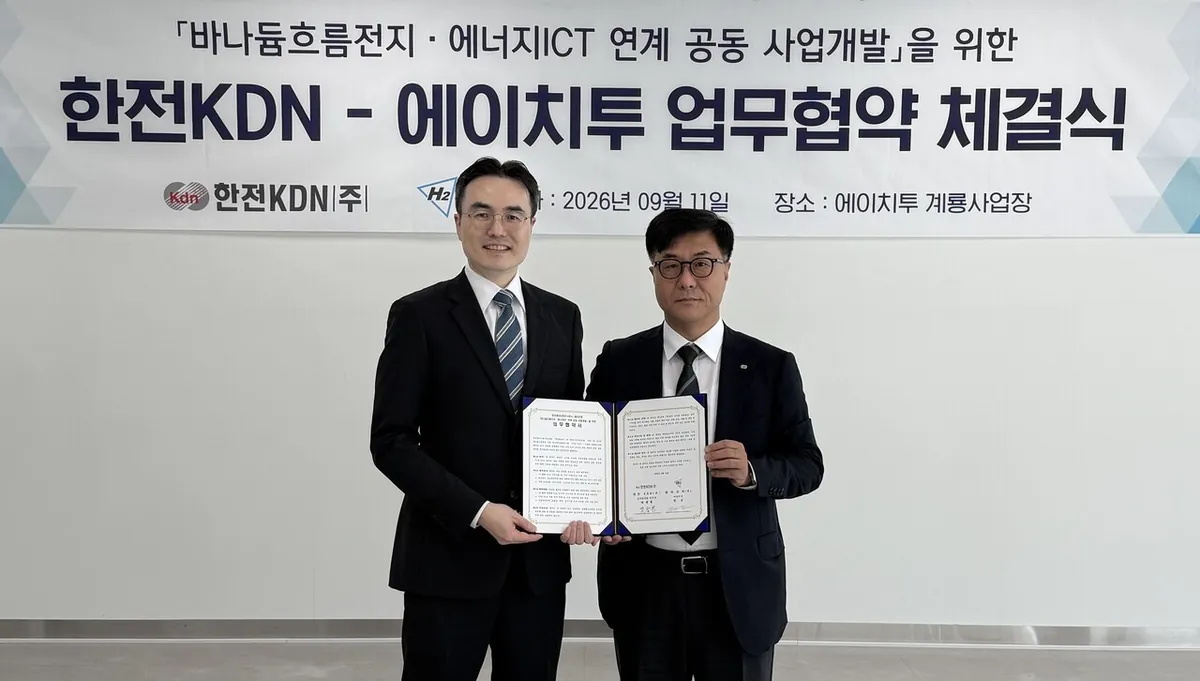
On September 11, 2026, KEPCO KDN (한전KDN — Korea Electric Power Corporation’s ICT subsidiary, state-owned, headed by CEO Park Sang-hyeong) and H2 Co. (에이치투, CEO Han Shin) signed a memorandum of understanding (MOU) at H2’s Gyeryong facility. The agreement targets joint development in the vanadium flow battery (VFB)-based ESS (energy storage system) market. KEPCO KDN brings over 30 years of operating ICT systems across Korea’s power grid; H2 contributes cell-to-system VFB hardware expertise. KEPCO KDN was recently selected as an operator for the government’s first “AI-assisted ESS deployment support project,” giving the partnership a concrete near-term project to work toward.
Why Korea does it this way
Korea’s electricity grid is under mounting strain as AI data centers, chip fabs, and renewable energy targets all compete for the same transmission infrastructure — particularly around the Seoul capital region where congestion is most severe. The government has pushed grid operators to diversify storage technology beyond lithium-ion, which carries fire and explosion risks that have caused costly incidents at Korean ESS facilities in recent years. Vanadium flow batteries use liquid electrolytes pumped through cells — a fundamentally different chemistry that eliminates thermal runaway risk, lasts semi-permanently, and allows the vanadium electrolyte itself to be recovered and reused indefinitely, making it attractive for long-duration, large-capacity storage tied to renewables.
What it means for you
This is an early-stage MOU — no contracts, capacity figures, or timelines have been announced. Concrete effects depend on projects that have yet to be tendered. That said, the sectors to watch:
- Electricity consumers and industrial users: If VFB-based storage successfully buffers renewable intermittency at scale, it could reduce grid congestion costs that currently pressure industrial electricity tariffs — but no rate change is decided or scheduled from this agreement alone.
- Supply chain: H2 Co. handles the full VFB stack from cell and electrolyte design to system integration; KEPCO KDN supplies the AI platform layer (its X-Grid VPP — virtual power plant — and X-Grid MG microGrid platform). Suppliers of vanadium electrolyte and power electronics for Korean grid projects are the upstream winners to watch.
- Investors: KEPCO KDN is a state-owned subsidiary of KEPCO (Korea Electric Power Corporation, listed on KRX and NYSE as KEP); H2 Co.’s listing status is not disclosed in this report. Any future procurement contract would be the material event — the MOU itself is not one.
- Foreign residents and expats: No immediate effect on electricity bills or daily services; this is infrastructure groundwork.
Watch next
- The government’s first “AI-assisted ESS deployment support project” — date not yet set publicly; watch the Ministry of Trade, Industry and Energy (MOTIE) for a project award announcement naming scope and capacity figures.
- Whether H2 Co. and KEPCO KDN submit a joint bid for any VPP or microgrid tender; trigger: a public procurement notice on Korea’s KONEPS (국가종합전자조달, the national e-procurement portal) naming either company.
- Korea’s 11th Basic Plan for Electricity Supply and Demand (제11차 전력수급기본계획) — finalisation expected in late 2026 — which will set long-duration storage targets that determine how large a market this partnership is actually chasing.
Source: AI Times
Was this useful?
What made the difference? Pick one.
What made the difference? Pick one.
Thanks. We read every answer.