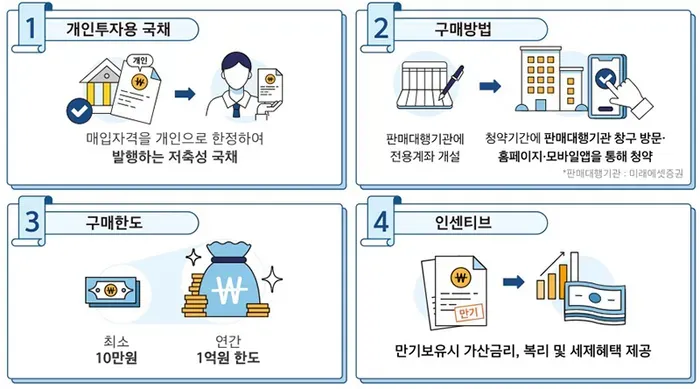
South Korea’s Ministry of Economy and Finance is promoting a retail savings product called the individual investor Treasury bond (개인투자용국채, a government bond sold exclusively to private citizens) as an alternative to equities and bank deposits, with new access via pension accounts opening in September 2026.
What happened
Since June 2024 the Korean government has issued individual investor Treasury bonds monthly (excluding December), and from September 2026 they can be purchased inside DC and IRP retirement pension accounts (DC: Defined Contribution plan; IRP: Individual Retirement Pension, Korea’s personal pension wrapper) at eight financial institutions — broadening access beyond the single dedicated brokerage account previously required at Mirae Asset Securities. The government is marketing the product as a response to a sluggish KOSPI (Korea’s main stock index) and rising bond yields globally that have made fixed-income assets more attractive.
Current coupon rates for the September 2026 issue are: 3-year at 3.780%, 5-year at 4.085%, 10-year at 4.415%, and 20-year at 4.570%. Longer maturities carry an additional spread (0.1% for 5-year; 0.35% for 10- and 20-year) on top of the coupon. Minimum purchase is ₩100,000 (roughly USD 75) in ₩100,000 increments, with an annual ceiling of ₩200 million per person.
Why Korea does it this way
Korea’s retail bond market has historically been dominated by institutional investors; ordinary savers typically held money in bank time deposits or equities rather than government bonds. The individual investor Treasury bond was designed specifically to widen the government’s funding base while giving households a sovereign-backed savings vehicle. Unlike ordinary Treasury bonds traded freely on the secondary market — whose prices move with interest rates — these bonds have no secondary market: they function more like a long-term savings account backed by the full faith of the Korean government.
The tax structure reflects Korea’s broader effort to encourage long-term household saving: interest on 5-, 10-, and 20-year bonds held to maturity is taxed at a flat 14% (15.4% including local income tax) and is excluded from the comprehensive financial income tax (금융소득종합과세, a surtax that applies when total annual investment income exceeds a threshold — check the current threshold at the National Tax Service of Korea). High earners who would otherwise face the surtax benefit most from the separate taxation treatment.
What it means for you
Savers and long-term investors: A ₩10 million (≈ USD 7,500) lump sum held for five years would return approximately ₩12.28 million pre-tax at the current 5-year rate — a gain of about ₩2.28 million. Held 10 years, the same sum grows to roughly ₩15.93 million. These are projected figures at current rates; the coupon is fixed at purchase but new monthly issues may carry different rates.
Retirement savers (DC/IRP holders): From September 2026 you can hold this instrument inside your pension wrapper at one of eight participating institutions. Combining the bond’s fixed return with pension tax-deferral could improve after-tax outcomes for workers building toward the mandatory retirement age — confirm your institution’s eligibility with your pension provider.
High-income investors: The separate 15.4% withholding on interest (for 5-year and longer) means the return is not stacked on top of other investment income for surtax purposes — a meaningful advantage if your annual financial income is near or above the comprehensive-income threshold (check the current figure at the National Tax Service of Korea).
Foreign residents in Korea: You can purchase these bonds if you hold a Korean securities account. Non-residents should verify their tax-treaty status with their home country, as the Korean withholding rate of 15.4% may differ from treaty rates.
Caution — illiquidity: These bonds cannot be sold, pledged as collateral, or gifted. Early redemption is only available after 13 months and forfeits the additional spread, compound-interest benefit, and preferential tax treatment. This is a product for money you genuinely will not need for years.
Watch next
- Monthly issuance window: New bonds are offered each month (no December issue). The October 2026 subscription opens in early October — check the Ministry of Economy and Finance website for exact dates and the coupon rate, which is reset each issue.
- Eight pension institutions: The government has not yet confirmed which eight institutions will offer the DC/IRP route beyond Mirae Asset Securities. A full list is expected to be published by the Ministry of Economy and Finance; watch for an official announcement — no firm date set as of September 24, 2026.
- Comprehensive financial income threshold review: If Korea’s National Tax Service revises the surtax threshold (check the current figure at nts.go.kr), the tax advantage of separate taxation could change for middle-income savers. Watch the annual tax-law amendment bill, typically tabled in the National Assembly each October–November.
Source: The Kyunghyang Shinmun (경향신문), reporting on materials provided by the Ministry of Economy and Finance, September 24, 2026.
Was this useful?
What made the difference? Pick one.
What made the difference? Pick one.
Thanks. We read every answer.



