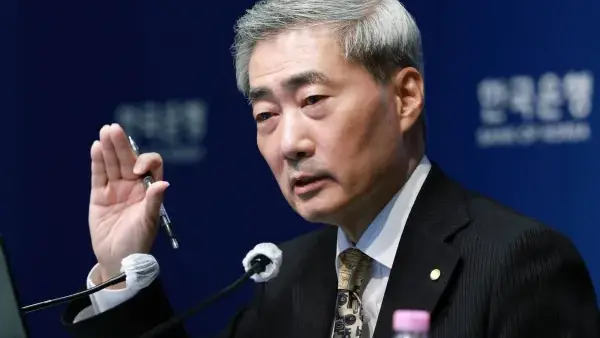
South Korea’s Deputy Prime Minister and Finance Minister Lee Hyoung-il visited the Bank of Korea (BOK, South Korea’s central bank) on Monday, September 28, 2026, where the two institutions agreed to deepen coordination in monitoring financial markets, foreign-exchange movements, and real estate prices — and to act pre-emptively if risks emerge.
What happened
In a joint meeting held at BOK headquarters, Finance Minister Lee and BOK Governor agreed to strengthen their cooperation framework across three specific areas: financial-market stability, the foreign-exchange (FX) market, and the real-estate market. The two sides pledged to share data and coordinate responses before problems escalate rather than reacting after the fact. No specific policy-rate change was announced at this meeting; the agreement is procedural — about how the two institutions will work together going forward.
Why Korea does it this way
Korea operates a dual-authority system: the Ministry of Economy and Finance sets fiscal and housing policy, while the Bank of Korea independently sets the benchmark policy rate (the base rate) eight times a year. In practice, the two institutions must coordinate closely because Korean households carry large amounts of variable-rate mortgage debt — when the BOK moves its base rate, borrowing costs ripple through to household budgets within a few months. Past episodes of poor coordination, including rapid real-estate price swings in the early 2020s, created political pressure for the two bodies to formalise joint-monitoring arrangements.
What it means for you
Borrowers and mortgage holders: No rate decision was made at this meeting, so your monthly payment does not change today. However, the agreement signals that the BOK and the Ministry will move together if housing or credit conditions deteriorate. To check the current base rate, see the Bank of Korea’s official site. A 0.25 percentage-point cut on a 300-million-won variable-rate mortgage typically trims the monthly payment by roughly 62,000 won — but no cut has been announced.
Renters: Real estate is explicitly named as a monitoring target. If joint surveillance leads to cooling measures — such as tighter loan-to-value limits — this could dampen house prices and reduce the size of jeonse deposits (a large lump-sum deposit paid instead of monthly rent, typically 60–80% of the property’s value) demanded by landlords.
Foreign residents and investors: FX market stability is on the joint watchlist. If the Korean won (KRW) faces sharp depreciation pressure, coordinated intervention is now more explicitly on the table. This is relevant for anyone receiving income or holding assets in a foreign currency while living in Korea.
Note: This meeting produced a cooperation agreement, not a policy decision. Concrete effects depend on what triggers the two institutions agree to act on — those thresholds have not been publicly disclosed.
Watch next
- Next BOK Monetary Policy Board meeting: The BOK sets its base rate eight times a year; check the BOK’s schedule page for the exact date of the next meeting (date not yet confirmed in this report). A rate decision at that meeting would be the first concrete policy signal following this cooperation agreement.
- Government real-estate policy announcements: With real estate named as a joint focus, watch for any Ministry of Economy and Finance press releases on loan-to-value (LTV) or debt-service-ratio (DSR) rule changes — these are typically announced with 1–4 weeks’ notice before taking effect.
- Monthly FX and household-debt data: The BOK publishes household credit statistics monthly (usually mid-month). If the September figure — due around mid-October 2026 — shows household debt rising above the previous quarter’s level, expect the cooperation framework to be activated sooner.
Source: KBS World Radio
Was this useful?
What made the difference? Pick one.
What made the difference? Pick one.
Thanks. We read every answer.