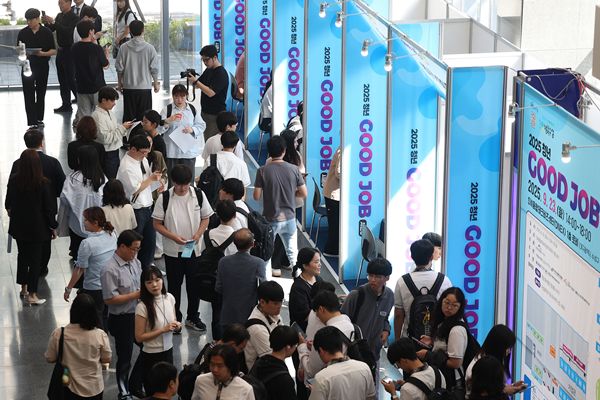
South Korea added 184,000 jobs in August 2026, but the youth unemployment rate climbed to its highest level in four years, revealing a growing generational split in the labour market.
What happened
Data released Wednesday, September 9, 2026, by South Korea’s Ministry of Data and Statistics (the government body that publishes monthly labour-force surveys) showed 29.15 million people aged 15 and older were employed in August — a net gain of 184,000 compared with the same month a year earlier. While that headline figure approached 200,000 and looks solid in aggregate, the youth cohort told a different story: unemployment among younger workers rose to a four-year high, meaning the rate has not been this elevated since roughly mid-2022. The exact rate was not disclosed in the article; check the current figure at Statistics Korea (kostat.go.kr).
Why Korea does it this way
Korea measures employment through a monthly household survey conducted by Statistics Korea (formerly the Korea National Statistical Office), benchmarked to the 15-and-older population — a standard that mirrors ILO (International Labour Organization) methodology used globally. Youth unemployment is tracked separately because Korea’s labour market has long had a structural mismatch: universities produce far more graduates than chaebol (large family-controlled conglomerates) and large public institutions can absorb, pushing graduates into extended job-search periods or precarious contract work. Demographics compound the problem — a shrinking youth cohort means even modest absolute job losses can push the rate sharply higher. The Employment Insurance (EI) system, funded by payroll contributions from both employers and workers, finances unemployment benefits and job-training programmes that are supposed to cushion these gaps.
What it means for you
Foreign workers and expats on salary contracts: Most salaried foreign workers in Korea are enrolled in the Employment Insurance (EI) system — the national scheme that pays goyong boheom (고용보험, literally “employment insurance”) benefits when you lose a job involuntarily. If you are laid off, EI eligibility typically requires at least 180 days of insured employment; check the current benefit level at Korea Employment Insurance (ei.go.kr). A weak youth jobs market generally does not reduce your EI entitlement, but it does signal that re-entry into the Korean job market may take longer if you need a new role.
Workers in affected age groups: If you or a dependent is in the 15–29 age bracket and job-hunting in Korea, today’s data confirms competition is at its stiffest since 2022. Sectors most commonly cited in past youth-unemployment spikes include construction, manufacturing, and retail — sectors that have faced weak domestic demand in 2026.
Investors watching Korean equities: Weak youth employment can weigh on consumer-spending sentiment, which feeds into domestic demand for retailers, food-and-beverage firms, and platform companies listed on the KOSPI and KOSDAQ indices. It also increases political pressure on the government to announce job-creation or training stimulus — watch for supplementary budget proposals in the National Assembly.
Parents qualifying for parental-leave benefits: Korea’s parental-leave pay is also disbursed through the Employment Insurance system. Ongoing funding pressures from higher unemployment claims do not immediately change individual benefit amounts, but fiscal stress on the EI fund is worth monitoring; the current benefit cap is published at Ministry of Employment and Labour (moel.go.kr).
Watch next
- September 2026 employment report — Statistics Korea typically releases the following month’s labour-force survey in the second week of the next month (around mid-October 2026). If the youth unemployment rate posts a second consecutive four-year-high reading, expect intensified policy debate.
- National Assembly supplementary budget session — date not yet set, decided by the ruling party and the Speaker; a jobs-stimulus package becomes politically likely if the youth rate does not retreat by October’s data release.
- Bank of Korea Monetary Policy Board meeting — scheduled dates are published at bok.or.kr; sustained labour-market weakness is one factor the Board weighs when considering rate adjustments. If the policy rate is cut, variable-rate borrowers benefit while savers see deposit yields trimmed.
Source: KBS World Radio
Was this useful?
What made the difference? Pick one.
What made the difference? Pick one.
Thanks. We read every answer.



