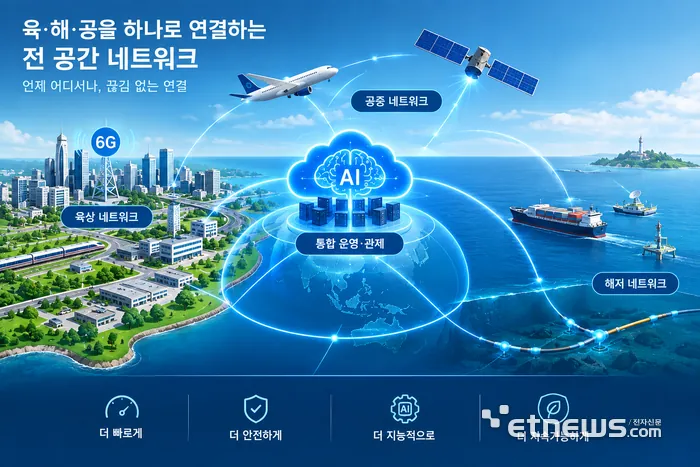
South Korea’s government has a plan to upgrade its AI-era communications infrastructure across land, undersea, and satellite layers — but a prominent tech policy voice argues the plan is missing its most important piece: connecting those three layers into a single intelligent system.
What happened
Korea’s Ministry of Science and ICT (MSIT, the government department that oversees technology and telecommunications policy) unveiled what it calls the Hyper AI Network Strategy last year. The plan sets out parallel upgrade tracks for each type of network: a 6G (sixth-generation mobile) commercial launch by 2030 paired with a four-fold expansion of backbone capacity and deployment of AI-RAN (AI-optimised radio access networks that let base stations handle processing intelligently), plus expansions to submarine cable capacity and the construction of a Korean-operated LEO (low Earth orbit) satellite constellation. Writing in the Electronic Times on 11 September 2026, journalist Jung Yong-chul argues that upgrading each network in isolation is the wrong frame. The real challenge, he says, is orchestrating them as a unified whole.
Why Korea does it this way
Korea built one of the world’s densest fixed and mobile broadband grids through heavy state-directed investment from the late 1990s onward, and MSIT has historically set national targets — coverage percentages, speed floors, generation timelines — that carriers are then funded or licensed to meet. That model works well for rolling out a single technology but was never designed to manage traffic across fundamentally different network types simultaneously. Submarine cable strategy has traditionally been handled separately by carriers and a small inter-ministry group, while satellite is newer still and sits in a different policy silo. The Hyper AI Network Strategy is the first time a single document has tried to hold all three together, which is why the gap Jung identifies — it upgrades each layer but does not specify how they interoperate — matters.
What it means for you
Residents and mobile users: The 6G target date is 2030. Until then, day-to-day connectivity is unaffected. The practical gain being argued for is resilience: if a regional tower cluster fails, AI routing would automatically shift traffic to satellite or an alternate ground path. That promise is contingent on the integration layer being built — which the current strategy does not mandate.
Businesses and data-intensive industries: Autonomous vehicles, robotics, and smart-factory systems are all cited as services that will need seamless handoffs between terrestrial and satellite links. Companies building on those platforms in Korea should watch whether the 2030 6G roadmap includes inter-network orchestration specs, or whether that remains a gap.
Investors: The Hyper AI Network Strategy, if expanded as Jung proposes, would enlarge the procurement pipeline for Korean telecoms equipment makers and network software vendors listed on KOSPI and KOSDAQ (Korea’s main and secondary stock exchanges). Any formal government upgrade to the strategy — adding integration mandates or new budget lines — would be a checkable event. This is reported commentary, not confirmed policy; no new spending has been announced. No investment advice.
Foreign residents: This story does not change current service plans, prices, or roaming terms. It is a policy-architecture debate about what comes after 5G.
Watch next
- MSIT has not announced a date for a revised Hyper AI Network Strategy. Watch for any MSIT press release or National Assembly (Korea’s parliament) ICT committee hearing that formally tables an updated version — that is the trigger that converts commentary into binding policy.
- Korea’s 6G commercialisation roadmap calls for a 2030 launch; the next checkable milestone is a government progress report expected in the first half of 2027 (date not yet confirmed — set by MSIT’s annual ICT policy schedule). If the inter-network integration layer is absent from that report, the gap Jung flags will persist.
- If Korea announces a specific LEO satellite contract or a joint submarine cable project with a named international partner, that would signal whether the integration vision is gaining procurement momentum — watch MSIT and KCC (Korea Communications Commission) official notices.
Source: Electronic Times (전자신문)
Was this useful?
What made the difference? Pick one.
What made the difference? Pick one.
Thanks. We read every answer.