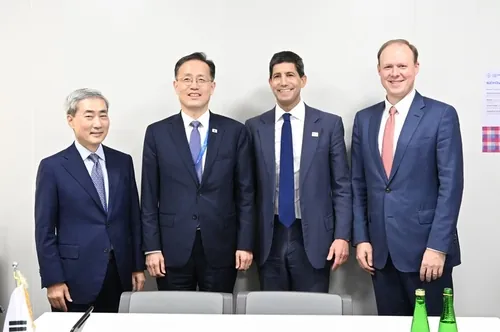
South Korea and the United States held their first-ever joint meeting of both finance ministers and central bank governors on 16 October 2026 in Bangkok — a step that could speed up policy coordination the next time a financial shock hits either economy.
What happened
On the sidelines of the G20 (Group of Twenty major economies) finance ministers’ gathering in Bangkok, South Korean Finance Minister Lee Hyoung-il and Bank of Korea (BOK — South Korea’s central bank) Governor Shin Hyun-song sat down with U.S. Federal Reserve Chair Kevin Warsh and U.S. Deputy Treasury Secretary Francis Brooke. The format — two finance officials plus two monetary officials from each side — is being called a “2+2” meeting, borrowing a label South Korea normally uses for defence talks. U.S. Treasury Secretary Scott Bessent did not attend. The South Korean finance ministry described the session as the first time the two countries had brought senior officials from both their fiscal and monetary authorities together in the same room. Minister Lee, who took office last month, was making his first overseas trip as finance minister.
Why Korea does it this way
South Korea runs one of Asia’s most open capital accounts, meaning money flows in and out quickly when global sentiment shifts — a vulnerability exposed sharply during the 1997–98 Asian financial crisis (IMF (International Monetary Fund) crisis, as Koreans call it) and again during the 2008 global crash. Close coordination with the U.S., whose Federal Reserve decisions drive dollar liquidity worldwide, is therefore more important to Seoul than to larger, more self-contained economies. At the same time, South Korean domestic policy has a direct pipeline to households: the BOK sets its base rate (the benchmark interest rate that flows through to mortgages and savings accounts) eight times a year, and because the vast majority of Korean home loans are variable-rate, a BOK move passes through to monthly payments within months. A standing bilateral channel with the Fed gives the BOK faster, more informal access to U.S. rate-path signals before they become market-moving surprises.
What it means for you
Borrowers with variable-rate mortgages: No rate change was announced at this meeting — it was a framework-building session, not a policy decision. However, the new channel could give the BOK more confidence to act pre-emptively if the Fed signals a sharp turn. To check the current BOK base rate, see the Bank of Korea website. As a rough guide to sensitivity: a 0.25 percentage-point cut on a 300-million-won (roughly USD 220,000) variable mortgage typically trims the monthly payment by around 62,000 won.
Savers and depositors: Tighter Korea–U.S. coordination cuts uncertainty in both directions — it could mean the BOK holds rates higher for longer if the Fed does, or moves faster if global stress erupts. Check the current deposit benchmark at your bank or at the BOK.
Foreign residents and expats: A more predictable bilateral policy channel reduces the risk of sudden won (Korean currency, ticker KRW) volatility driven by U.S.–Korea policy divergence. No immediate change to exchange rates was announced.
Investors in Korean assets: The meeting signals that South Korea is institutionalising its crisis-response coordination with Washington. This matters most for holders of Korean government bonds (KTBs — Korea Treasury Bonds) and financials listed on the Korea Exchange (KRX), where rate-path uncertainty is the primary repricing risk. No specific policy commitments were disclosed.
Watch next
- The BOK’s next scheduled base-rate decision: the BOK meets eight times a year — check the BOK monetary policy calendar for the exact date of the next Monetary Policy Board meeting after October 2026.
- The U.S. Federal Reserve’s next policy decision: the FOMC (Federal Open Market Committee) meets on a set schedule — if the Fed signals a rate change at its next meeting, watch for a BOK response or statement within days, given this new coordination channel.
- A follow-up 2+2 meeting: no schedule was announced; the trigger to watch is any joint communiqué from the Korean finance ministry naming a second session date.
FAQ
What is the Korea–U.S. 2+2 finance meeting and what was decided?
The 2+2 finance meeting is a new bilateral forum pairing each country’s finance minister and central bank governor; the 16 October 2026 session in Bangkok was the first of its kind, and no specific policy changes were announced — the two sides agreed to establish the framework itself as a standing coordination channel.
Will the Bank of Korea cut interest rates after the Bangkok meeting?
The Bangkok meeting did not produce a rate decision; the BOK sets its base rate at separate Monetary Policy Board meetings eight times a year, and no cut or hold was announced. The current rate level is not stated in this article — check the current figure at the Bank of Korea.
Source: Yonhap News Agency
Was this useful?
What made the difference? Pick one.
What made the difference? Pick one.
Thanks. We read every answer.



