The International Monetary Fund has endorsed South Korea’s current combination of fiscal and monetary policies, explicitly supporting the government’s proposal to create a Future Response Fund — a dedicated reserve designed to buffer against coming economic shocks.
What happened
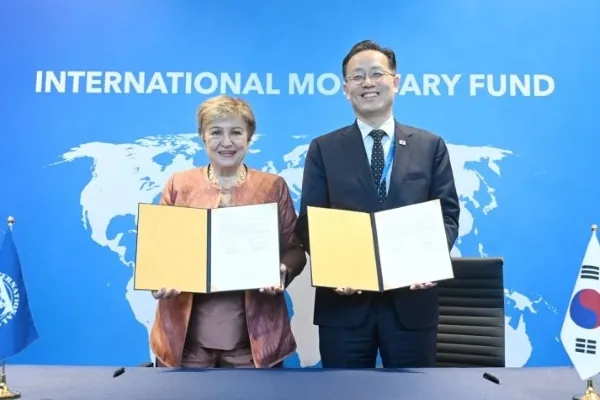
IMF Managing Director Kristalina Georgieva assessed South Korea’s policy stance favourably, according to a statement released by Korea’s Ministry of Economy and Finance on Sunday, October 18, 2026. Georgieva endorsed both the government’s overall fiscal-monetary policy mix and its specific plan to set up a Future Response Fund. The Fund is intended as a forward-looking fiscal reserve — money set aside now so the government can respond rapidly to future crises or structural economic challenges without scrambling for emergency budget authority. No specific capitalisation figure for the Fund was disclosed in the ministry’s statement.
Why Korea does it this way
Korea has a long tradition of using supplementary budgets (추경, chugyeong — extra spending bills passed mid-year outside the main annual budget) as rapid-response tools, delivering cash transfers and local-use vouchers during downturns. The idea of a standing Future Response Fund reflects a desire to institutionalise that flexibility rather than relying on ad-hoc legislative approval each time a shock hits. The IMF’s endorsement carries weight because it signals to bond markets and international investors that Korea’s fiscal trajectory is considered credible and sustainable. Georgieva’s backing also tends to ease domestic political resistance to fiscal consolidation measures.
What it means for you
- Taxpayers and voters: IMF endorsement typically strengthens the government’s hand when Parliament debates whether to approve a new fund or supplementary spending — expect the government to cite this assessment during budget deliberations in late 2026.
- Borrowers with variable-rate mortgages: The IMF’s approval of the overall policy mix implies no pressure on Korea to tighten fiscal policy abruptly; combined with monetary policy direction, this reduces the near-term risk of a surprise rate hike. For the exact current Bank of Korea base rate (기준금리, gijun geumni), check the current figure at the Bank of Korea.
- Foreign residents and expats: A government with IMF backing and a dedicated shock-response reserve is less likely to impose sudden emergency levies or abrupt benefit cuts. Day-to-day financial planning is not immediately disrupted by this announcement.
- Investors in Korean assets (KRW bonds, KOSPI): IMF endorsement of fiscal sustainability is a positive signal for Korean sovereign bonds and the won. The Future Response Fund concept, if legislated, could reduce Korea’s perceived fiscal risk premium — watch for any movement in the Korea CDS (credit-default swap) spread in the days following this announcement.
Watch next
- National Assembly budget session (정기국회, jeongguk hoe): Korea’s regular parliamentary session runs through December 2026; the government must submit its budget bill by September 3 and the Assembly must pass it by December 2 — watch whether the Future Response Fund appears as a line item and how opposition parties respond.
- Next Bank of Korea Monetary Policy Committee meeting: Date not yet set for Q4 2026 — decided by the Bank of Korea; if the MPC signals a rate cut while fiscal policy remains accommodative, that would confirm the “policy mix” the IMF endorsed is holding.
- IMF World Economic Outlook update: The IMF typically releases a WEO update in January 2027 — if Korea’s growth forecast is revised upward alongside this endorsement, it would validate the Fund’s assessment.
FAQ
What is South Korea’s Future Response Fund?
It is a proposed government fiscal reserve that would set aside funds in advance to enable rapid responses to future economic shocks or structural challenges, eliminating the need for emergency legislative approval each time a crisis occurs. The exact capitalisation amount has not yet been publicly disclosed.
Did the IMF criticise any part of Korea’s economic policy?
Based on the Ministry of Economy and Finance’s statement of October 18, 2026, the IMF Managing Director’s assessment was broadly positive — no criticisms of Korea’s current policy mix were reported in this announcement.
Source: KBS World Radio
Was this useful?
What made the difference? Pick one.
What made the difference? Pick one.
Thanks. We read every answer.