This guide is for investors, expats, and anyone watching Korea’s technology industry who keeps seeing the acronym HBM and wants to understand what it actually is. The short answer: high-bandwidth memory (HBM) is a specialised type of computer memory that sits directly on the processors powering modern artificial intelligence, and South Korea’s SK hynix and Samsung Electronics together make the vast majority of the world’s supply.
How it works
To understand HBM, start with ordinary DRAM (dynamic random-access memory), the standard memory found in laptops and servers. Conventional DRAM chips sit on flat circuit boards and connect to the processor through a relatively narrow data path. That path—the memory bus—becomes a bottleneck when the processor needs to move enormous volumes of data quickly, which is exactly what AI model training and inference require.
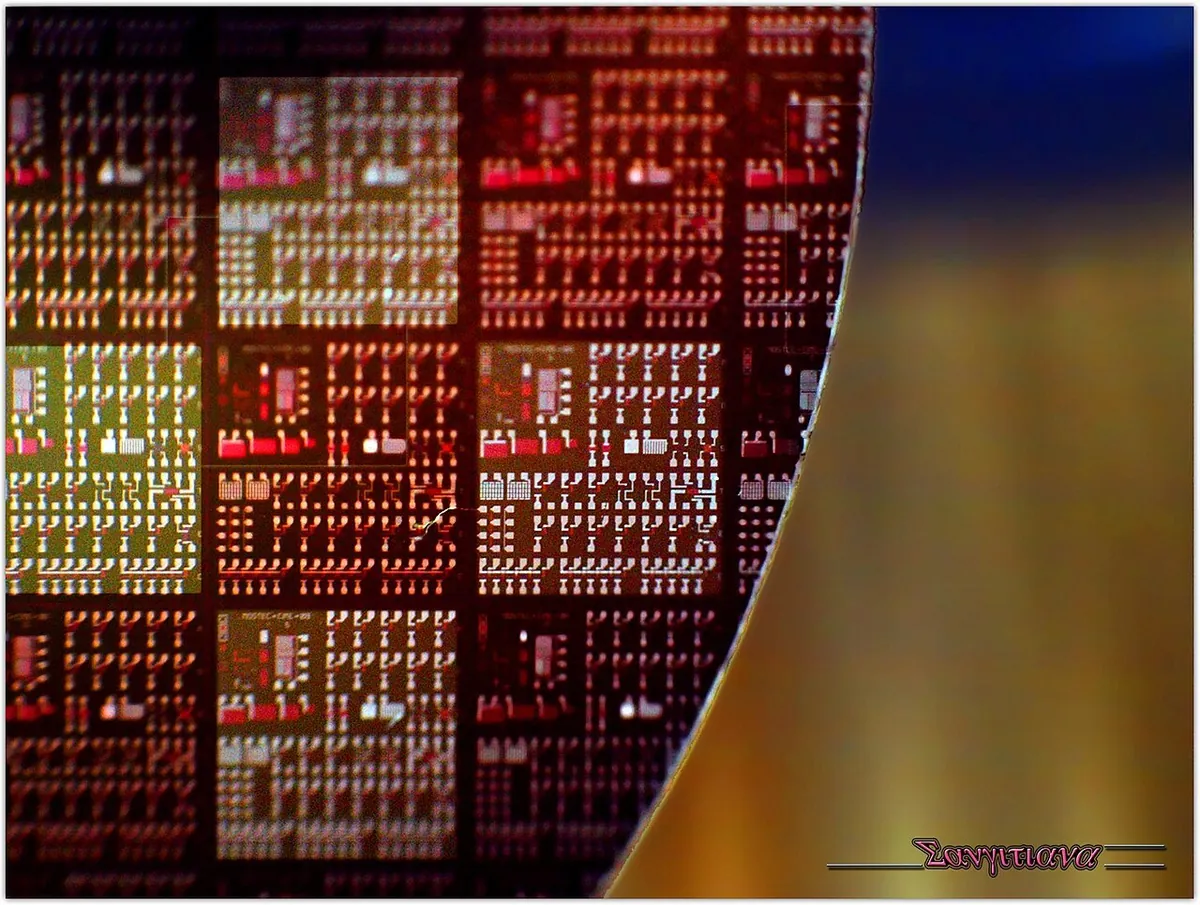
HBM solves this differently. Instead of placing memory chips beside the processor on a board, engineers drill microscopic vertical holes through each memory die (a single chip slice) and fill them with copper. These are called through-silicon vias (TSVs), vertical copper wires that pass through the chip itself. Multiple memory dies are then stacked on top of each other, connected pin-to-pin through those vias, forming a compact tower.
That tower is placed directly next to—or on top of—the processor on a silicon interposer (a thin silicon wafer that acts as a wiring platform connecting multiple chips). The result is a data path that is thousands of bits wide instead of the dozens of bits available in standard DRAM. More width means more data moves per clock cycle without needing to run the memory faster.
HBM therefore delivers very high memory bandwidth—the volume of data that can flow per second—at lower power consumption than alternatives. Those two properties make it the only practical memory technology for today’s AI accelerators.
Why Korea does it this way
South Korea’s dominance in memory chips did not happen overnight. Samsung entered DRAM production in 1983, just as Japanese manufacturers dominated the market. By 1993, Samsung was producing more DRAM by revenue than all Japanese semiconductor companies combined. The Japanese memory industry never recovered its leading position.
SK hynix was founded as Hyundai Electronics in 1983. Its founder described semiconductors as “industrial rice”—essential inputs for all manufacturing. The company produced South Korea’s first 64-kilobit DRAM in 1985.
What the Korean companies built over four decades is difficult to replicate quickly: vertically integrated fabrication (making everything from raw wafers to finished chips in-house), disciplined capital investment through multiple industry downturns, and accumulated process knowledge in the extremely precise art of stacking thin silicon dies. HBM requires both advanced DRAM manufacturing and advanced packaging expertise. Korea’s two giants have both. No other country has established a comparable combined capability at scale.
SK hynix was Nvidia’s exclusive supplier for HBM used in the H100 GPU, the chip that defined the first wave of AI data centre buildout. That relationship gave SK hynix an early volume advantage it has sustained through successive generations.
The numbers that matter
| Metric | Figure | Source / as of |
|---|---|---|
| SK hynix 2025 full-year revenue | 97.1 trillion won (approx. USD 71 billion at 2025 average rates) | SK hynix official results / January 2026 |
| SK hynix 2025 full-year operating profit | 47.2 trillion won; operating margin 49% | SK hynix official results / January 2026 |
| SK hynix HBM revenue trend | More than doubled year-on-year in 2025 | SK hynix / CNBC / January 2026 |
| SK hynix 2026 capex plan | Over 30 trillion won projected | TrendForce / January 2026 |
| HBM market share — SK hynix | Approx. 50–62% (varied by quarter) | Counterpoint Research / Q2 2025–Q2 2026 |
| HBM market share — Samsung | Approx. 17–35% (recovering after qualification delays) | Counterpoint Research / 2025–2026 |
| HBM market share — Micron | Approx. 21–24% | Counterpoint Research / 2025–2026 |
| Micron HBM annualised revenue run-rate | Approx. USD 8 billion | Micron management guidance / 2026 |
| HBM total addressable market | USD 35 billion (2025); projected USD 100 billion (2028) | Micron projection / 2026 |
| Nvidia H100 HBM content | 80 GB of HBM3 | Nvidia specifications |
| Nvidia H200 HBM content | 141 GB of HBM3E across six stacks; bandwidth over 1.2 TB/s per stack | Nvidia specifications |
| HBM4 bandwidth | Over 2.0 TB/s per stack (vs. approx. 1.2 TB/s for HBM3E) | JEDEC standard / industry sources, 2026 |
| AI data centres’ share of global memory demand | Projected up to 70% in 2026 | Industry analysts / 2026 |
What it means for you
If you invest in Korean equities: SK hynix (KRX: 000660) and Samsung Electronics (KRX: 005930) are the two most direct ways to access HBM exposure on the Korea Exchange (KRX, South Korea’s main stock exchange). SK hynix overtook Samsung in annual operating profit in 2025 for the first time in the companies’ histories, reflecting its larger share of HBM supply. HBM pricing and qualification news from Nvidia, AMD, and hyperscalers (large cloud companies such as Google, Microsoft, and Amazon) are the primary short-term earnings drivers to watch.
If you work in Korea’s technology sector: HBM manufacturing requires highly specialised process engineers. Both SK hynix and Samsung have significantly increased capex (capital expenditure, investment in factories and equipment) and are expanding facilities, particularly SK hynix’s campus in Icheon and its new fab (fabrication plant) in Cheongju.
If you are watching Korea’s broader economy: Semiconductors account for roughly 20% of South Korea’s total exports. A sustained HBM demand cycle has macroeconomic consequences: it strengthens the won against the dollar when chip export revenues are high, supports government tax receipts, and drives ancillary employment in chemicals, equipment, and logistics.
If you are a foreign resident monitoring trade policy: US export controls on advanced chips to China affect the end-market for AI accelerators that use HBM. Any tightening of those controls can shift demand patterns and supplier mix. Monitor announcements from the US Bureau of Industry and Security (BIS) alongside Korean chip earnings calls.
FAQ
What is the difference between HBM3E and HBM4, and why does it matter?
HBM3E is the generation currently shipping at volume. It uses a 1,024-bit data interface and delivers roughly 1.2 terabytes per second (TB/s) of bandwidth per stack. HBM4, which entered mass production at SK hynix and Samsung in early 2026, doubles the interface width to 2,048 bits and delivers over 2.0 TB/s per stack. Nvidia’s next major GPU platform, codenamed Rubin, is built around HBM4. Higher bandwidth per stack means each GPU can process more data per second, which directly affects how fast AI models can be trained or run.
Why is Micron relevant if Korean companies dominate?
Micron Technology is the only US-headquartered HBM supplier. It held roughly 21–24% of HBM market share in 2025–2026 and reported its entire 2026 HBM production capacity was sold out. Micron’s presence matters geopolitically: US policymakers prefer not to have a critical AI supply chain wholly dependent on two foreign companies. For investors, Micron’s pricing and capacity decisions influence industry-wide HBM supply and therefore Korean chip margins.
What should I watch in quarterly earnings to track HBM health?
Four signals matter most. First, HBM revenue as a share of total DRAM revenue at SK hynix and Samsung—rising share indicates sustained demand. Second, capex guidance: both companies publish annual capital expenditure plans that signal how much new HBM capacity they expect to build. Third, qualification updates—whether Samsung’s or Micron’s latest-generation HBM has passed testing at Nvidia or AMD determines which supplier captures the next wave of orders. Fourth, average selling price (ASP) trends for HBM: because production is essentially sold out through 2026, prices have held firm; any softening would signal either demand slowdown or new supply arriving faster than expected.
Was this useful?
What made the difference? Pick one.
What made the difference? Pick one.
Thanks. We read every answer.