A survey published September 15, 2026 found that four out of five Seoul residents want bus drivers to stay on the road — yet barely one in twelve could say what the union is actually demanding.
What happened
The Seoul Institute (a city-funded research body) polled 1,000 Seoul residents on September 14–15, the eve of a full city bus strike announced by the Seoul City Bus Union (the collective bargaining unit representing drivers across the capital’s private bus operators) for September 16. Results: 81.3% opposed the strike — 43.0% “strongly” and 38.3% “somewhat.” Only 9.9% expressed support. Yet awareness was thin: 33.4% knew a strike had been announced, and just 8.1% knew the specific details of the union’s demands. The survey also noted a methodological limit — it did not present the union’s own explanation for why it called the strike, which may have skewed responses toward opposition.
Why Korea does it this way
Seoul’s city buses are operated by private companies but run under a quasi-public management system (준공영제, jun-gong-yeong-je) introduced in 2004: the city subsidises operating deficits with taxpayer money in exchange for route and fare control. That structure means bus workers are private employees in law but publicly funded in practice — a tension that makes every wage dispute simultaneously a labor negotiation and a budget argument. Korean labor law requires unions to give advance notice of strikes in essential public services, hence the announced September 16 date. Seoul bus strikes have already occurred multiple times since January 2026, which the survey found was itself a source of public frustration.
What it means for you
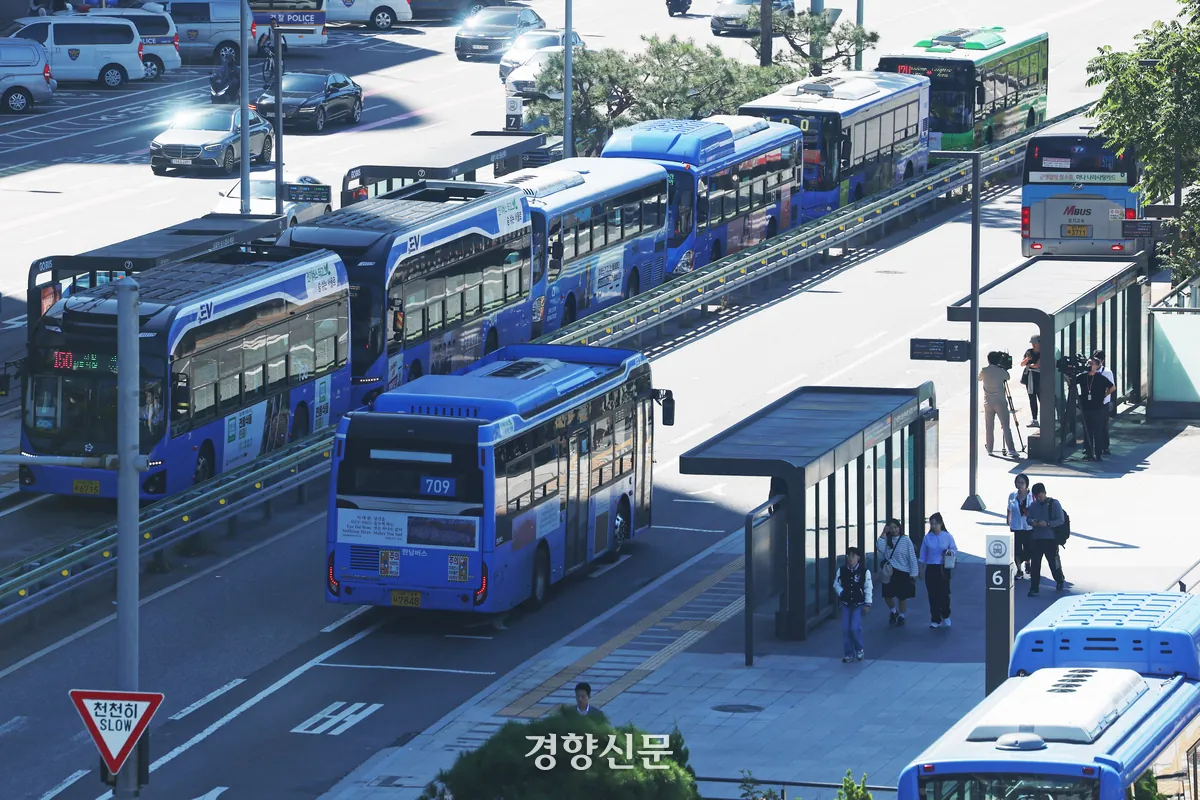
Daily commuters and foreign residents: A full strike would suspend the roughly 7,400 city buses that carry millions of trips a day across Seoul. The city typically activates emergency transport (extra subway runs, chartered buses) but coverage is partial — plan for crowded subway lines and longer journey times if the strike proceeds on September 16.
Workers and the labor debate: Drivers cite long hours and wages as their core grievances. This dispute sits inside a broader national conversation: Korea’s statutory retirement age is 60, and a push to raise it to 65 (linked to pension reform) directly affects older bus drivers who face mandatory exit before they are ready to stop working. No legislative change has passed yet — watch for a National Assembly vote, date not yet set.
Taxpayers: Because the city subsidises bus operator deficits, any wage settlement that raises driver pay flows partly from the Seoul municipal budget. The exact fiscal impact depends on the final settlement figure, which has not been disclosed.
Watch next
- September 16, 2026 (tomorrow): Whether the strike actually begins — last-minute mediation talks under the Labour Relations Commission (노동위원회) could suspend it; check Seoul Metro announcements by 05:00 KST.
- Next Labour Relations Commission ruling: If talks fail and the strike starts, a compulsory mediation decision (date not yet set — determined by the Commission) would be the next legal checkpoint that could end it.
- National Assembly retirement-age bill: Date not yet set — decided by the Assembly’s Environment and Labour Committee; passage would reshape driver tenure rules and union bargaining leverage across public-service sectors.
Source: The Kyunghyang Shinmun (경향신문)
Was this useful?
What made the difference? Pick one.
What made the difference? Pick one.
Thanks. We read every answer.