South Korea’s government is drawing up plans to deploy military assets to the Strait of Hormuz at Washington’s request, but the move faces a significant domestic hurdle: the ruling Democratic Party of Korea is publicly urging caution before any vote in the National Assembly (Korea’s single-chamber parliament, where a party needs 180 of 300 seats to bypass filibusters).
What happened
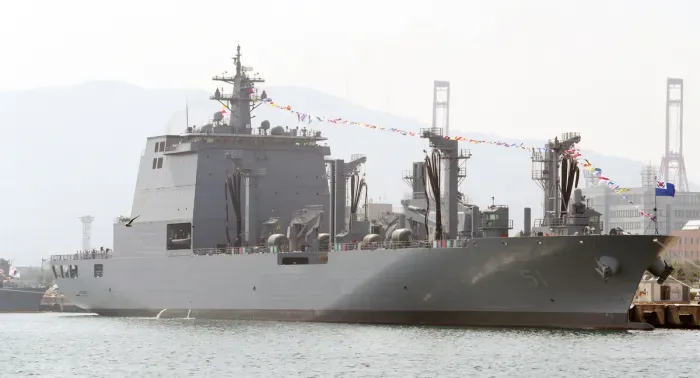
On September 9, 2026, two senior Democratic Party lawmakers spoke out against a rushed deployment. Rep. Song Young-gil told YTN Radio that the mission lacks both a UN Security Council resolution and constitutional grounding, calling it less justified than the 2003 Iraq War — which President Trump himself had opposed. Rep. Kim Byung-joo, the party’s secretary on the National Defense Committee, appeared on KBS1 Radio the same day and echoed those concerns, saying Korea should be “very cautious” and that if the real goal is protecting freedom of navigation and Korean merchant ships, cooperation with France and the UK would be a preferable framework. The government has reportedly identified specific assets: maritime patrol aircraft and the logistics support ship Soyang (commissioned 2018). The Ministry of National Defense has already sent a survey team to Hormuz to assess conditions on the ground, though officials say no formal decision has been made.
Why Korea does it this way
Under Korea’s Constitution, overseas troop deployments require National Assembly approval — a hard legal constraint that has shaped every major dispatch debate since the 1960s. Korea has previously deployed to the Gulf region: the Cheonghae (청해) anti-piracy unit (a standing naval task force in the Gulf of Aden) has operated continuously since 2009 under periodic parliamentary renewals. A new Hormuz mission would require a separate vote, and the Democratic Party, which holds a commanding majority in the current Assembly, effectively controls that outcome. The Iraq War comparison matters politically because Korea’s 2003 dispatch — eventually approved — remains controversial in public memory as an example of alliance pressure overriding domestic opinion.
What it means for you
Korea-watchers and alliance analysts: Nothing is decided yet — a formal government proposal must be submitted to the National Assembly before any vote can happen, and Rep. Song explicitly said passage “will not be easy.” Watch the gap between government signaling and legislative reality widen before it closes.
Investors in Korean defense and shipping stocks: If a deployment is eventually approved, companies supplying logistics support and maritime patrol equipment to the Korean military could see incremental contract activity — but check current constituent weights at the Korea Exchange before drawing conclusions, as no contracts have been announced. Conversely, a failed or delayed vote signals continued Democratic Party leverage over defense spending priorities.
Korean exporters and freight operators: The Strait of Hormuz handles a significant share of Korea’s oil imports. If participation in a multilateral naval presence eventually helps secure Korean-flagged or Korean-chartered vessel passage, freight risk premiums could ease — but that outcome is contingent on a vote that has not yet been scheduled.
Foreign residents: No immediate impact on daily life, taxes, or public services. This is a foreign-policy debate at an early stage.
Watch next
- A formal government bill submitted to the National Assembly — no date set as of September 9; the trigger is an official cabinet decision to table the proposal, which the Ministry of National Defense has not yet announced.
- The National Defense Committee’s scheduled review session — once a bill is submitted, the committee (on which Rep. Kim Byung-joo sits as Democratic Party secretary) holds the first hearing; watch for that agenda date on the National Assembly website.
- Public polling on the deployment: if approval drops below 40% in two consecutive major surveys, Democratic Party leadership has signaled the vote becomes politically untenable — check Gallup Korea’s weekly release (published every Friday).
Source: The Kyunghyang Shinmun (경향신문)
Was this useful?
What made the difference? Pick one.
What made the difference? Pick one.
Thanks. We read every answer.



