OpenAI has unveiled an invisible text-watermarking system called textGrain, joining Anthropic and Google in a race to label AI-generated content — but experts warn the technology is far from foolproof.
What happened
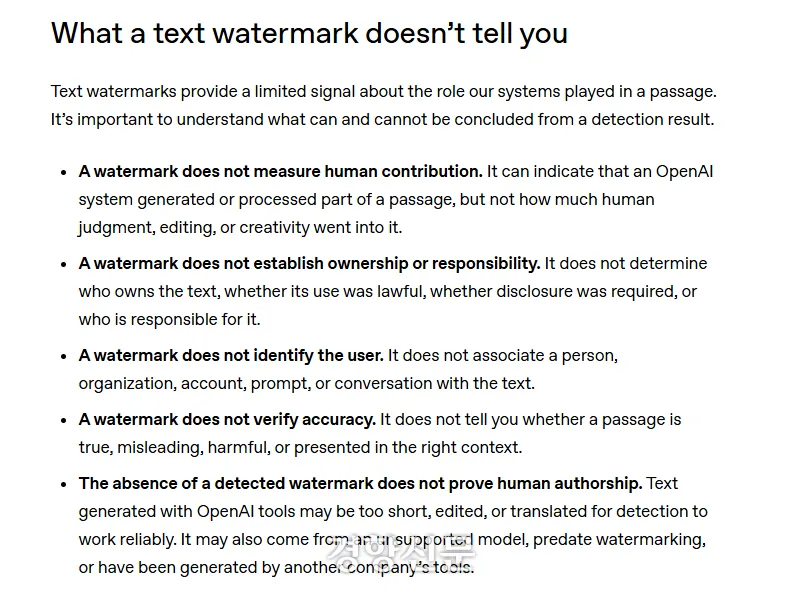
On October 5, 2026, OpenAI publicly announced textGrain, a system that embeds hidden identification patterns into text produced by its AI models. Rollout begins across European Union member states within the coming weeks. Because false positives and false negatives are possible, OpenAI is initially restricting the detection tool to approved researchers and vetted organisations. The move follows Anthropic, which introduced watermarking in Claude in August 2026, and Google, which has applied its SynthID identification technology to Gemini since 2024. The trigger is the EU AI Act, which legally requires machine-readable labels on outputs from generative AI systems. Source reporting is from The Kyunghyang Shinmun (경향신문), translated from Korean.
Why Korea does it this way
This is a global regulatory story, not a Korea-specific policy, but Korean AI researchers and government bodies follow it closely because South Korea is developing its own AI Basic Act framework. ETRI (Electronics and Telecommunications Research Institute, a state-funded Korean research body), quoted in the source article, has specialists evaluating these tools for potential adoption in Korean public-sector AI oversight. Korea’s heavy reliance on AI in education and content production makes detection accuracy a live policy question domestically.
What it means for you
Students and writers submitting work that was drafted with AI assistance, then heavily edited, may find themselves in a grey zone: replacing just 25% of words in a watermarked text drops detection accuracy from 92% to as low as 17%, meaning the same document could look “AI-written” or “human-written” depending on how much was changed — and neither verdict is reliable.
Employers and educators using AI-detection tools as gatekeepers should note that at a 1% false-positive rate, roughly 1 in 100 entirely human-written documents could be flagged. At scale — say, 10,000 job applications — that is 100 wrongly accused humans.
Businesses operating in the EU using OpenAI’s API will need to comply with the EU AI Act’s labelling requirement; textGrain is OpenAI’s compliance mechanism. No Korean domestic legal deadline has been reported yet.
Investors tracking AI infrastructure plays should note that SynthID is already live in Google’s Gemini products, textGrain is OpenAI’s new entry, and Anthropic’s Claude version launched in August 2026 — all three are now competing on detection accuracy metrics. No specific contracts, revenue figures, or Korean-listed company exposures were reported in this article.
Watch next
- EU AI Act enforcement on generative AI labelling: the Act’s relevant provisions are in force; watch for the European Commission to issue formal compliance guidance — date not yet set, decided by the Commission.
- OpenAI textGrain broader rollout: OpenAI stated EU deployment within “coming weeks” of October 5, 2026 — check for an official announcement by end of October 2026 confirming live status.
- Korea AI Basic Act progress: if the National Assembly passes implementing regulations that include AI-content labelling requirements (no vote date set as of today, October 6, 2026), domestic platforms would face similar obligations — watch the National Assembly legislative calendar.
FAQ
How accurate is OpenAI’s textGrain watermark at detecting AI-written text?
In OpenAI’s own tests with a 1% false-positive rate, textGrain detected about 80% of AI-written text at 200 tokens (roughly 150 English words) and about 95% at 400 tokens in psychology-domain texts — but accuracy fell to around 60% in mathematics, and editing just 25% of the words dropped detection to 17%.
Does an AI watermark prove a document was written entirely by AI?
No. According to ETRI researcher Kim Myung-Ju quoted in the source article, watermarks are auxiliary triage tools, not definitive proof; the technology cannot distinguish between fully AI-generated text and human text that was written with AI assistance and then edited.
Source: The Kyunghyang Shinmun (경향신문) — English Edition
Was this useful?
What made the difference? Pick one.
What made the difference? Pick one.
Thanks. We read every answer.