South Korean homeowners who locked in mortgages at historically low rates during the pandemic are now facing payment shock as their fixed-rate periods end and loans roll into today’s much higher variable rates.
What happened
Between 2020 and 2021, South Korea’s central bank — the Bank of Korea (BOK) — held its benchmark base rate at a record low of 0.50%, pushing fixed mortgage rates down to the 2.4%–2.83% range. Many borrowers seized the moment: fixed-rate mortgages made up 69.1% of new home loans in 2020 and 55.5% in 2021. Most of those products carried five-year fixed terms, meaning they are now resetting to variable rates — right as variable rates sit in the 4.2%–4.4% range in the first half of 2026.
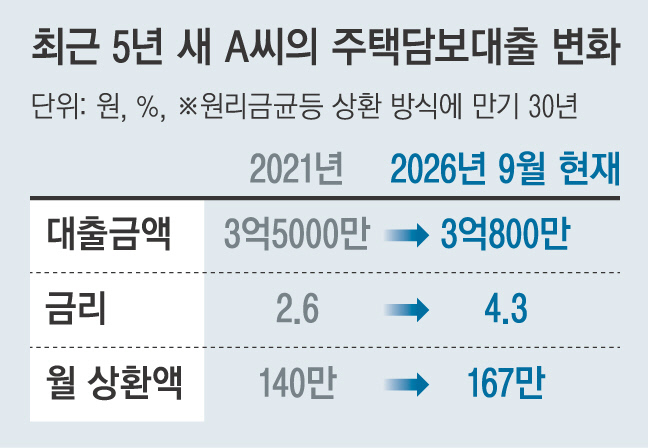
The real-world impact is stark. One borrower in Dongtan (a new-town district in Hwaseong, Gyeonggi Province), who took out a 350 million won (roughly $250,000 USD) loan in the pandemic era, saw his monthly payment jump from 1.4 million won to 1.67 million won when his rate reset in April 2026. On a 500 million won loan — common in the Seoul metro area — the same transition pushes monthly payments from 1.97 million won to 2.63 million won, a surge of 660,000 won (~$480) per month. The benchmark rate used for variable mortgages — the six-month bank bond rate — crossed 3.0% in May 2026 and exceeded 3.5% by September 2026. COFIX (Cost of Funds Index, the rate banks use to price home loans, calculated from their actual funding costs) rose to 3.0% in August 2026.
Why Korea does it this way
Korea’s mortgage market leans heavily on shorter fixed-rate products — typically three to five years — after which loans revert to variable rates tied to COFIX or the bank bond rate. This structure differs from markets like the United States, where 30-year fixed mortgages insulate borrowers from rate cycles. Korean housing policy has historically prioritized loan availability over rate stability, and regulators use DSR (Debt Service Ratio — the rule that caps total annual loan repayments as a share of a borrower’s annual income, currently at 40% for most borrowers) and LTV (Loan-to-Value — the cap on how much you can borrow relative to the appraised value of the property) limits to contain overall leverage rather than locking in long-term rates. The result is that rate policy changes transmit quickly into household cash flows once fixed periods expire.
What it means for you
Homeowners with expiring fixed terms: If you took out a Korean mortgage in 2020–2021 on a five-year fixed product, your reset window is now through roughly 2026–2027. Budget for a payment increase of roughly 1.5–1.7 percentage points above your original rate. Check your loan contract for the exact reset date and whether your bank offers a re-fixing option.
Foreign residents and expats: If you hold property in Korea or are considering a purchase, the variable-rate environment means near-term payments will reflect current funding costs, which are materially higher than they were two years ago. DSR rules also limit borrowing based on your verifiable Korean income, which can constrain foreign buyers.
Renters: Higher mortgage burdens can pressure some landlords to raise rents — especially in jeonse (a uniquely Korean arrangement where a tenant pays a large lump-sum deposit, typically 50–80% of the property value, instead of monthly rent, and gets it back in full at the end of the lease). Landlords who used jeonse deposits to fund leveraged purchases may face cash-flow stress at renewal time.
Savers and investors: Rising COFIX and bank bond rates reflect higher bank funding costs, which have also pushed up deposit rates, benefiting savers. For bond investors, the trajectory of the six-month bank bond rate is a live indicator of mortgage stress in the system.
Watch next
- Bank of Korea rate decisions in late 2026: any cut would ease variable-rate resets; any hold or hike extends the squeeze.
- COFIX monthly releases — the August 2026 reading hit 3.0%; further moves will directly set the floor for new variable-rate payments.
- Government guidance on DSR policy adjustments: regulators may loosen or restructure rules to relieve borrower distress if delinquency data deteriorates.
Source: The Korea Herald / Kyunghyang Shinmun (English)
Was this useful?
What made the difference? Pick one.
What made the difference? Pick one.
Thanks. We read every answer.