This guide is for expats, investors, and Korea-watchers who want to understand why South Korea is doubling down on nuclear power — and how that decision is now directly tied to the country’s ambition to host the data centers and chip factories that run the AI economy. The short answer: Korea generates roughly a third of its electricity from nuclear today, has legally committed to building two large reactors and one small modular reactor by 2038, and has already picked the sites — all while scrambling to keep the lights on for a projected sixfold surge in data-center power demand by 2040.
How it works
The current reactor fleet
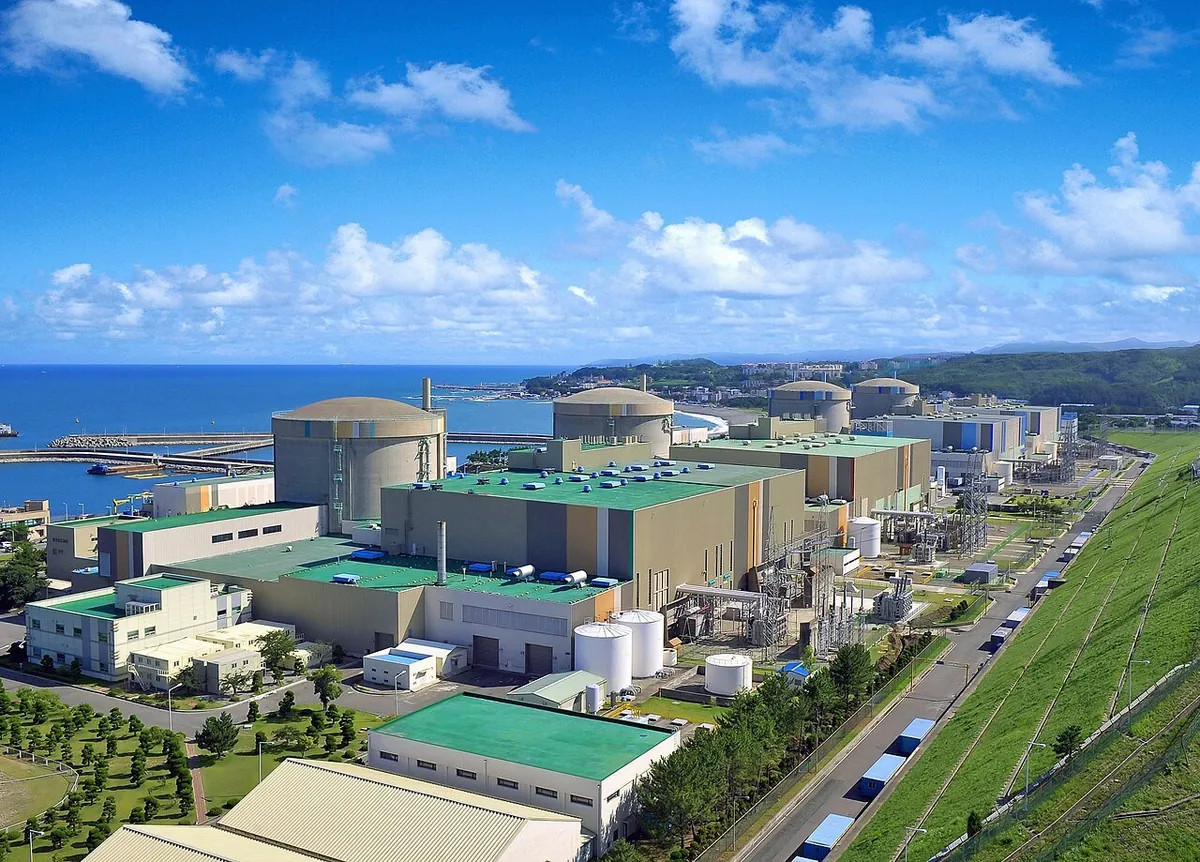
Korea operates 26 nuclear reactors managed by KHNP (Korea Hydro and Nuclear Power, the state-owned company that builds and runs the plants). Together they produced roughly 31.7% of the country’s electricity in 2024, according to the World Nuclear Association. The 11th Basic Plan for Electricity Supply and Demand — the government’s master document for power policy covering 2024 to 2038, finalized by the Ministry of Trade, Industry and Energy in February 2025 — targets 31.8% nuclear share by 2030 and 35.6% by 2038.
Life extensions: keeping old reactors running
Several reactors have reached, or are approaching, their original 40-year design life. Rather than shutting them down, KHNP is applying to the NSSC (Nuclear Safety and Security Commission, the independent regulator) for continued-operation permits. In November 2025, the NSSC approved Kori 2 — Korea’s second-oldest reactor — for operation until April 2033, making it the first unit to receive such an extension. Kori 2 was restarted in April 2026. Nine more units at Kori, Hanbit, Hanul, and Wolsong stations have applications pending; their licences expire before 2030.
New large reactors: Yeongdeok
The 11th Basic Plan adds two new large reactors with a combined capacity of 2.8 GWe (gigawatts of electricity). In June 2026, KHNP’s site-selection committee chose Yeongdeok County on the southeastern coast as the host location. Each reactor is rated at up to 1,400 MWe. Construction permits are scheduled for the early 2030s; grid connection is targeted for 2037 and 2038.
The SMR program: i-SMR and Gijang
An SMR (small modular reactor) is a compact reactor — typically under 300 MW — that can be factory-built and deployed in places too small for a conventional plant. Korea’s design is the i-SMR (Innovative Small Modular Reactor), a 170 MWe integrated pressurized water reactor developed jointly by KHNP and KAERI (Korea Atomic Energy Research Institute). Four units stacked together equal 680 MWe — roughly the output of a mid-size gas plant.
The 11th Basic Plan calls for 700 MWe of SMR capacity online by 2035. In June 2026, KHNP selected Gijang County in Busan as the SMR site. The i-SMR team is aiming to complete the standard design and submit a Standard Design Approval application to the NSSC by 2028. If the regulator approves on schedule, construction permits could follow in the early 2030s. The National Assembly passed the SMR Special Act on February 20, 2026, giving the program formal legal backing, a five-year master plan framework, and KRW 1.2 trillion (about $830 million) in government R&D funding through 2030.
The AI data-center connection
The urgency behind all of this is power demand. AI model training and inference, plus the semiconductor fabs that make AI chips, consume enormous amounts of electricity around the clock — exactly the kind of steady, uninterruptible load that nuclear handles better than intermittent renewables. Korea’s grid planner projects that AI data centers alone will expand to 18.4 GW of installed capacity by 2035, consuming roughly 121 TWh per year. Semiconductor clusters could add another 20 GW by 2041. The Korea Times editorial board described the situation as a “power crunch” in August 2026.
The government has already responded with two targeted measures. In May 2026, the National Assembly passed a special law designating AI data centers as national strategic facilities, fast-tracking grid connections. Separately, KEPCO (Korea Electric Power Corporation, the state grid monopoly) and the Ministry of Climate Environment unveiled 11 regional rate zones that give data-center operators in nuclear-rich southern provinces up to 10% off industrial power rates — a direct financial incentive to locate near nuclear plants.
Internationally, KHNP, Doosan Enerbility (the South Korean company that manufactures reactor components), and other Korean industrial partners signed a strategic collaboration agreement with Amazon and X-energy to deploy X-energy’s Xe-100 SMR in the United States, targeting more than 5 GW of new nuclear capacity for US data centers by 2039. The deal signals that Korean nuclear expertise is being commercially linked to Big Tech’s power needs.
Why Korea does it this way
Korea has almost no domestic fossil-fuel reserves. It imports virtually all of its coal, gas, and oil. Nuclear power was embraced from the 1970s onward as a way to reduce that dependence and keep electricity cheap for the manufacturing industries — steel, petrochemicals, semiconductors — that drive the economy.
By the 2000s, Korea had built a largely self-sufficient nuclear supply chain: KEPCO designs plants, KHNP operates them, and Doosan Enerbility forges the heavy components. This vertical integration keeps costs down relative to Western peers and gave Korea the confidence to export reactors — it won a contract to build four APR-1400 units in the UAE (Barakah plant, now operational).
Nuclear policy became politically contentious after Japan’s 2011 Fukushima accident. The Moon Jae-in administration (2017–2022) began a phase-down, cancelling two planned reactors and letting licences expire. The Yoon Suk-yeol administration reversed course in 2022, restoring the pro-nuclear trajectory and commissioning the 11th Basic Plan. Yoon was impeached in late 2024 and President Lee Jae-myung took office in June 2025. The Lee administration has continued with the nuclear expansion for electricity supply — the January 2026 confirmation of the two large reactors happened under his watch — while opposing, in separate political debates, any discussion of South Korea acquiring independent nuclear weapons capability.
The numbers that matter
| Metric | Figure | Source / as of |
|---|---|---|
| Nuclear share of electricity generation | ~31.7% | World Nuclear Association / 2024 |
| Number of operating reactors | 26 | World Nuclear Association / mid-2026 |
| Target nuclear share by 2030 | 31.8% | Ministry of Trade, Industry and Energy — 11th Basic Plan / Feb 2025 |
| Target nuclear share by 2038 | 35.6% | Ministry of Trade, Industry and Energy — 11th Basic Plan / Feb 2025 |
| Nuclear generation 2023 (baseline) | 180.5 TWh | Ministry of Trade, Industry and Energy — 11th Basic Plan / Feb 2025 |
| Nuclear generation target 2038 | 248.3 TWh | Ministry of Trade, Industry and Energy — 11th Basic Plan / Feb 2025 |
| New large reactors planned (Yeongdeok) | 2 units, 2.8 GWe combined | KHNP site announcement / June 2026 |
| New SMR planned (Gijang) | 4 × 170 MWe i-SMR units = 700 MWe | KHNP site announcement / June 2026 |
| i-SMR Standard Design Approval target | 2028 | KHNP / KAERI — as of 2025–2026 |
| SMR commercial operation target | 2035 | Ministry of Trade, Industry and Energy — 11th Basic Plan / Feb 2025 |
| SMR R&D funding commitment | KRW 1.2 trillion (~$830 million) by 2030 | Ministry of Science and ICT — SMR Special Act / Feb 2026 |
| AI data-center capacity projection | 18.4 GW by 2035, ~121 TWh/year | Check the current figure at the Ministry of Trade, Industry and Energy |
| KEPCO total debt | ~KRW 202 trillion (~$146 billion) | Reported by multiple outlets / as of late 2025 |
What it means for you
For workers and residents in host regions
Yeongdeok County and Gijang County will receive significant economic activity — construction jobs, local tax revenue, and eventually long-term plant operations employment — but also the political scrutiny that comes with hosting nuclear facilities. If you live in or near these areas, monitor local council decisions and KHNP’s community consultation process, which is ongoing.
For businesses and data-center operators
The 11 regional electricity-rate zones introduced in August 2026 mean that where you locate a data center in Korea now affects your electricity bill. Facilities in nuclear-rich southern provinces qualify for discounts of up to 10% on industrial rates. Verify current zone boundaries and rates directly with KEPCO before signing a lease or land contract, as the program is new and details may be revised.
For investors and Korea-watchers
The nuclear supply chain — KEPCO, KHNP (unlisted, state-owned), and Doosan Enerbility (listed on the Korea Stock Exchange) — stands to benefit from both domestic build-out and export deals. The KHNP–Amazon–X-energy SMR partnership also puts Korean companies in the international data-center nuclear supply chain. This guide does not recommend any investment. Verify company financials and government contract announcements independently before making any decisions.
For foreign residents
Your electricity bill in Korea is set by KEPCO under a tiered residential tariff, not directly linked to nuclear policy. However, KEPCO’s large debt load has prompted tariff increases in recent years; further adjustments are possible as infrastructure spending rises. Check KEPCO’s published tariff schedule for the current residential rates.
FAQ
Did Korea’s change of president in 2025 put the nuclear expansion at risk?
Not significantly, based on actions taken so far. President Lee Jae-myung’s administration confirmed in January 2026 that it would proceed with the two large reactors in the 11th Basic Plan, and the sites were announced in June 2026. The SMR Special Act passed the National Assembly — where Lee’s party holds a majority — in February 2026. The political debate in Korea has shifted to nuclear weapons, not civilian power plants.
What happens if the i-SMR design does not receive regulatory approval on schedule?
The 2035 commercial-operation target depends on the NSSC granting Standard Design Approval by 2028. That review has not yet begun; the application is expected to be submitted around 2028. If the approval is delayed, the first commercial i-SMR would slip past 2035. KAERI and KHNP have cited competitive pressure from Chinese and US SMR programs as motivation to stay on schedule.
Can Korea actually build enough grid capacity to connect these new plants to data centers?
This is the central uncertainty. KEPCO reported in October 2025 that over 55% of planned transmission and substation projects were delayed, largely due to permitting timelines and local opposition to new power lines. The government has designated AI data centers as national strategic facilities partly to accelerate grid permits. Whether construction can keep pace with demand growth by the late 2030s is a question that regulators, utilities, and industry are actively working through.
Was this useful?
What made the difference? Pick one.
What made the difference? Pick one.
Thanks. We read every answer.