This guide is for investors, expats, and Korea-watchers trying to understand why announcements about artificial intelligence and semiconductor factories keep running into the same obstacle: electricity. The short answer is that Korea wants to build one of the world’s largest concentrations of data centers and chip fabs (semiconductor fabrication plants), but its transmission grid, the wires that carry power from generators to users, cannot keep up. The national utility is still digging out of record debt. And the rules that decide who gets power, where, and at what price are only now being rewritten.
How it works
Korea’s electricity system has one dominant actor: KEPCO (Korea Electric Power Corporation, the state-owned utility that generates, transmits, distributes, and bills for almost all electricity in the country). KEPCO buys power from its own subsidiaries and from independent generators, then sells it to homes and businesses at rates set by the government.
Electricity rates in Korea are reviewed each quarter through a mechanism called the adjusted unit fuel cost (연료비조정단가, a per-kWh surcharge or discount applied on top of the base tariff to reflect changes in fuel costs). Until June 2024, rates were uniform nationwide: a factory in rural South Gyeongsang paid the same per kilowatt-hour as one in central Seoul, regardless of how far the power had to travel or how congested the local grid was.
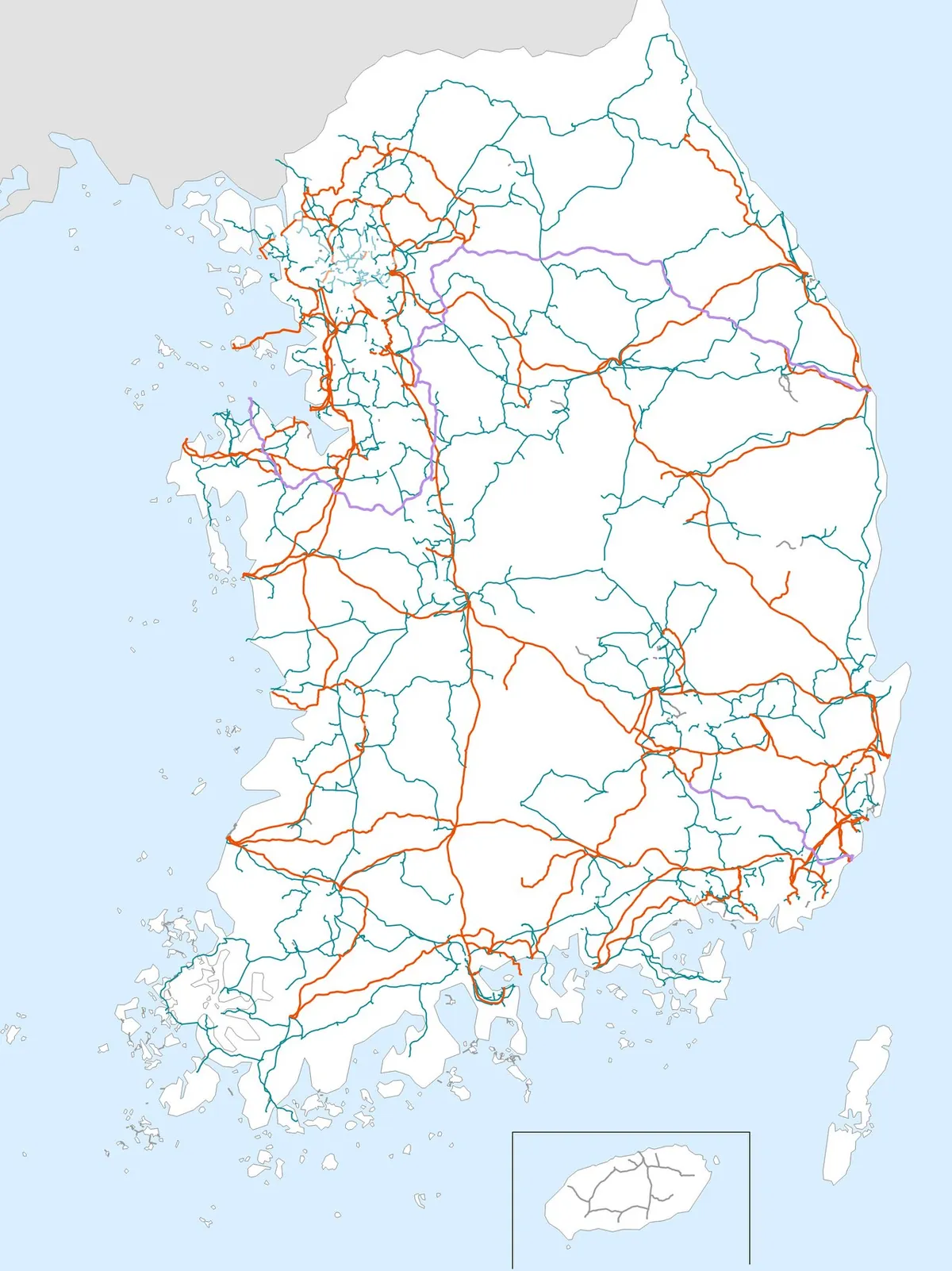
The grid itself consists of ultra-high voltage transmission lines (345 kV and 765 kV) that carry bulk power from large plants, mostly nuclear and coal stations on the coast, into urban load centers. Substations step that voltage down for local distribution. Building new transmission lines requires land acquisition, local government consent, environmental review, and, in practice, years of community negotiation.
Any company that wants to connect a large new load — a data center, a fab, a battery factory — must first file a grid impact assessment (계통영향평가) with KEPCO. The assessment checks whether the local grid can absorb the new demand. If it cannot, the connection is denied or deferred until new lines are built.
Why Korea does it this way
Korea built its electricity system around a centralized model in the 1960s and 1970s, when large coal and later nuclear plants could be sited away from cities and power wheeled in. That model delivered cheap, reliable electricity and supported rapid industrialization.
Rate-setting became politically sensitive because residential electricity rates are a proxy for the cost of living. Governments repeatedly froze or limited rate increases, even when global fuel costs rose. After Russia’s invasion of Ukraine sent LNG (liquefied natural gas, a fuel Korea imports heavily) prices surging in 2022, KEPCO was forced to sell power below cost. The utility accumulated losses of approximately 47.8 trillion won (roughly $34 billion) between 2021 and 2023, according to KEPCO financial disclosures.
The uniform national tariff also reflects a deliberate industrial policy: cheap power was a subsidy to manufacturing. That logic is now in tension with geography. The capital region (Seoul, Incheon, and Gyeonggi Province, collectively called the Sudogwon) holds roughly half of Korea’s economic activity but generates little of its own power. It depends on long-distance transmission from coastal plants, and those lines are near capacity.
The numbers that matter
| Indicator | Figure | Source / As of |
|---|---|---|
| Korea data center IT load capacity (2025 estimate) | ~1,960 MW | Mordor Intelligence market report, 2025 |
| Korea data center IT load capacity (2030 forecast) | ~6,320 MW | Mordor Intelligence market report, 2025 |
| Yongin semiconductor cluster full build-out power need | ~15 GW (9 GW Samsung + 6 GW SK Hynix) | Seoul Economic Daily, June 2026 |
| Power committed to Yongin cluster as of late 2025 | ~9 GW formally committed; full supply target: 2041 | Seoul Economic Daily, July 2026 |
| Grid impact assessment applications (Aug 2024 – Mar 2026) | 736 filed; 1.9% approval rate in capital region; 89.7% outside | Korea Data Center Power analysis, 2026 |
| KEPCO accumulated debt (H1 2026) | 210.7 trillion won (~$150 billion) | KEPCO disclosure, as of H1 2026 |
| KEPCO operating profit (2025) | 13.5 trillion won (~$9.5 billion) | KEPCO earnings, FY 2025 |
| KEPCO planned grid investment over next decade | 113 trillion won | KEPCO, as reported by Korea Herald, 2025–2026 |
| KEPCO prepayment request to Samsung and SK Hynix (Sep 2026) | 25 trillion won (~$18 billion); ~5 years of bills | Seoul Economic Daily / TrendForce, September 3, 2026 |
| Industrial electricity rate (2025 average) | 181.9 won per kWh | KEPCO tariff data, 2025 |
| Regional rate discount in southern provinces (from Aug 2026) | 13–18 won/kWh (7–10% cut) vs. effectively 0 in southern Seoul metro | Ministry of Trade, Industry and Energy, August 26, 2026 |
What it means for you
For investors and developers
The grid impact assessment (계통영향평가) is now the gating document for any large power project in Korea. Between August 2024 and March 2026, only one application inside Seoul city limits received final approval. Developers should price in years of delay for capital-region sites and model southern-province alternatives, where the new 11-zone pricing scheme offers up to 10% lower industrial rates and far higher grid approval rates.
The government’s August 2026 announcement creating 11 electricity pricing zones is the first time since Korea’s grid was built that location affects what an industrial user pays. Projects in the Honam (southwest) and Yeongnam (southeast) regions now carry a structural cost advantage over Seoul-area sites. That advantage is locked in by regulation, not just current fuel prices.
For large corporate power users
KEPCO asked Samsung Electronics and SK Hynix in September 2026 to prepay approximately 25 trillion won in electricity bills — the equivalent of about five years of combined payments — to help fund grid construction for the Yongin semiconductor cluster. The proposal suggests KEPCO will increasingly look to anchor tenants of new grid infrastructure to share upfront costs. Companies planning large loads should expect similar conversations and should assess the financial terms carefully before committing.
For ordinary electricity customers
Residential rates have been held below industrial rates as a policy choice. The average residential rate in 2025 was 159 won per kWh versus 181.9 won for industry. However, KEPCO’s debt of over 210 trillion won means rate pressure remains, even as the utility posted record profits in 2025 from prior industrial rate hikes. Check the current adjusted unit fuel cost each quarter at KEPCO’s official tariff page, as it can change by up to 5 won per kWh per quarter.
For foreign residents
Day-to-day electricity bills are unlikely to jump sharply in the short term: the government has consistently protected residential rates politically. The bigger near-term effect is on housing and office supply in the capital region — if data centers and fabs cannot get grid connections, some will be steered to other regions, slightly reducing commercial real estate pressure in greater Seoul.
FAQ
Why can’t Korea just build more transmission lines quickly?
Transmission projects in Korea require local government consent, land acquisition, and extensive community consultation — the same political dynamics that slow infrastructure globally. A single 154-kV line planned by KEPCO near Busan was originally scheduled for completion in October 2025; it has been pushed to at least 2028. The Special Act on Distributed Energy (분산에너지 활성화 특별법), which took effect in June 2024, is intended to ease permitting for smaller, local generation so that some demand can be met without long-distance lines, but large-scale relief is years away.
What is the LMP debate and why does it matter?
LMP stands for locational marginal price, a method used in some power markets (notably the United States) where the price of electricity at any given point on the grid reflects the actual cost of delivering power there, including congestion. Korea has used a single national price. The August 2026 shift to 11 pricing zones is a step toward location-based pricing, though it is still a zonal system rather than full nodal LMP. Advocates say location-based pricing will incentivize generators and data centers to site where the grid has headroom; critics in industry groups warn it creates regional winners and losers and complicates long-term investment planning.
Is KEPCO financially stable enough to build the grid Korea needs?
KEPCO returned to profit in 2024 and 2025 after years of losses, posting 13.5 trillion won in operating profit for 2025. But its accumulated debt stood at over 210 trillion won as of the first half of 2026, with daily interest costs of approximately 11.5 billion won. The utility has identified 113 trillion won in grid investment needed over the next decade. Its bond issuance cap is due to expire in 2027. The prepayment proposal to Samsung and SK Hynix is one sign that KEPCO is looking for ways to finance construction without issuing new bonds. Whether that is sufficient to meet the pace of demand growth is a question investors and policymakers are actively debating.
Was this useful?
What made the difference? Pick one.
What made the difference? Pick one.
Thanks. We read every answer.