South Korea’s Hyundai Engineering & Construction has signed a five-year services deal with U.S. nuclear startup FANCO to help build a next-generation small modular reactor (SMR) — a move that extends Korea’s construction expertise into an emerging American nuclear technology that uses liquid metal instead of water to cool the reactor core.
What happened
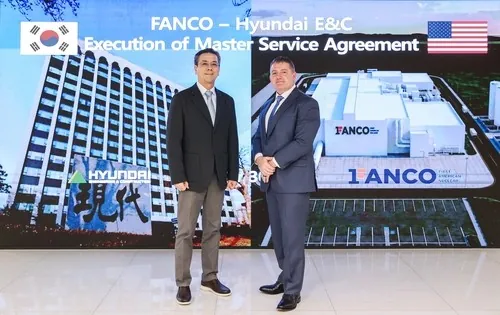
Hyundai Engineering & Construction (E&C), the construction arm of South Korea’s Hyundai Motor Group, signed a five-year master service agreement with First American Nuclear Co. (FANCO) on October 30, 2026, at Hyundai E&C’s Seoul headquarters. The deal expands a framework agreement the two companies first struck in July 2026. Under the new contract, Hyundai E&C will provide technical support for FANCO’s EAGL-1 reactor — a next-generation SMR designed to produce approximately 240 megawatts of electricity (MWe). Services include reviews of construction feasibility, engineering and design consultations, and advice on construction methods. FANCO has already submitted a regulatory engagement plan to the U.S. Nuclear Regulatory Commission (NRC), the federal body that licenses commercial nuclear facilities in the United States, as part of its path toward commercialising the technology.
Why Korea does it this way
Korea has been building nuclear power plants since the 1970s and operates one of the most export-oriented nuclear industries in the world, completing the UAE’s Barakah plant as a flagship overseas project. Korean construction conglomerates — known as chaebols (large family-controlled industrial conglomerates) — have leveraged that accumulated expertise to bid for plant-engineering and construction contracts abroad, since domestic nuclear expansion has historically moved in fits and starts with each change of government. SMRs, which are factory-built reactors of under roughly 300 MWe, are now a priority growth market because they can be sited more flexibly and require less upfront capital than conventional gigawatt-scale plants. The EAGL-1 is distinctive in using a lead-bismuth eutectic coolant (a low-melting-point liquid metal alloy) rather than pressurised water — a design that proponents say offers passive safety advantages but that requires new engineering know-how that Hyundai E&C is positioning itself to supply.
What it means for you
Investors in Korean construction and energy stocks: Hyundai E&C (listed on the Korea Exchange, ticker 000720) is building an SMR order book in the U.S. market. The FANCO deal is a services contract — revenue and timeline details have not been disclosed — so watch for order-book updates in quarterly earnings. No financial figures from this agreement have been confirmed.
The nuclear supply chain: FANCO must still clear NRC licensing — a multi-year process with no confirmed completion date — before construction can begin. Korean engineering and materials suppliers that feed into Hyundai E&C’s nuclear division could eventually benefit, but no procurement contracts have been announced.
Korea’s AI and power bottleneck: Korea faces congested transmission lines around the Seoul capital region, squeezing data centres, semiconductor fabs, and other high-load users. Domestically, SMR projects could eventually add distributed generation capacity, but EAGL-1 is a U.S.-sited project. Its near-term relevance to Korea’s grid is indirect: success in the U.S. market would validate the technology and Korean construction capability, strengthening the case for similar domestic deployments — though no domestic EAGL-1 contract exists yet.
Residents and electricity consumers: This agreement has no direct effect on Korean electricity tariffs (check the current rate at KEPCO, Korea Electric Power Corporation, Korea’s state-owned grid operator) or on household power bills at this stage.
Watch next
- NRC regulatory timeline: FANCO has filed a regulatory engagement plan with the U.S. Nuclear Regulatory Commission — date not yet set, decided by NRC review schedule. Watch for a formal Construction Permit or Early Site Permit application filing, which would mark the next hard milestone.
- Hyundai E&C Q4 2026 earnings: Due in early 2027 (exact date not yet set — scheduled by Hyundai E&C’s investor-relations calendar). Look for any FANCO contract value disclosure or SMR order-book line item.
- Korea’s domestic SMR policy: The Ministry of Trade, Industry and Energy (MOTIE) has signalled interest in domestic SMR deployment. Watch for a formal SMR roadmap announcement — no date confirmed as of November 2026.
FAQ
What is the EAGL-1 reactor and how much power does it produce?
The EAGL-1 is a small modular reactor (SMR) developed by U.S. startup FANCO, designed to generate approximately 240 megawatts of electricity using lead-bismuth liquid metal as a coolant instead of water. It has not yet received a construction licence from the U.S. Nuclear Regulatory Commission.
What will Hyundai E&C actually do under the FANCO deal?
Under the five-year master service agreement signed October 30, 2026, Hyundai E&C will provide construction feasibility reviews, engineering and design consultations, and advice on construction methods for the EAGL-1 project. No contract value has been disclosed.
Source: Yonhap News Agency
Was this useful?
What made the difference? Pick one.
What made the difference? Pick one.
Thanks. We read every answer.