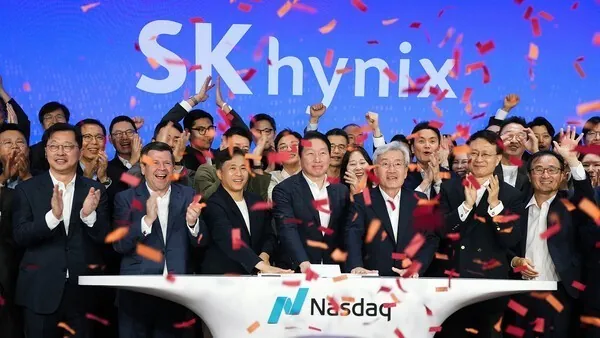
SK hynix, South Korea’s second-largest chipmaker and the world’s leading maker of HBM (High Bandwidth Memory — the specialised stacked memory that sits beside AI accelerators), has scrapped plans to separately list its NAND flash subsidiary Solidigm on the Nasdaq, citing unfavourable market conditions and shareholder opposition.
What happened
On October 23, 2026, SK hynix announced it was ending its review of a potential initial public offering (IPO) for Solidigm, a US-incorporated subsidiary it created in 2021 after acquiring Intel’s NAND flash memory business. The plan had been alive for just 79 days: reports of a pre-IPO fundraising effort first surfaced on August 5, and SK hynix shares fell more than 10% the following day as investors reacted negatively. Reuters and Bloomberg had reported that Solidigm was shortlisting underwriters and targeting a Nasdaq listing as early as 2027. The final blow came from regulators: on October 19 the governor of the FSS (Financial Supervisory Service — South Korea’s markets watchdog) told the National Assembly that the proposed listing would fall under South Korea’s dual-listing (이중상장) rules, meaning the parent company must formally assess shareholder harm and obtain board approval even for an overseas spin-off listing. The FSC (Financial Services Commission — the policy-setting body above the FSS) chairman confirmed the same view on October 22. The very next day, SK hynix pulled the plug.
Structurally, Solidigm sits inside a US intermediate holding company called AI Company, which SK hynix set up in January 2026; AI Company owns 100% of Solidigm. The company said the decision “does not reflect any change in Solidigm’s growth potential or investment needs.”
Why Korea does it this way
South Korea’s dual-listing rules were introduced to protect minority shareholders of listed parent companies from having subsidiaries separately floated in ways that carve out value they already own. Under the rules, even a listing on a foreign exchange can trigger disclosure requirements, board-level resolutions, and impact assessments if the parent is a Korean-listed entity. The framework is enforced jointly by the FSC (Financial Services Commission) and the FSS (Financial Supervisory Service), with the National Assembly (South Korea’s parliament) able to pressure both bodies through annual parliamentary audits — which is exactly how this case surfaced publicly in October. Korean retail investors, who hold meaningful stakes in large-cap stocks like SK hynix, have become increasingly vocal about subsidiary spin-offs diluting the parent’s value, and regulators have grown more willing to act on those concerns.
What it means for you
SK hynix shareholders and Korea-focused investors: The immediate risk — a new share class competing with SK hynix on Nasdaq — has been removed. SK hynix is a constituent of the KOSPI 200 (South Korea’s main large-cap index) and is widely held by Korea-focused ETFs; its 10%-plus share-price drop in August has already partially reversed following the IPO cancellation. No specific recovery figure has been confirmed; check live pricing on the Korea Exchange (KRX).
NAND flash and AI storage supply chain: Solidigm still needs capital to expand production capacity — SK hynix’s statement explicitly said so. Without an IPO, financing will have to come from SK hynix’s own balance sheet, debt markets, or a private placement. That means Solidigm’s capital spending timeline may slip, which could affect enterprise SSD supply for data-centre customers including hyperscalers building out AI infrastructure.
Foreign residents and general investors: This story has no direct impact on Korean domestic interest rates, mortgages, rents, or utility bills. Its relevance is narrower: anyone holding SK hynix shares or a Korea equity fund with meaningful KOSPI exposure should note that the dual-listing risk premium that weighed on the stock since August has now been removed.
Watch next
- Solidigm’s alternative financing announcement: SK hynix said Solidigm is still reviewing “various financing options.” No date set — triggered by an SK hynix regulatory filing or investor relations announcement on the KRX disclosure system (KIND).
- SK hynix Q4 2026 earnings call (date not yet set — typically scheduled 4–6 weeks after quarter-end, so watch for an announcement in late January 2027): management is expected to clarify Solidigm’s capex plan and whether it affects the parent’s HBM investment schedule.
- FSC dual-listing rule revision: The FSC chairman’s October 22 statement flagged that existing rules may need updating to cover overseas listings more explicitly. Watch for a formal FSC consultation paper — no date set, decided by the FSC.
FAQ
Why did SK hynix cancel the Solidigm IPO?
SK hynix cited unfavourable capital market conditions and share price movements, but the immediate trigger was South Korean financial regulators confirming on October 19–22 that the proposed Nasdaq listing would fall under Korea’s dual-listing rules, which require shareholder-impact assessments and board approval — combined with shareholder opposition that had already sent the parent’s stock down more than 10% in August.
What is Solidigm and why does it matter for AI?
Solidigm is a US NAND flash memory company formed from SK hynix’s 2021 acquisition of Intel’s NAND business; it makes storage chips used in enterprise SSDs that go into AI data centres, making its production capacity relevant to the pace and cost of AI infrastructure buildout.
Source: The Elec
Was this useful?
What made the difference? Pick one.
What made the difference? Pick one.
Thanks. We read every answer.