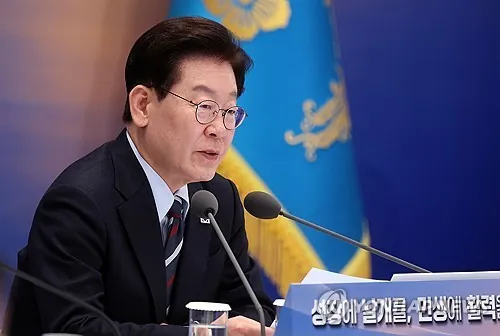
South Korean President Lee Jae-myung on October 23, 2026, called for sweeping reform of regulations that slow the growth of advanced industries, framing deregulation as central to making Korea economically irreplaceable on the world stage.
What happened
President Lee spoke at the second plenary meeting of the regulation rationalization committee (a government body tasked with reviewing and easing business rules to support new industries and regional balance). He made two main arguments: first, that outdated rules blocking new technologies and advanced industries must be reformed “promptly and boldly”; second, that his administration’s balanced development policy (a strategy to spread economic activity beyond the Seoul metropolitan area) must be pursued just as aggressively.
Lee specifically flagged administrative barriers to launching venture businesses (startups and early-stage companies, often in tech) as a target for removal, arguing that a thriving startup ecosystem creates jobs and drives growth. He also pointed to “megaprojects” — large-scale government-backed investments in semiconductor clusters (concentrated zones of chip design and manufacturing facilities) and AI-related infrastructure in regional areas — as tools for narrowing the development gap between Seoul and the rest of the country.
Why Korea does it this way
Korea’s economy has long been dominated by a small number of large conglomerates known as chaebol (family-controlled industrial groups such as Samsung and SK). Regulations that made sense for an earlier industrial era have often stayed on the books, creating friction for newer, smaller technology companies trying to scale. Successive Korean governments have promised deregulation, but entrenched bureaucratic and legislative processes have made reform slow. The Lee administration is framing regulatory overhaul as a competitiveness issue — particularly urgent as Korea competes with the US, Japan, and Taiwan in semiconductors and AI hardware. Korea’s president serves a single five-year term, so the current window for structural reform runs only until the mid-2020s.
What it means for you
Startup founders and workers: If administrative barriers to registering and operating venture businesses are reduced, launching a company in Korea should become faster and cheaper — though specific rule changes and effective dates have not yet been announced from this meeting.
Regional residents and workers (outside Seoul): The semiconductor and AI megaprojects are explicitly targeted at regions outside the capital. If they proceed, they could bring construction jobs, then permanent manufacturing and engineering roles, to areas that have seen population decline. No confirmed project locations or timelines were announced at this meeting.
Investors in Korean-listed tech and chip companies: The KOSPI (Korea Composite Stock Price Index, Korea’s main stock exchange benchmark) and KOSDAQ (the index weighted toward smaller tech and biotech firms) include major semiconductor and AI-adjacent names. A sustained deregulation push — especially around land-use and environmental permitting for fab (chip fabrication plant) construction — could reduce project costs and timelines for listed chipmakers. No specific legislative changes were confirmed at this meeting; watch for follow-on bills.
Foreign residents and expats: No immediate changes to visa, employment, or daily-life regulations were announced. If startup deregulation extends to rules around foreign-founded businesses, that would be a separate, later development.
Watch next
- Regulation rationalization committee output: The October 23 meeting was the second plenary — watch for a formal list of targeted regulations to be published by the committee. Date not yet set; decided by the Presidential Office (Cheong Wa Dae).
- National Assembly legislative schedule: Deregulation requires statutory changes in many cases. The next major Assembly session begins in the coming weeks — if specific deregulation bills are tabled, the trigger is their first reading in the Industry or Science committees.
- Megaproject site announcements: If the government names specific regions for semiconductor or AI infrastructure clusters, that is the first checkable confirmation that balanced-development promises are moving to execution. Watch for Ministry of Science and ICT or Ministry of Trade, Industry and Energy press releases.
FAQ
What is Korea’s regulation rationalization committee?
The regulation rationalization committee is a presidential advisory and action body set up by the Lee administration to identify and remove outdated business regulations, with a focus on advanced industries and regional development; the October 23 meeting was its second full plenary session.
Which industries will benefit from Korea’s deregulation push?
President Lee specifically named new technologies, advanced industries broadly, semiconductor clusters, AI-related facilities, and venture businesses (startups) as the targets; no exhaustive industry list or effective dates were released at the October 23 meeting.
Source: Yonhap News Agency
Was this useful?
What made the difference? Pick one.
What made the difference? Pick one.
Thanks. We read every answer.