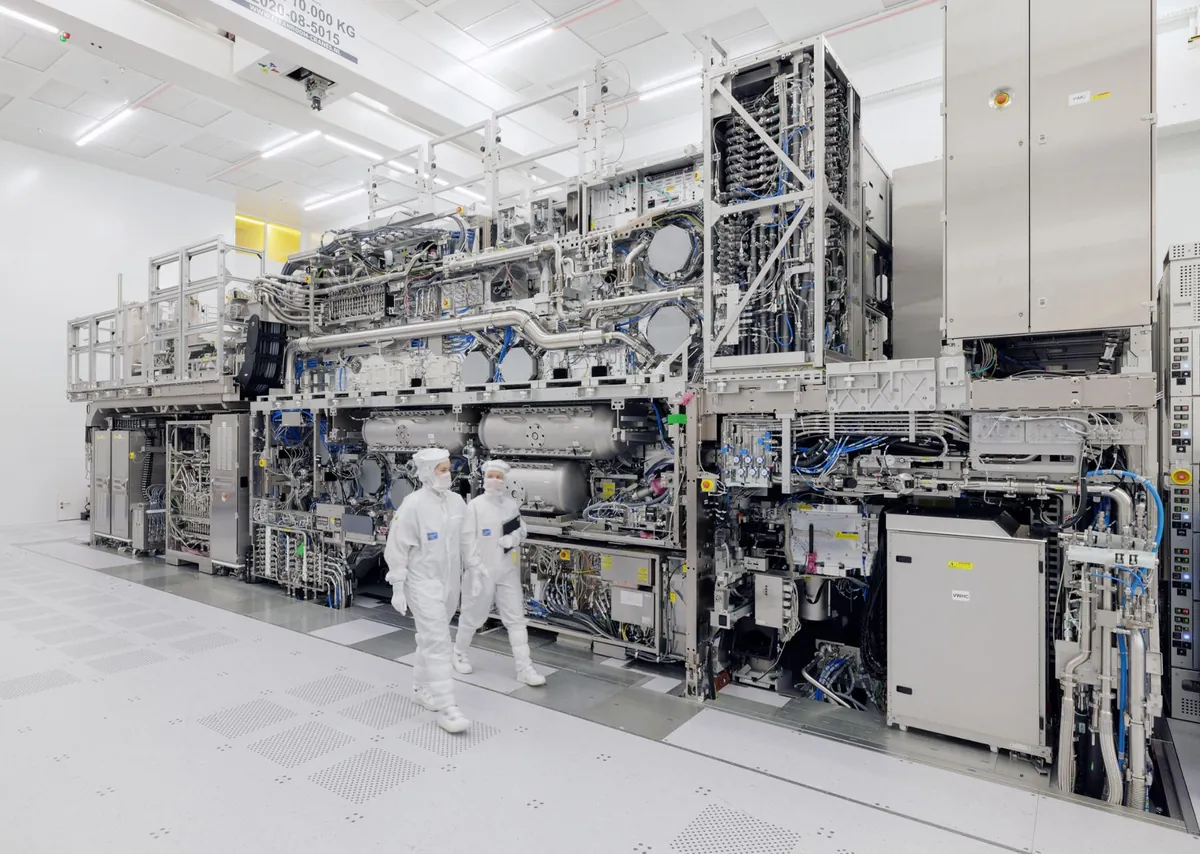
ASML, the Dutch company that makes the world’s most advanced chipmaking machines, warned this week that even a 30% annual increase in its own production will fall short of what its customers — including Korea’s Samsung Electronics and SK hynix — need to build out their next generation of chip factories.
What happened
On Wednesday October 15, 2026, during its quarterly earnings call, ASML CEO Christophe Fouquet said the company’s plan to grow output of advanced lithography (light-based circuit-printing) machines by 30% in both 2027 and 2028 “will not allow us to meet our customer demand.” Discussions with customers have already shifted to 2028 delivery slots, with strong interest in locking in orders for 2029 and even 2030. The shortage covers both low-NA EUV (extreme ultraviolet, used to print the finest circuit lines on chips) and DUV immersion (deep ultraviolet, used for a wider range of chip layers) systems — the two machine families that are essential to making high-bandwidth memory (HBM) and other advanced chips.
Korea’s two flagship chipmakers are in the middle of massive cluster builds. SK hynix is constructing a fab (semiconductor fabrication plant) in Yongin, Gyeonggi Province, targeting production in October 2027. Samsung Electronics is building in the same area, aiming for operations from 2029. Both companies also have large-scale facilities planned for Jeonnam-Gwangju Special Metropolitan City (a new administrative city merging South Jeolla Province and Gwangju), where local authorities had been targeting a construction start in 2025 and mass production by 2030. Equipment lead times — the gap between placing an order and taking delivery — run 18 to 24 months, meaning machines needed for a 2027 start had to be ordered around 2025.
Why Korea does it this way
Korea has concentrated its semiconductor industry in government-backed industrial clusters for decades, using coordinated land, tax, and infrastructure support to let Samsung and SK hynix co-locate suppliers and utilities at scale. The strategy worked well when equipment supply was predictable, but it creates timing risk when a single dominant supplier — ASML holds a near-monopoly on EUV machines — cannot ramp fast enough to serve every cluster simultaneously. Korea’s memory chip dominance (Samsung and SK hynix together produce the large majority of the world’s HBM) means their fab timelines directly affect the global supply of the memory stacked inside AI accelerators (graphics processing units used for machine learning). When Korea’s fabs are delayed, the AI supply chain feels it.
What it means for you
Investors in Korean chipmakers: Samsung Electronics (KRX: 005930) and SK hynix (KRX: 000660) are among the largest weights in the KOSPI index (Korea’s main stock exchange benchmark). Equipment delays do not cancel fab plans but push revenue from new capacity further into the future; watch for guidance revisions in upcoming earnings calls. No investment advice — these are reported facts about listed companies.
Supply-chain businesses and workers: Suppliers to the Yongin and Jeonnam-Gwangju clusters — construction firms, materials companies, utilities — may see project timelines stretch. SK hynix’s Yongin target of October 2027 is the nearest firm date; if equipment cannot be delivered in time, that date is at risk. The Jeonnam-Gwangju mass-production target of 2030 gives more buffer, but construction contracts that were timed to that schedule may need review.
Residents near cluster sites: Power and water infrastructure commitments tied to fab opening dates could be delayed alongside equipment. No change to electricity tariffs has been announced in connection with this story.
Foreign workers and expats in Korea’s tech corridor: Hiring ramps for new fabs typically begin 12–18 months before production. If the SK hynix Yongin start date slips from October 2027, recruitment for that facility would move accordingly.
Watch next
- SK hynix quarterly earnings (next scheduled: late October 2026) — listen for any update to the October 2027 Yongin production start date and whether equipment orders have been secured.
- Samsung Electronics quarterly earnings (next scheduled: late October 2026) — watch for any revision to its 2029 Yongin operations target and commentary on EUV/DUV delivery slots.
- ASML Q4 2026 earnings call (expected January 2027) — ASML’s CFO Roger Dassen said the company will assess whether a capacity increase beyond 30% per year is feasible; if ASML announces a higher growth target, the equipment bottleneck eases for 2028–2029 orders.
FAQ
Will ASML’s equipment shortage delay Korea’s HBM chip production?
It is a growing risk but not yet confirmed. ASML’s CEO said 30% annual capacity growth in 2027 and 2028 will not meet customer demand, and equipment lead times are 18–24 months — meaning any shortfall now affects deliveries needed for fabs targeting production in late 2027 and beyond. Neither Samsung nor SK hynix has publicly announced a delay as of October 17, 2026.
What is an EUV machine and why can only ASML make it?
An EUV (extreme ultraviolet) lithography machine uses extremely short-wavelength light to print circuit patterns finer than any other technology can achieve; ASML holds the dominant market position because developing EUV required decades of R&D and a tightly integrated global supply chain that no competitor has replicated at commercial scale.
Source: The Korea Times
Was this useful?
What made the difference? Pick one.
What made the difference? Pick one.
Thanks. We read every answer.