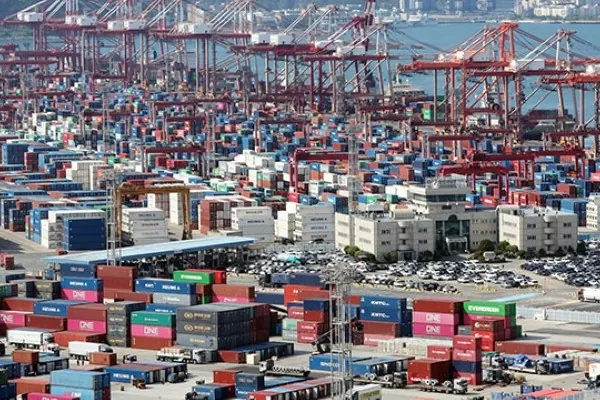
South Korea recorded a current account surplus (the broadest measure of money flowing into a country versus out of it) of US$46.11 billion in August 2026, the second-largest monthly figure in the country’s history, powered by a surge in semiconductor exports, according to provisional data released by the Bank of Korea (BOK) on October 8.
What happened
The Bank of Korea’s provisional balance-of-payments data, published Thursday (October 8, 2026), put August’s current account surplus at $46.11 billion — topping July’s surplus of $42 billion-plus and landing as the second-largest monthly surplus on record. The gain was driven primarily by the goods trade balance, where semiconductor exports led the charge. South Korea is home to Samsung Electronics and SK Hynix, two of the world’s three largest memory-chip makers, whose export revenues flow directly into the current account figures. The Bank of Korea is the central bank and sole compiler of balance-of-payments statistics for Korea.
Why Korea does it this way
Exports account for roughly 40% of South Korea’s GDP, an unusually high share for an economy of its size, which means the current account is a core economic barometer watched by policymakers as closely as growth or inflation data. Korea industrialized rapidly in the 1960s–80s by building globally competitive export industries — electronics, shipbuilding, petrochemicals, autos — and the economy remains structurally dependent on external demand. The won (KRW, South Korea’s currency) tends to strengthen when the current account runs large surpluses and weaken when it narrows, so the surplus number feeds directly into currency and monetary-policy debates. The BOK releases provisional current account data monthly, typically about five weeks after the reference month.
What it means for you
- Won holders and foreign residents: A sustained large surplus supports the won against the US dollar. If the August figure holds through revision, it reinforces a positive won bias — relevant if you convert a foreign salary into KRW or hold KRW savings accounts.
- Investors in Korean equities (KOSPI): Samsung Electronics and SK Hynix together make up a large share of the KOSPI 200 index. Strong semiconductor export revenue is a direct earnings driver. The August surplus data confirms that chip shipment volumes and/or prices remained elevated through the summer. No forward guidance is implied here — check each company’s next earnings release for projections.
- Supply-chain watchers: Strong semiconductor exports from Korea typically signal healthy order books from AI server and data-centre builders globally. Companies supplying packaging, substrates, and wafer-fabrication equipment to Korean chipmakers may also see order flow benefit.
- Workers and the domestic economy: Large export surpluses do not automatically translate into wage or employment gains at home; much depends on whether corporate profits are reinvested domestically. However, a healthy current account reduces the risk of a currency crisis, which keeps import inflation (and therefore grocery and energy prices) more stable for households.
Watch next
- BOK’s September current account data — due around early-to-mid November 2026 (the BOK releases provisional figures roughly five weeks after month-end). Watch whether the surplus holds above $40 billion, which would confirm a structural shift rather than a one-month spike.
- Samsung Electronics and SK Hynix Q3 2026 earnings — both companies are scheduled to release preliminary Q3 results in October 2026. If operating profit guidance beats consensus, it corroborates the strong August export data; a miss would suggest pricing or volume headwinds not visible in trade figures.
- US and China tariff decisions — Korea’s surplus is heavily exposed to semiconductor demand in both markets. Any announced tariff change on chips or electronics — particularly any US Section 232 or China retaliatory measures — that crosses a 5 percentage-point tariff increase threshold would materially alter the export outlook for the next quarter.
FAQ
What is South Korea’s current account surplus for August 2026?
South Korea’s current account surplus for August 2026 was US$46.11 billion, the second-largest monthly surplus on record, according to provisional Bank of Korea data released on October 8, 2026. The figure surpassed July 2026’s surplus of over $42 billion.
Why is South Korea’s current account surplus so large in 2026?
The August 2026 surplus was driven by a boom in semiconductor exports. South Korea is home to two of the world’s largest memory-chip makers, and strong global demand — particularly from AI and data-centre industries — has kept chip export volumes and revenues elevated. The article does not break down the exact share from semiconductors versus other goods.
Source: KBS World Radio
Was this useful?
What made the difference? Pick one.
What made the difference? Pick one.
Thanks. We read every answer.