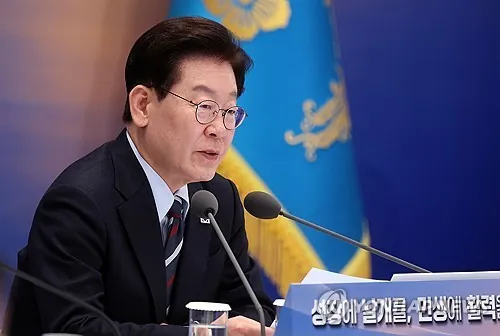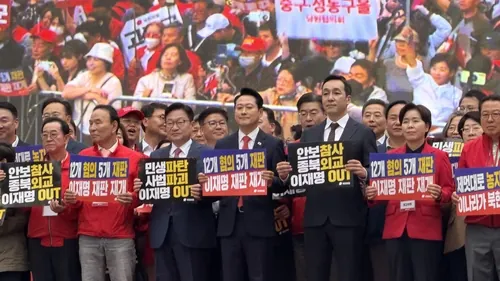
Nearly 70 lawmakers from South Korea’s main opposition People Power Party (PPP — the conservative party that held the presidency until 2025) marched in central Seoul on October 3, 2026, drawing a claimed crowd of 200,000 to protest President Lee Jae Myung’s prosecution reform and his response to a North Korean mine explosion inside the DMZ (Demilitarized Zone, the heavily fortified buffer strip dividing North and South Korea).
What happened
PPP leader Rep. Jang Dong-hyeok led the rally in central Seoul on Korea’s National Foundation Day public holiday. The party says roughly 200,000 people attended, though independent crowd figures were not available at time of publication. PPP floor leader Rep. Jeong Jeom-sig accused President Lee of failing to condemn North Korea after a September 21 blast triggered by North Korean land mines inside the DMZ left three South Korean soldiers injured — two of them seriously. Rep. Lim Jong-deuk called Lee’s characterisation of the blast as an “unfortunate accident” — made during his Armed Forces Day address on October 1 — a sign of submission to Pyongyang. Separately, lawmakers criticised Lee’s push to expand the number of Supreme Court justices, arguing the move is designed to install friendly judges ahead of Lee’s own suspended criminal trials. It is the PPP’s first large-scale street rally since a similar event in late September 2025.
Why Korea does it this way
South Korea’s single-chamber National Assembly (국회, the sole legislative body, with 300 seats) gives the ruling party broad power to reshape institutions — including court composition — with a simple majority, and the ability to push through most legislation without obstruction if it holds 180 seats. Opposition parties historically use street rallies alongside parliamentary manoeuvres to signal public pressure when they cannot block legislation alone. The prosecution reform debate is not new: successive administrations since the early 2000s have fought over the independence and scope of the Prosecution Service (검찰청), which in Korea has both investigative and indictment powers rarely combined in one agency in other democracies.
What it means for you
Foreign residents and expats: No immediate change to daily life. The rally is a political signal, not a policy enactment. Watch for legislative votes, not street events, to gauge real-world impact.
Investors in Korean assets: Inter-Korean tension is a well-documented driver of short-term volatility in the KOSPI (Korea’s main stock index, which carries roughly a 1–2% “Korea discount” in analyst models due to geopolitical risk). The September 21 DMZ mine blast has already been priced in to some degree; a further escalation — such as a formal North Korean provocation — would be the trigger for a renewed risk-off move, not this rally itself. Check current KOSPI levels and USD/KRW rate at the Korea Exchange (KRX) or your broker.
Business and legal environment: If Lee’s bill to expand the Supreme Court passes the National Assembly, it could alter the composition of the bench that hears major commercial and constitutional disputes. No vote date has been confirmed yet. Until legislation passes, the current court structure remains unchanged.
Watch next
- National Assembly vote on Supreme Court expansion: Date not yet set — the ruling party must schedule a plenary vote; watch the National Assembly legislative calendar (parliament.go.kr) for a bill number and hearing date.
- North Korea response to DMZ blast: If North Korea conducts a missile test or issues a formal statement escalating the mine incident, the USD/KRW rate and KOSPI are the fastest-moving indicators — watch for a move beyond the 30-day average range as a threshold for reassessment.
- PPP’s next large-scale rally: The party held its previous major street rally in late September 2025 (approximately one year ago); if another is called within 30 days, it would signal an accelerating opposition campaign ahead of any scheduled by-elections or legislative votes.
FAQ
Why is the PPP rallying against President Lee Jae Myung in October 2026?
The PPP is protesting two issues: Lee’s prosecution reform push — including a plan to add Supreme Court justices, which critics say protects him from his own pending trials — and his description of a September 21 North Korean land-mine blast in the DMZ as an “unfortunate accident” rather than a provocation.
Did the North Korean DMZ mine blast on September 21 2026 cause casualties?
Yes — three South Korean soldiers were injured in the blast, two of them seriously, according to Yonhap’s reporting; no South Korean fatalities were confirmed in this report.
Source: Yonhap News Agency
Was this useful?
What made the difference? Pick one.
What made the difference? Pick one.
Thanks. We read every answer.