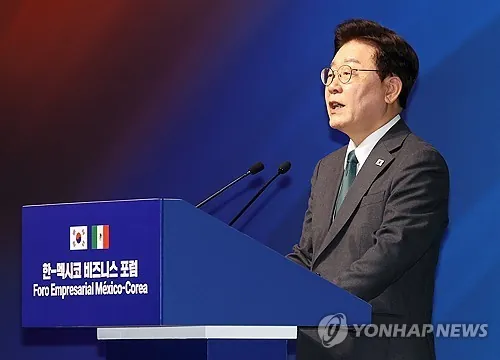
South Korean President Lee Jae Myung called on Mexico to swiftly restart long-dormant free-trade negotiations during a state visit to Mexico City on September 25, 2026, making the case that a formal deal would lock in supply-chain ties that already run to $20.6 billion a year.
What happened
Speaking at a South Korea–Mexico business forum attended by senior executives from both countries, President Lee noted that Mexico is South Korea’s largest trading partner in Latin America, while South Korea ranks as Mexico’s fifth-largest overall trading partner — with bilateral goods trade reaching $20.6 billion in 2025. Despite that volume, no comprehensive free trade agreement (FTA — a treaty that cuts tariffs and harmonises trade rules between two countries) exists between them.
South Korea and Mexico launched FTA negotiations in 2006, but talks stalled and have never formally concluded. Lee and Mexican President Claudia Sheinbaum had already agreed in principle the previous day — September 24, 2026 — on a broad action plan covering cooperation in artificial intelligence, defence, and aerospace. Lee described Mexico as “a main axis” of North American supply chains and a global automotive manufacturing hub, underscoring why Seoul wants the relationship anchored in a binding legal framework.
Why Korea does it this way
South Korea is one of the world’s most trade-dependent economies; exports have historically accounted for roughly half of GDP, so market-access agreements are a core instrument of economic policy. Seoul has signed FTAs with over 50 countries, but the 2006 Mexico talks broke down largely over differences on automotive and agricultural market access — sectors where both sides hold sensitive domestic interests.
With the United States-Mexico-Canada Agreement (USMCA) making Mexico a preferred manufacturing base for companies that want tariff-free access to North American consumers, Korean firms — including major automakers and electronics companies — have invested heavily in Mexican factories. Formalising an FTA would extend preferential treatment to Korean goods and protect Korean investors from policy uncertainty.
What it means for you
Korean exporters and manufacturers in Mexico: Companies operating Mexican plants — particularly in automotive parts, electronics and steel — currently face tariff exposure that an FTA would eliminate. No rate cuts take effect until a deal is signed and ratified; that process typically takes two to four years from the restart of formal talks.
Foreign investors tracking Korean equities: Korean automakers and their Tier-1 suppliers have significant production in Mexico. Progress on FTA talks is a positive signal for their cost structures, but no deal is yet in force. Check current constituent weights and price moves at the Korea Exchange (KRX) before drawing portfolio conclusions — this briefing contains no investment advice.
Expats and residents in Korea: This is primarily a trade-diplomacy story with no immediate effect on domestic prices, mortgage rates, or utility bills. If a deal is eventually concluded, it could modestly lower prices on Mexican agricultural imports (avocados, corn) and Mexican-assembled consumer goods sold in Korea — but any such effect is years away.
Korean workers in export industries: Securing a legal trade framework with Mexico reduces the risk that Korean factories there face sudden tariff hikes, supporting job stability in export-linked manufacturing at home.
Watch next
- Formal restart of FTA negotiations: No date has been set — the trigger is an official announcement by both governments’ trade ministries (Korea’s Ministry of Trade, Industry and Energy and Mexico’s Secretaría de Economía). Watch for a joint communiqué following this state visit, expected to be published within days of September 25, 2026.
- Korea–Mexico action plan details: The comprehensive cooperation plan agreed on September 24, 2026 covering AI, defence, and aerospace is expected to be published in full; watch for the official text release from Cheong Wa Dae (the South Korean presidential office, known as the Blue House) or its equivalent announcement portal.
- Korea’s next trade-balance data release: Statistics Korea publishes monthly trade figures; the September 2026 report (covering August trade) will show whether Korea–Mexico bilateral flows are accelerating ahead of any deal — watch for that release in late September or early October 2026.
Source: Yonhap News Agency
Was this useful?
What made the difference? Pick one.
What made the difference? Pick one.
Thanks. We read every answer.