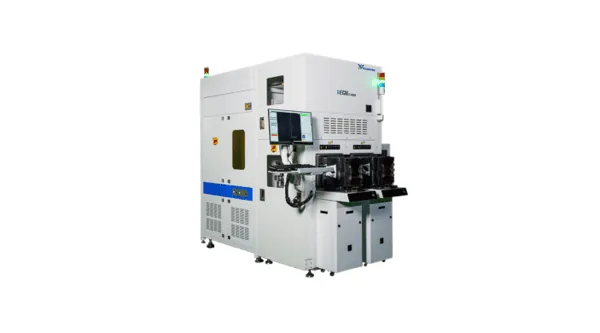
Youngwoo DSP, a South Korean equipment maker best known for display inspection tools, is now testing its semiconductor packaging inspection system on a domestic foundry (a chip fabrication service plant that makes chips for other companies) production line — a move that could open a new revenue stream in the fast-growing advanced packaging market.
What happened
As of September 2026, Youngwoo DSP is supplying a small number of its VEGA S-1000 inspection systems to an unnamed mid-sized Korean foundry for a validation trial expected to last two to three months. The equipment inspects wafer-level packaging (WLP) — a technique that shrinks chip modules by attaching components directly onto the silicon wafer before cutting it into individual chips, rather than packaging them separately afterward.
The VEGA S-1000 combines 2D and 3D automated optical inspection (AOI), using a line-scan camera to sweep the wafer surface and catch defects as small as 1.7 micrometers (roughly one-fiftieth the width of a human hair). It can flag missing bumps, positional errors, and shape irregularities in the tiny copper pillars and micro-bumps that connect chip layers. The system processes 103 wafers per hour — about 2.5 times the throughput of comparable competing equipment. It also integrates AI-based defect classification, reaching a reported detection success rate of 99.7%.
Youngwoo DSP first validated the equipment at LB Semicon, a Korean OSAT (outsourced semiconductor assembly and test) company that handles chip packaging and testing on behalf of chip designers. That earlier trial generated the performance data used to optimize the system before approaching foundry customers.
Why Korea does it this way
Korea’s semiconductor equipment industry has long sat in the shadow of dominant Japanese and American suppliers, but government-backed programs and the surge in demand for advanced packaging — driven by AI chip stacks like high-bandwidth memory (HBM) — have created openings for domestic challengers. Foundries and OSATs in Korea face pressure to qualify local suppliers both to reduce supply-chain risk and to meet policy goals tied to subsidies under Korea’s Chips Act framework. Validation trials of this kind are the standard gatekeeping step: a supplier must prove equipment performance on a live production line before any mass-production contract is signed.
Youngwoo DSP’s pivot from display to semiconductor equipment mirrors a broader trend among Korean equipment firms, as smartphone display demand has flattened while chip packaging investment — especially for AI and HPC (high-performance computing) applications — accelerates.
What it means for you
Investors: Youngwoo DSP is listed on the Korea Stock Exchange (KSE). The foundry validation trial is a material development for a company whose semiconductor revenue has been minimal; watch for the mass-production supply discussion expected in November–December 2026 if the two-to-three-month trial completes on schedule. No revenue is confirmed yet.
Supply chain: LB Semicon, already a validated customer, anchors Youngwoo DSP’s OSAT reference. The unnamed foundry customer is the new prize; if qualification succeeds, other Korean foundries could follow. Competing AOI suppliers — largely Japanese and European — would face a domestic rival with a significant throughput advantage in micro-bump inspection.
Residents and workers: This story does not directly affect rents, utility bills, or consumer prices. However, successful equipment localization in semiconductor packaging supports Korea’s stated goal of keeping high-value manufacturing jobs on shore as global chip investment clusters around Yongin (the site of Korea’s planned mega chip cluster south of Seoul).
Watch next
- Trial verdict, November–December 2026: The two-to-three-month validation window closes around that timeframe. A positive result triggers mass-production supply talks — watch for a Youngwoo DSP regulatory disclosure (공시, gongsi) on the Korea Exchange filing system (KIND) if a contract is signed.
- Youngwoo DSP earnings, Q3 2026 results (date not yet set — typically released within 45 days of quarter-end): Look for any semiconductor equipment revenue line or guidance update that reflects the new foundry pipeline.
- LB Semicon capacity announcements: As the confirmed OSAT reference customer, any LB Semicon expansion or HBM packaging contract win would likely increase demand for the VEGA S-1000 systems already on its line.
Source: The Elec
Was this useful?
What made the difference? Pick one.
What made the difference? Pick one.
Thanks. We read every answer.