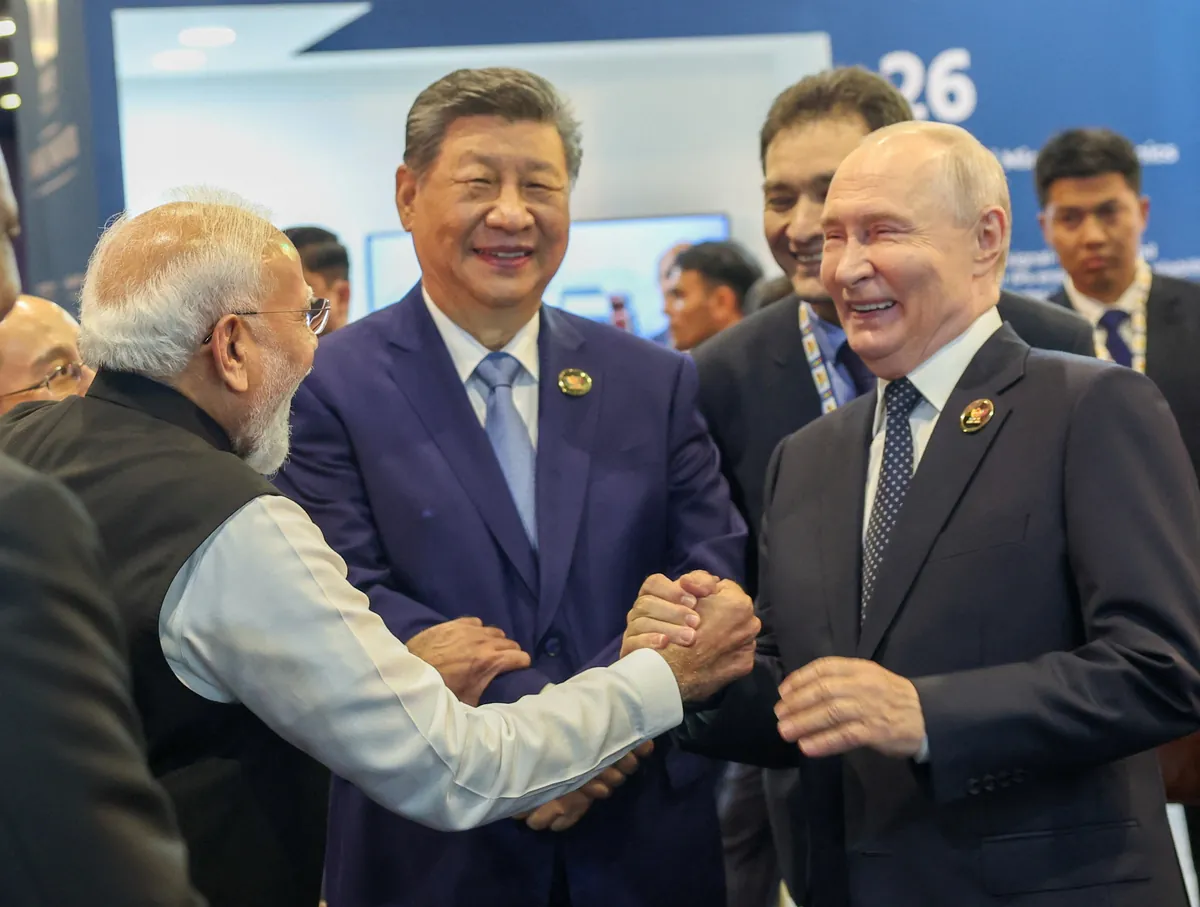
At the 18th BRICS summit in New Delhi on September 12–13, 2026, leaders including China’s Xi Jinping, Russia’s Vladimir Putin, and India’s Narendra Modi unanimously adopted a joint declaration opposing unilateral sanctions and calling for alternatives to dollar-based trade settlement — a direct challenge to the Western-led economic order that underpins Korea’s export machine.
What happened
Meeting at the Bharat Mandapam International Convention Center in New Delhi, the BRICS bloc (Brazil, Russia, India, China, South Africa — plus newer members) issued its first unanimously adopted joint statement since at least the May 2026 foreign ministers’ meeting, which had failed to produce one due to disagreements over the Middle East. The declaration condemned “unilateral coercive measures that contravene international law” and expressed “serious concern” about rising tariff and non-tariff barriers that distort trade and conflict with World Trade Organization (WTO) rules. Leaders pledged to maintain smooth global supply chains and energy flows. Crucially, they agreed to “continue discussions to develop practical solutions” for cross-border settlements among BRICS members — meaning payment systems that do not rely on the US dollar or SWIFT (the Belgium-based interbank messaging network that processes most international payments). Indian Prime Minister Modi proposed a ten-point implementation plan to be delivered before the next summit, framing the current global governance architecture as “pyramidal” with power too concentrated at the top. Russian President Putin pushed for expanded UN Security Council representation for the Global South, particularly Asia, Africa, and Latin America.
Why Korea does it this way
Korea is structurally exposed to exactly this kind of geopolitical fracture. Exports account for roughly 40% of GDP, and China alone absorbs about 20–25% of those exports (check the current share at the Korea International Trade Association, kita.net). Korea sits at the hinge between the Western alliance system it depends on for security and the Chinese-led trade ecosystem it depends on for growth. When the US imposes sanctions or tariffs on BRICS members, Korean firms trading with those countries face secondary-sanction risk — the threat of being cut off from US markets or dollar financing if they continue dealing with sanctioned counterparts. This is not hypothetical: Korean chipmakers and battery producers have already navigated multiple rounds of US export controls targeting China.
The push for non-dollar settlement systems is a longer-term structural threat to Korea’s financial plumbing. Korean exporters price most contracts in dollars; a fragmented settlement world means more currency and counterparty risk.
What it means for you
Exporters and their workers: If BRICS members accelerate de-dollarisation (reducing reliance on the US dollar for trade), Korean exporters selling into China, India, or Russia may face pressure to accept yuan- or rupee-denominated contracts. That shifts currency risk onto the Korean side. Companies most exposed include steel, petrochemicals, and intermediate goods makers that feed Chinese factories.
Investors in Korean equities: The KOSPI (Korea Composite Stock Price Index, the main Korean stock benchmark) is heavily weighted toward Samsung Electronics, SK Hynix, and POSCO — all of which have significant China revenue. A sharper US–BRICS trade divide that forces companies to choose sides would compress earnings multiples for these names. No specific dates or thresholds have been set yet; watch for any US executive order targeting BRICS settlement mechanisms for the trigger event.
Won (KRW) holders: Sustained dollar-alternative momentum tends to weaken dollar demand globally, which historically supports emerging-market currencies including the won — but a simultaneous global risk-off shock (e.g., Middle East escalation the declaration warns about) would dominate and send the won lower. These forces are currently pulling in opposite directions.
Foreign residents: No immediate change to daily transactions. If you receive income in dollars or euros, a gradual weakening of dollar dominance over years would reduce your purchasing power in Korea if the won strengthens. Nothing here is decided or imminent.
Watch next
- BRICS implementation plan deadline — before the 19th summit (date not yet set, to be announced by the BRICS rotating presidency): Modi committed to a ten-point reform plan. If it includes a concrete settlement mechanism or BRICS currency basket proposal, that is the moment secondary-sanction risk for Korean firms becomes quantifiable.
- US Treasury / Commerce Department response: Watch for any executive order or rule specifically targeting BRICS settlement infrastructure — no date set, but any such move would trigger immediate compliance reviews at Korean banks and export-credit agencies. Trigger: official US Federal Register publication.
- Korea’s monthly trade data (released by the Korea Customs Service on the first day of each month): If China’s share of Korean exports falls below 18% — a level not seen since the early 2010s — it would signal that de-coupling is already happening faster than policy, regardless of declarations.
Source: The Kyunghyang Shinmun (Khan.co.kr)
Was this useful?
What made the difference? Pick one.
What made the difference? Pick one.
Thanks. We read every answer.



