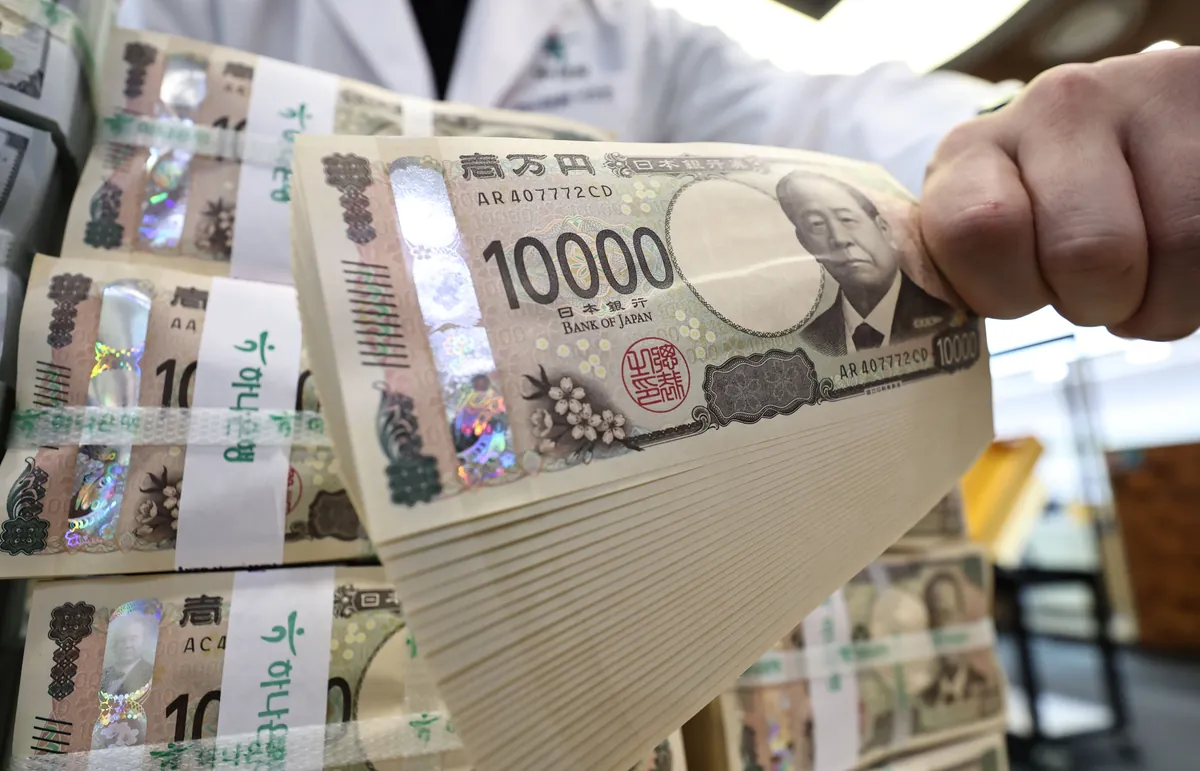
The Japanese yen has surged roughly 7% against the dollar in weeks, reviving fears of a “carry trade unwind” that could ripple through Korean stocks, bonds, and the won.
What happened
The yen hit 164 per dollar at the end of July — its weakest level in roughly 40 years — before staging a sharp reversal. By September 8 it briefly touched 152, the lowest in about seven months. As of September 10 (3:30 p.m. Tokyo time), it stood at 153.5. Two forces are driving the rebound: expectations that the Bank of Japan (BOJ) will raise its policy rate at its Monetary Policy Meeting on September 18, following a hike to 1.0% in June; and coordinated currency intervention — Japan injected 15.4 trillion yen into markets during July–August, with the United States reportedly purchasing yen alongside it. U.S. Treasury Secretary Scott Bessent signalled Washington’s backing on September 8, saying: “We know very well what Japan will do — if you want to bet on yen weakness against me, go ahead and try.”
Why Korea does it this way
Korea runs a deeply open capital market, so global “risk-off” moves — especially involving the yen carry trade (borrowing cheaply in yen to invest in higher-yielding overseas assets) — hit Seoul fast. When the yen strengthens sharply, carry traders unwind positions by selling foreign assets and buying yen back, sending money out of emerging markets including Korea. A precedent came in August 2024, when a similar BOJ rate-hike surprise triggered a brief but violent sell-off in Asian equities. Korea’s comparatively high stock-market foreign ownership and its export-driven economy make the KOSPI (Korea Composite Stock Price Index, the main Korean stock benchmark) especially sensitive to these flows.
What it means for you
Stock investors: The KOSPI closed at 7,033.92 on September 10, down 0.25% on the day. Analysts at Eugene Investment & Securities warn that a rapid yen surge could trigger foreign fund outflows from Korean equities, intensifying downward pressure — similar to the August 2024 episode.
Bond holders and borrowers: Capital outflows tend to push Korean Treasury bond yields higher, which feeds into fixed-rate borrowing costs. For context on what that means for your mortgage or loan, check the current benchmark lending rate at the Bank of Korea (www.bok.or.kr).
Won watchers and expats: The won-dollar rate rose to 1,339.2 won as of September 10, up 3.1 won on the week. A weaker won raises the cost of anything priced in dollars — including imported energy, which Korea buys almost entirely from abroad — and lifts utility and fuel bills. Foreign residents sending money home get less per dollar converted.
Cautious take: Analysts at Korea Investment & Securities argue that a rapid, August-2024-style unwind requires both falling asset prices and synchronized global investor behaviour — conditions they say are not yet in place.
Watch next
- September 18: Bank of Japan Monetary Policy Meeting decision. A rate hike would signal higher yen funding costs and could accelerate carry-trade unwinding; no hike would likely ease pressure on the KOSPI and won.
- Weekly won-dollar fixing: If the won breaches 1,350 per dollar — a level that has historically prompted Bank of Korea verbal intervention — watch for an official statement or market operation. The won-dollar rate is published daily by the Seoul Money Brokerage Services.
- BOJ total 2026 rate hike count: Markets are pricing in two BOJ hikes for the full year. If a second hike is confirmed or signalled after September 18, a renewed round of carry-trade unwinding becomes more likely — monitor BOJ statements for forward guidance language.
Source: The Kyunghyang Shinmun (경향신문), reporting by staff correspondents, published September 10, 2026.
Source: The Kyunghyang Shinmun (Khan)
Was this useful?
What made the difference? Pick one.
What made the difference? Pick one.
Thanks. We read every answer.



