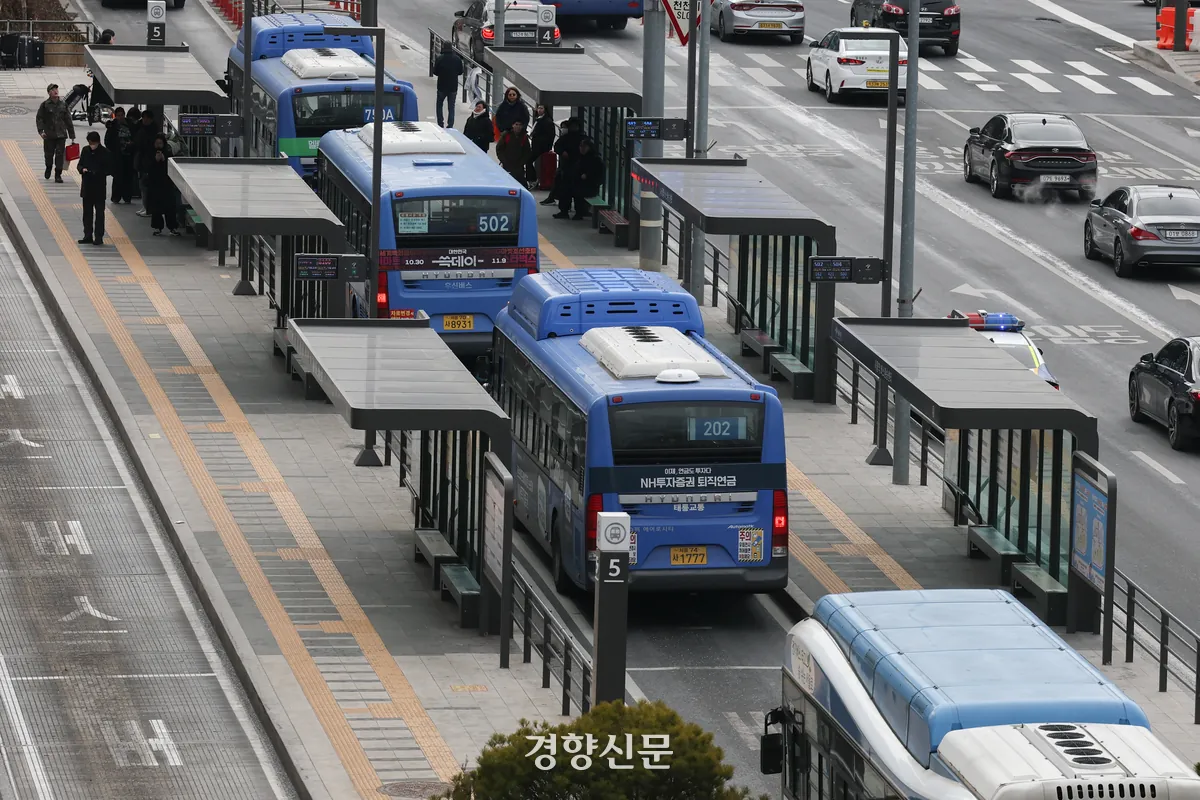
Seoul’s city bus drivers are set to walk off the job on September 16, 2026, after wage negotiations between the union and operators collapsed over a Supreme Court ruling on how overtime pay is calculated.
What happened
The Seoul City Bus Union (affiliated with the Korean Automobile and Transport Workers Federation) announced a strike for September 16 after a first mediation session at the Seoul Regional Labor Relations Commission (SRLRC, a government body that mediates labor disputes before a strike can legally proceed) ended without agreement on September 9. A strike authorization vote among union members is scheduled for September 11, and a second — and likely final — mediation session is set for September 15. If that session fails, the strike begins the following morning.
The dispute centres on two demands: a 7.85% hourly wage increase, and a change to the standard time (the divisor used to convert a monthly salary into an hourly rate) from 209 hours to 176 hours per month. The union argues a Supreme Court ruling issued in April 2026 — in a case brought by workers at Dong-A Transport, a Seoul bus operator — already set 176 hours as the legally correct figure. Management, the Seoul City Bus Transport Business Association, says 64 separate lawsuits involving other bus companies are still pending and wants to wait for those verdicts before changing the formula industry-wide.
Why does the divisor matter so much? Ordinary wages (the legally defined base pay used to calculate overtime, holiday pay and severance) are derived by dividing monthly pay by the standard time. Shrinking that divisor from 209 to 176 hours mechanically raises the hourly rate — and every allowance built on top of it — by roughly 19%. Management calculates that switching to 176 hours alone would add 16.44% to total pay, on top of any negotiated raise. Combined with the 7.85% demand, a senior step-9 driver’s annual salary would rise from ₩68.7 million to at least ₩85.1 million — an increase of about ₩16.4 million (roughly US $12,000 at current rates). Across the whole system, management estimates the annual cost at ₩539.4 billion (approximately US $390 million).
Why Korea does it this way
Korea’s Labour Standards Act defines ordinary wages narrowly and requires that overtime, night-shift, and holiday premiums all be calculated off that base — making the hourly divisor a high-stakes number for any unionised workforce. Courts have repeatedly been asked to rule on which hours count toward the denominator, creating waves of litigation after major sector-level judgments. Seoul’s bus network operates under a government-subsidised cost structure (the city covers deficits when fare revenue falls short), so a large wage bill flows partly to the municipal budget and ultimately to taxpayers. Korea’s statutory retirement age is 60; an ongoing national debate about raising it to 65 is linked to pension reform and youth employment concerns, adding political sensitivity to any large pay increase for public-transit workers, who often work beyond 60 under re-employment contracts.
What it means for you
Daily commuters and residents: If the strike proceeds on September 16, Seoul’s bus network — one of the world’s busiest — will be partially or fully suspended. The city typically deploys emergency shuttle services on key corridors, but expect severe crowding on the subway (metro) system. Check the Seoul Metropolitan Government’s real-time transit app for live updates from September 15 evening onward.
Foreign residents and expats: Airport bus routes (including those to Incheon) may be affected. Build extra time into any travel plans on or after September 16 until the dispute is resolved.
Seoul taxpayers and investors in transport stocks: A settlement on the 176-hour basis would add an estimated ₩539.4 billion per year to operator costs. Because Seoul subsidises bus deficits, a portion of that burden falls on the city budget. For listed companies with exposure to bus operations or municipal contracts, check current index weight and revenue breakdown at the Korea Stock Exchange (KRX) — no investment advice is implied.
Workers in other sectors: The April Dong-A Transport Supreme Court ruling on the 176-hour standard could be cited in wage litigation across any industry that still uses 209 hours. If your employer’s collective agreement references the 209-hour divisor, this ruling is relevant to consult with a labour attorney.
Watch next
- September 11: Union strike-authorization vote result — determines whether the strike mandate is confirmed.
- September 15: Second SRLRC mediation session — if both sides reach agreement, the September 16 strike is called off; if not, the walkout begins the next morning.
- Pending court dates (date not yet set — decided by Seoul courts): Verdicts in the 64 remaining bus-company ordinary-wage lawsuits will determine whether the 176-hour standard applies industry-wide; watch for announcements from the Seoul Central District Court.
Source: The Kyunghyang Shinmun (경향신문)
Was this useful?
What made the difference? Pick one.
What made the difference? Pick one.
Thanks. We read every answer.