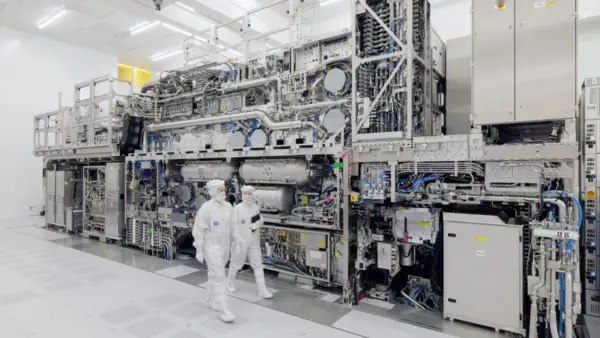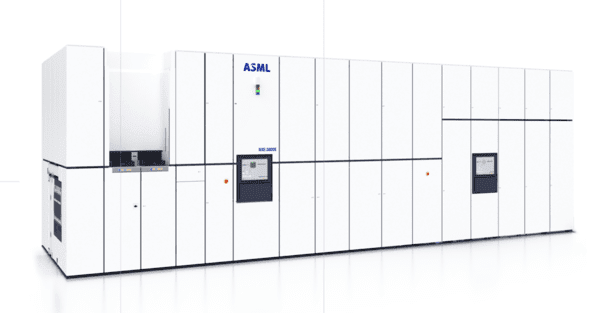
Samsung Electronics and Dutch lithography giant ASML announced on September 8, 2026 that Samsung will be the first chipmaker to deploy High-NA EUV (extreme ultraviolet lithography with a higher-precision optical system) inside advanced DRAM (the type of volatile memory in every smartphone, PC and AI server) production lines — targeting full deployment by 2028.
What happened
On September 8, 2026, Samsung and ASML expanded their technology partnership in two concrete ways. First, Samsung committed to introducing High-NA EUV machines — equipment with a numerical aperture (a measure of how finely a lens can focus light) of 0.55, versus the current industry-standard 0.33 — into its DRAM fabs by 2028. The higher aperture lets the machine print circuit lines so thin that far more transistors fit on a single chip, pushing memory density and performance further than today’s tools allow. Second, Samsung joined an ASML-led international consortium working to replace the semiconductor industry’s long-standing 150mm photomask (the precision stencil through which light is projected to etch circuits onto silicon wafers) with a larger 300mm standard. The bigger mask eliminates a costly workaround called stitching — where a chip design too large for one exposure must be printed in two separate passes and joined — cutting process steps, improving yields, and lowering unit costs.
Why Korea does it this way
Samsung and SK hynix together supply the majority of the world’s DRAM and HBM (High Bandwidth Memory, the ultra-fast memory stacked directly beside AI accelerators in data-centre GPUs). Maintaining leadership in memory density is an existential competitive necessity: DRAM is priced as a commodity, so the manufacturer that fits more bits per wafer at the lowest defect rate wins on margin. Korean chipmakers have historically absorbed enormous capital expenditure cycles early — Samsung bought its first Low-NA EUV tools well ahead of rivals — because being one process node ahead translates directly into years of pricing power. The High-NA move follows the same playbook: enter the consortium, co-develop the tooling, and lock in early access before competitors can react.
What it means for you
Investors in Korean tech stocks: Samsung Electronics (005930.KS) is the world’s largest DRAM maker and a top-five constituent of the KOSPI 200 index. A successful High-NA ramp by 2028 would be the clearest signal yet that Samsung can close the process-node gap with SK hynix, which currently leads in HBM supply to Nvidia. Watch Samsung’s memory operating-margin disclosures — not yet published for the period after this announcement — for the first financial read-through. No investment advice is implied.
The AI supply chain: HBM supply schedules currently set the pace of global AI server buildout. If Samsung reaches High-NA DRAM production by 2028 on schedule, it adds a second credible high-density memory supplier alongside SK hynix, which could ease the HBM bottleneck that has constrained GPU server shipments since 2024.
Residents and workers in Korea’s chip corridor: Samsung’s main DRAM fabs are in Hwaseong and Pyeongtaek (Gyeonggi Province). Large new tool deployments typically require fab expansion or fit-out work — construction, facilities engineering, and tool-qualification headcount — starting roughly 18–24 months before first wafer output, which would place hiring ramps around 2026–2027. No specific headcount figures were announced.
Electricity costs: High-NA EUV machines are among the most power-hungry tools in a fab. KEPCO (Korea Electric Power Corporation), the state utility, has not yet published a specific tariff tied to this expansion; check KEPCO’s industrial rate schedule for any updates to large-consumer pricing.
Watch next
- Samsung Q3 2026 earnings call (date not yet confirmed — typically mid-October): listen for any capital expenditure guidance tied to High-NA tool orders, which ASML books as revenue on delivery.
- ASML Q3 2026 results (scheduled for October 15, 2026): ASML discloses EUV order intake by tool type; a spike in High-NA bookings from a memory customer would confirm Samsung has placed formal purchase orders.
- 300mm photomask consortium milestones: the consortium has not yet set a public roadmap date; watch for announcements from ASML or consortium members if a 300mm mask standard vote is scheduled — that date will signal when the cost advantage becomes industry-wide rather than Samsung-exclusive.
Source: The Elec
Was this useful?
What made the difference? Pick one.
What made the difference? Pick one.
Thanks. We read every answer.