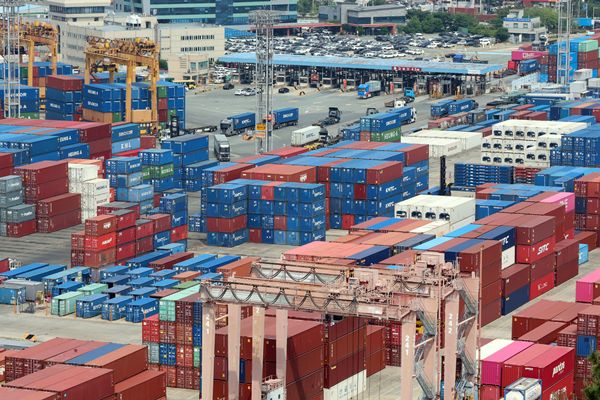
South Korea’s economy expanded by 0.6% in the second quarter of 2026, driven by stronger exports and household spending, the Bank of Korea (BOK, South Korea’s central bank) announced, keeping recovery hopes alive even as global uncertainty persists.
What happened
The Bank of Korea reported that real GDP (gross domestic product — the total value of goods and services produced, adjusted for inflation) grew 0.6% in Q2 2026 compared to the previous quarter. The expansion was broad-based, with both exports — South Korea’s economic engine, dominated by semiconductors, cars, and petrochemicals — and private consumption rising during the period. The BOK is South Korea’s equivalent of the Federal Reserve or the European Central Bank, and its quarterly GDP releases are among the most closely watched economic indicators in Asia.
Why Korea does it this way
South Korea is one of the world’s most trade-dependent large economies: exports routinely account for roughly 40–50% of GDP, which means global demand swings hit Korean growth figures faster and harder than in more domestically oriented economies. The BOK sets its benchmark base rate eight times a year, using GDP data as a key input alongside inflation and employment. Because the vast majority of Korean mortgages are variable-rate — tied directly to the BOK’s base rate or market rates that track it closely — any change in the policy rate ripples into household budgets within a matter of months, making BOK decisions unusually direct in their impact on ordinary people.
What it means for you
Borrowers and mortgage holders: A 0.6% quarterly growth print is solid but not overheating. It gives the BOK room to hold rates steady or consider cuts if inflation allows — which would lower monthly payments on variable-rate home loans relatively quickly. Watch the BOK’s next rate decision closely.
Renters: Korea’s unique jeonse (a large lump-sum deposit paid upfront instead of monthly rent, with the landlord investing the funds) market is sensitive to interest rates. If BOK rates ease, jeonse deposit returns fall, which can shift demand between jeonse and monthly rent (wolse) contracts and affect the size of deposits landlords demand.
Savers: Stronger growth without runaway inflation suggests rates may stay elevated longer than in some peer economies, which is relatively good news for deposit rates at Korean commercial banks.
Foreign residents and expats: A growing economy supports a more stable Korean won (KRW). Currency stability matters for anyone converting salaries or remitting money abroad.
Investors: The KOSPI (Korea’s main stock index) is heavily weighted toward export giants like Samsung Electronics and SK Hynix. A quarter of solid export-led growth is a positive signal for those companies’ earnings outlook, though global trade conditions remain the bigger variable.
Watch next
- The BOK’s next Monetary Policy Committee meeting: the rate decision will be the immediate market-moving event following this GDP release.
- Q3 2026 GDP flash estimate: will confirm whether recovery momentum is holding or fading.
- South Korea’s monthly export data: a leading indicator of where the next GDP print is likely to land.
Source: KBS World Radio
Was this useful?
What made the difference? Pick one.
What made the difference? Pick one.
Thanks. We read every answer.



