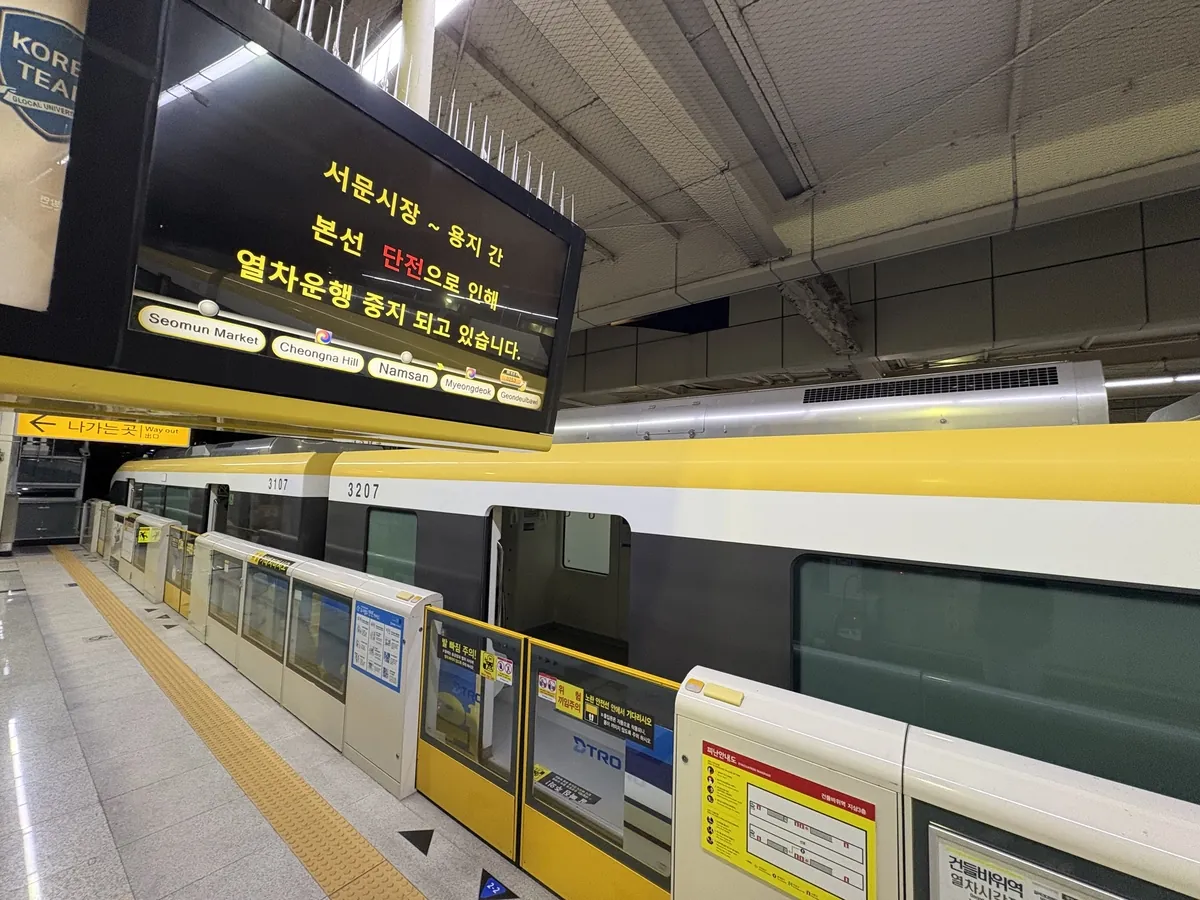
A power supply failure knocked out Daegu Metro Line 3 during the Sunday evening rush, halting all nine trains on the line for roughly 32 minutes before partial service resumed — a small incident in one Korean city, but a pointed reminder of how thin the margin is between routine grid demand and transit failure.
What happened
At approximately 7:38 p.m. on September 7, 2026, a fault originating near Suseong Market Station (수성시장역) on Daegu Metro Line 3 cut power to the entire elevated rail line. All nine trains in service at the time coasted to a stop at the nearest stations using backup power; no passengers required emergency rescue. By 8:10 p.m. — about 32 minutes later — the operator, Daegu Transportation Corporation (대구도시철도공사, the city-owned rail authority), restored limited service on one section: from Chilgok Kyungpook National University Hospital Station in the north to Dalseong Park Station in the south. Full normal service was expected to resume with the first train the following morning at 5:30 a.m. on September 8. The cause of the failure had not been identified as of the time of reporting, and the corporation stated no timeline for complete restoration had been set.
Why Korea does it this way
Daegu Metro Line 3 is unusual even by Korean standards: it is a fully automated, driverless monorail (a single-rail elevated train running on rubber tyres) that opened in 2015, rather than the conventional underground subway lines that serve most Korean cities. Because driverless systems rely entirely on centralized power and signalling, a supply fault propagates across the whole line instantly — there is no driver who can manually limp a train to a depot. Korea’s urban rail networks are operated by city-owned public corporations under the Ministry of Land, Infrastructure and Transport, and power is supplied via dedicated substations connected to KEPCO (한국전력공사, Korea Electric Power Corporation), the state-controlled national utility that owns and operates virtually all transmission and distribution infrastructure in the country.
What it means for you
Commuters and residents in Daegu: Line 3 is the only rapid-transit option connecting the northern Chilgok district to the southern reaches of the city. During Sunday’s outage, passengers were left to find taxis or buses — options that are scarcer on a Sunday evening. Anyone depending on the line for a late commute or return trip faced a roughly 30-minute gap in service at minimum.
Investors and Korea-watchers: The incident is not financially material on its own, but it illustrates a systemic pressure point relevant to the broader Korea power-grid story. KEPCO (listed on KRX: 015760; ADR on NYSE: KEP) supplies power to every piece of Korean public infrastructure, including the data centers and semiconductor fabs that are central to Korea’s AI and chip investment thesis. Grid faults — even localised ones — highlight the capital investment required to harden distribution networks. Korea’s government has committed to expanding both nuclear capacity (including SMR, small modular reactor, development through KHNP, Korea Hydro & Nuclear Power) and grid modernisation spending, partly in response to chronic congestion around the Seoul Capital Area where power demand from AI data centers and DRAM fabs is concentrated. A disruption to a city metro’s substation is a different scale of problem, but the underlying vulnerability — ageing or under-redundant distribution infrastructure — is the same one policymakers are trying to address nationally.
Nothing has been decided yet on the cause or liability for Sunday’s outage; the investigation was still pending as of the time of reporting.
Watch next
- Daegu Transportation Corporation’s investigation findings: the root cause — whether a KEPCO substation fault or an internal rail system failure — will determine where responsibility and repair costs fall.
- Korea’s grid investment policy: the government’s next announced capital expenditure plan for KEPCO grid modernisation, expected in the context of the 2027 budget cycle, will signal how quickly distribution-level vulnerabilities are being addressed.
- KEPCO earnings and rate review: KEPCO’s next quarterly results and any electricity tariff adjustment announcements (the regulator reviews rates periodically) will show whether the utility has the financial headroom to fund the grid upgrades its network clearly needs.
Source: The Korea Herald / Kyunghyang Shinmun (English)
Was this useful?
What made the difference? Pick one.
What made the difference? Pick one.
Thanks. We read every answer.



