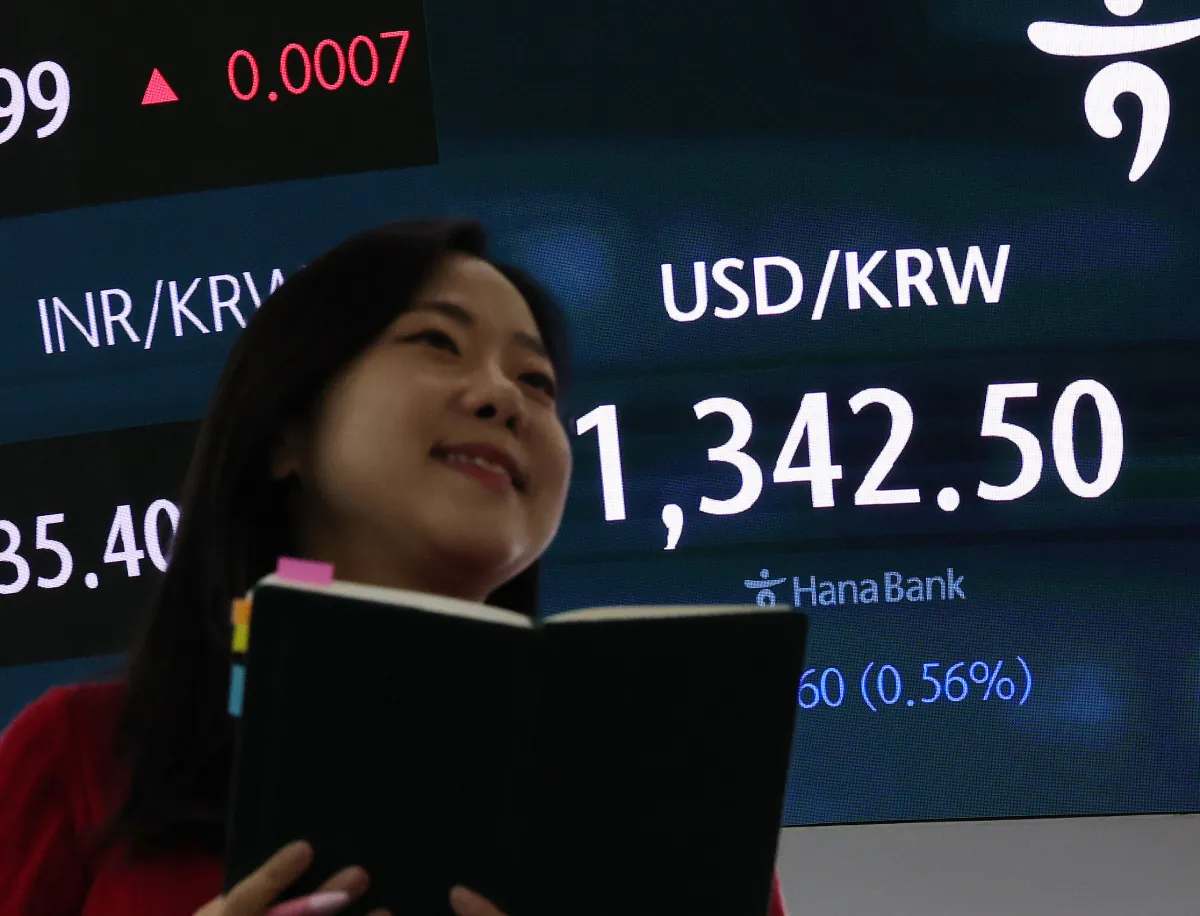
The Korean won surged to its strongest point against the U.S. dollar in almost two years on September 7, 2026, briefly touching the 1,330-won level before closing at 1,340.5 won.
What happened
The won-dollar exchange rate (the number of Korean won needed to buy one U.S. dollar — a lower number means a stronger won) hit an intraday low of 1,334.7 won on September 7, 2026, the first time the rate had dipped into the 1,330s since October 4, 2024. The day’s closing rate settled at 1,340.5 won, down 9.9 won from the previous session. The move caps a dramatic two-month rally: as recently as July 1, 2026, the rate stood at 1,559.2 won, meaning the won has gained more than 200 won — roughly 13% — against the dollar in just eight weeks. A major catalyst on the day was a surge in foreign investor buying on the KOSPI (Korea’s main stock index, Korea Composite Stock Price Index), with overseas funds purchasing approximately 2.59 trillion won (about $1.9 billion) worth of Korean shares. The KOSPI itself jumped more than 4%, rising over 300 points. Analyst Park Sang-hyun of iM Securities raised his year-end forecast, suggesting the rate could approach 1,300 won sooner than previously expected.
Why Korea does it this way
South Korea runs a small, open economy that is heavily export-oriented and deeply integrated into global financial markets. Because foreign investors hold roughly a third of KOSPI by market value — and the index is dominated by semiconductor and electronics giants — large swings in global risk appetite translate directly into big currency moves. When overseas funds buy Korean stocks in size, they must first convert dollars into won, which pushes the won higher. Korea does not fix its exchange rate; the won floats freely, so these flows show up immediately in the daily fixing. The Bank of Korea (BOK) can intervene to smooth excessive volatility but does not target a specific level.
What it means for you
Expats and foreign residents: A stronger won means your dollar, euro, or pound buys fewer won when you convert. If you receive a foreign-currency salary or remit money from abroad, your purchasing power in Korea has shrunk noticeably over two months. Conversely, sending money out of Korea is now cheaper in dollar terms.
Importers and consumers: A stronger won lowers the cost of imported goods — from food to electronics — which can gently ease prices over the coming months.
Korean exporters: Companies that earn revenue in dollars (Samsung, Hyundai, SK Hynix) receive fewer won for each dollar repatriated, which can pressure profit margins if the rate stays low. Watch for any guidance revisions in upcoming earnings calls.
Investors: Foreign buying concentrated in KOSPI blue chips drove the single-day surge. KOSPI is heavily weighted toward semiconductors; the index’s 4%-plus move on this date reflects that sector’s outsize influence. This is a reported fact about index composition and fund flows — not investment advice.
One risk to watch: U.S. August PPI (Producer Price Index, a measure of wholesale inflation) and CPI (Consumer Price Index, retail inflation) data are due September 10–11. Analyst Oh Jae-young of KB Securities cautions that stronger-than-expected U.S. inflation could revive bets on Federal Reserve rate hikes, boosting the dollar and reversing some of the won’s recent gains. The strong U.S. August jobs report — 162,000 nonfarm payrolls added, well above the 53,000 forecast — has already kept that scenario alive.
Watch next
- September 10: U.S. August PPI release — a hot reading could spark dollar buying and push the won-dollar rate back up.
- September 11: U.S. August CPI release — the key inflation gauge watched by the Federal Reserve; outcome will shape near-term rate expectations.
- Year-end: iM Securities projects the won-dollar rate could reach 1,300 won; any shift in Fed policy signals or Korean trade data will be the deciding factors.
Source: The Korea Herald / Kyunghyang Shinmun (English)
Was this useful?
What made the difference? Pick one.
What made the difference? Pick one.
Thanks. We read every answer.



