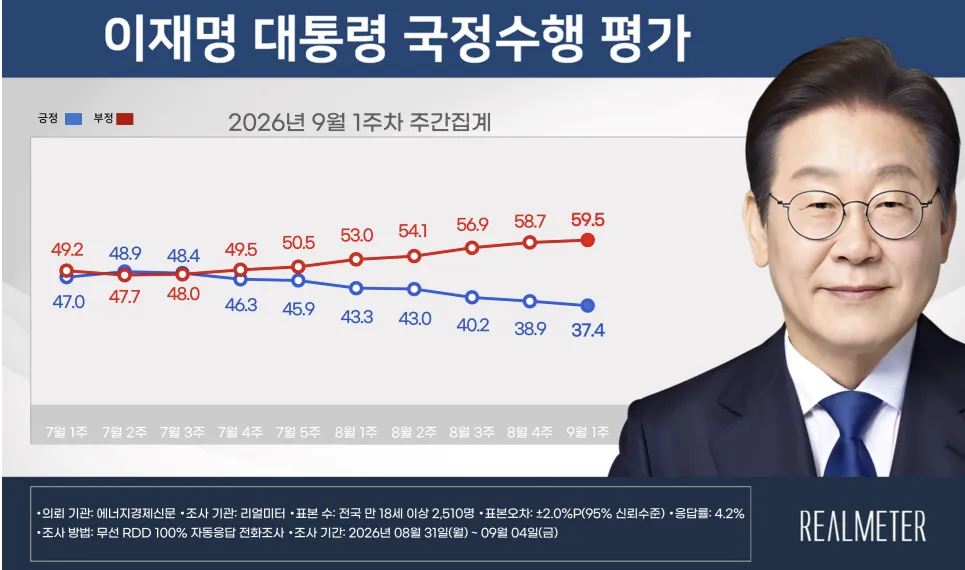
South Korean President Lee Jae-myung’s approval rating fell to 37.4 percent in the latest weekly poll, the eighth straight weekly decline — and the first survey taken after a six-minister cabinet reshuffle that was expected to steady his government.
What happened
A Realmeter poll commissioned by Energy Economy News and conducted August 31–September 4, 2026 put President Lee’s job-approval rating at 37.4 percent, down 1.5 percentage points from the prior week. Disapproval stood at 59.5 percent (up 0.8 points), leaving an approval-disapproval gap of −22.1 percentage points — the widest since Lee took office. The survey covered 2,510 registered voters nationwide, used wireless automated response calls, and carries a margin of error of ±2.0 percentage points at 95 percent confidence. A separate party-support poll (September 3–4, n=1,001) showed the ruling Democratic Party of Korea at 41.8 percent and the main opposition People Power Party (PPP) at 37.6 percent. On August 30, President Lee nominated six new cabinet ministers, a reshuffle aimed at addressing public dissatisfaction — yet the first poll afterward showed the slide continuing.
Why Korea does it this way
Under South Korea’s constitution, the president nominates ministers and the National Assembly (parliament) holds confirmation hearings, but the president can proceed with an appointment even if the Assembly declines to issue a formal confirmation report — meaning nominees can take office over legislative objection. This arrangement gives presidents considerable unilateral power over cabinet formation while still exposing nominees to public scrutiny during hearings. Weekly presidential approval tracking is a well-established feature of Korean political media, making short-term rating moves highly visible. Realmeter is one of several pollsters that publish a recurring weekly series, giving politicians and markets a near-real-time sentiment gauge.
What it means for you
For foreign residents and expats, a president whose approval is sliding faces pressure to produce visible policy wins quickly — which can accelerate or stall pending reforms depending on political calculations. Factors cited in the poll coverage include a proposed real estate tax reform reversal, appointment controversies, and favoritism allegations; if the tax-reform U-turn holds, property-related tax burdens could shift for homeowners and landlords. For investors and Korea-watchers, a weakening political mandate can slow legislative business: budget bills, financial regulation changes, and trade policy all require some degree of Assembly cooperation. The Democratic Party’s 41.8 percent support still leads the PPP’s 37.6 percent, but a narrowing gap limits the government’s ability to claim a broad popular mandate for contested legislation. Nothing is decided yet on the cabinet: the six nominees named August 30 still face Assembly hearings, and the president’s next moves will depend partly on whether any nominee becomes a political liability during those proceedings.
Watch next
- National Assembly confirmation hearings for the six nominees named August 30 — outcomes will signal whether the reshuffle steadies or deepens the political turbulence.
- Realmeter’s next weekly approval release (expected mid-September) — whether the rating stabilises or extends to a ninth straight weekly decline.
- Any formal Assembly vote on cabinet confirmation reports, which would test the ruling party’s floor strength against the PPP.
Source: The Korea Herald / Kyunghyang Shinmun (English)
Was this useful?
What made the difference? Pick one.
What made the difference? Pick one.
Thanks. We read every answer.