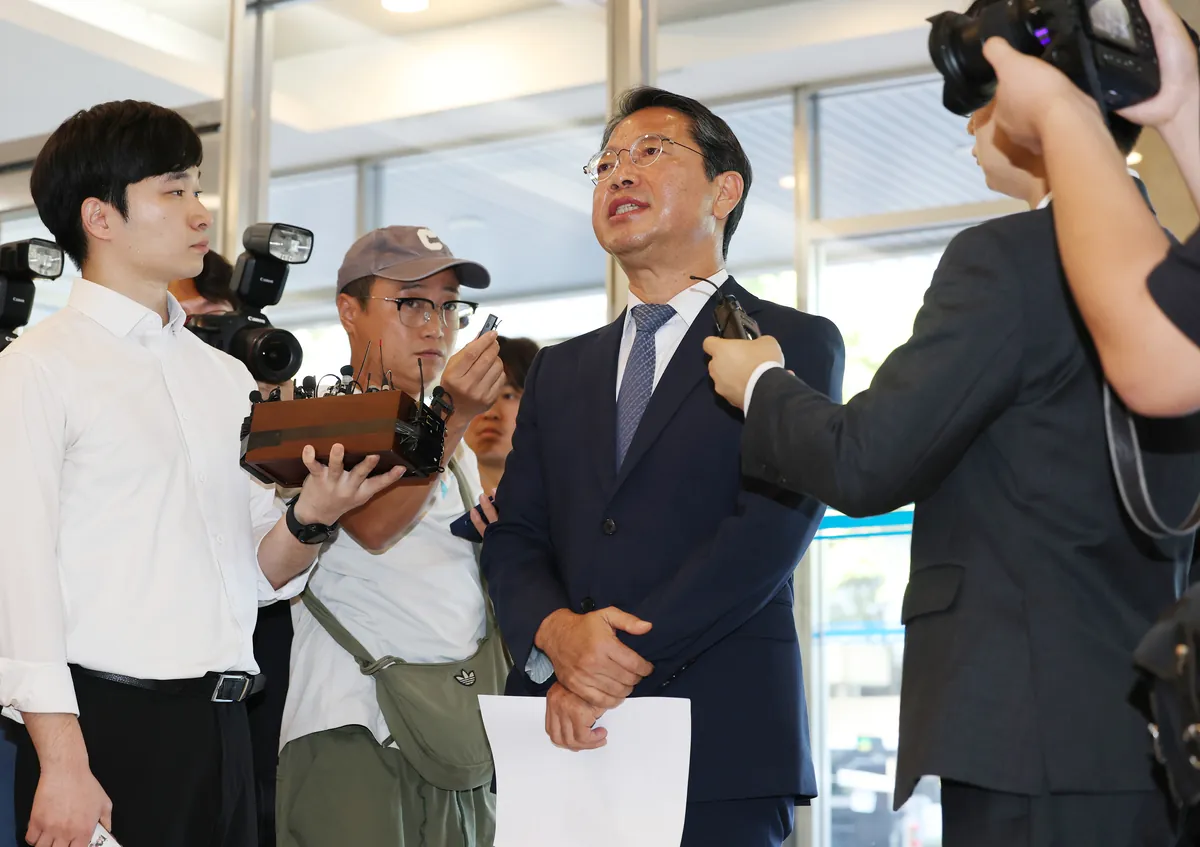
South Korea’s nominee for Minister of Justice, Kim Seung-won, publicly denied allegations that he improperly lobbied a government regulator on behalf of a pharmaceutical company — the disclosure coming just as his National Assembly confirmation hearing (a public vetting session where lawmakers question cabinet nominees) gets under way.
What happened
Kim Seung-won, nominated by the president to lead the Ministry of Justice, is facing scrutiny over a phone call he made in October 2021 to Kim Gang-lip, then-commissioner of the Ministry of Food and Drug Safety (Korea’s equivalent of the FDA). The call concerned Genencell, a biotech firm seeking expedited approval for a COVID-19 treatment clinical trial. A broker identified only as “Ms. Yang” is alleged to have asked Kim Seung-won to intervene, and prosecutors later investigated whether Kim agreed — in exchange — to receive a political donation of approximately ₩5 million (about $3,750 USD). In December 2024, prosecutors closed the case with a deferred prosecution (a decision not to indict, sometimes used when evidence is insufficient or the offense is deemed minor), stopping short of formal charges. Appearing outside the hearing preparation office at the Jeokseon Hyundai Building in Seoul’s Jongno-gu district on September 7, 2026, Kim told reporters the call amounted to nothing more than asking that a delayed administrative procedure be handled promptly, and that the review process was never compromised.
Why Korea does it this way
Under the Korean Constitution, the president appoints cabinet ministers and can proceed with appointments even if the National Assembly declines to issue a confirmation report — making hearings influential but not legally binding. The hearings are nonetheless politically significant: opposition parties use them to scrutinize nominees’ professional conduct, financial disclosures, and past controversies. Allegations of “청탁” (cheong-tak — improper solicitation or favoritism) carry particular weight in Korea, where the Improper Solicitation and Graft Act (known as the Kim Young-ran Act, enacted in 2016) created strict criminal liability for accepting requests that could influence public officials’ decisions, even without a direct bribe changing hands.
What it means for you
For foreign residents and Korea-watchers, the immediate practical stakes are limited until the hearing concludes. What matters more is the policy signal: the Ministry of Justice oversees prosecutors, immigration, and law enforcement priorities. If the nomination proceeds smoothly, Kim is expected to shape prosecution policy and potentially foreign-worker visa frameworks. If the ruling party cannot deflect the lobbying narrative, political bandwidth gets consumed by the confirmation fight rather than legislation. Former Justice Minister Han Dong-hoon, who originally raised the allegation, is a rival within conservative circles, suggesting part of the controversy reflects intra-party competition as much as regulatory misconduct. No policy decision is final until the appointment is confirmed and the ministry publishes its agenda.
Watch next
- The National Assembly confirmation hearing date — lawmakers’ questioning sessions are typically scheduled within days of the hearing preparation office opening; watch for the official calendar announcement.
- Whether the presidential office issues the formal appointment before or after the hearing report — a pre-hearing appointment would signal the administration is prepared to push past opposition objections.
- Any further disclosure from prosecutors about the deferred prosecution reasoning, which could resurface during the hearing as opposition lawmakers press for the full investigative record.
Reported by The Korea Herald / Kyunghyang Shinmun English edition on September 7, 2026, citing Kim’s remarks to reporters and court/prosecution records. This story has been reported by a single outlet at time of writing; treat details as preliminary pending further coverage.
Source: The Korea Herald (Kyunghyang Shinmun English)
Was this useful?
What made the difference? Pick one.
What made the difference? Pick one.
Thanks. We read every answer.