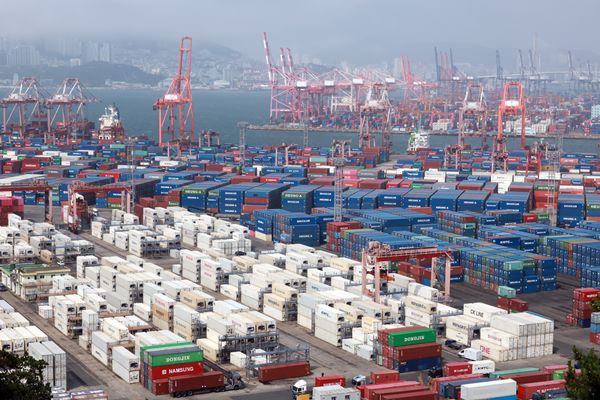
South Korea recorded its largest-ever July current account surplus in July 2025, driven almost entirely by a surge in semiconductor exports, according to provisional data released by the Bank of Korea.
What happened
The Bank of Korea (South Korea’s central bank) reported on Friday that the country’s current account surplus (the broadest measure of money flowing in versus out of a country, covering trade in goods, services, and investment income) reached $42.08 billion in July — the highest figure ever recorded for that month. The only larger monthly surplus in recent history was June’s $49.73 billion. Semiconductors, South Korea’s dominant export product, were the primary engine behind the result. The data are provisional, meaning minor revisions are possible.
Why Korea does it this way
Exports account for roughly 40% of South Korea’s GDP (gross domestic product — the total value of everything the country produces), making the economy unusually dependent on global trade compared with most wealthy nations. South Korea deliberately built this export-oriented model from the 1960s onward, concentrating industrial policy behind a handful of globally competitive sectors — steel, shipbuilding, autos, and most recently memory chips and display panels. Today, semiconductors alone can swing the monthly trade balance by tens of billions of dollars depending on global chip demand cycles. Because the economy is so trade-heavy, decisions made in Washington or Beijing about tariffs and trade rules feed through almost immediately into Korean growth rates, the Korean won (South Korea’s currency, abbreviated KRW or ₩), and employment.
What it means for you
Investors and won-watchers: A record surplus means more foreign currency flowing into South Korea than going out, which tends to support the won. A stronger won makes imports cheaper but can squeeze exporters’ margins when revenues earned in dollars are converted back.
Workers in tech and manufacturing: Strong chip export numbers translate into sustained production schedules at facilities run by Samsung Electronics and SK Hynix (the two South Korean companies that together supply a large share of the world’s memory chips). When the surplus is driven by semiconductors rather than a broad range of industries, workers outside that sector benefit less directly.
Foreign residents and expats: A healthy current account typically reduces the risk of a sharp currency depreciation, which matters if you hold savings, pay rent, or send remittances in Korean won. No policy change is imminent from this data release alone — it is a measurement, not a decision — but it informs the Bank of Korea’s thinking on interest rates and currency intervention.
Caveat: Record surpluses also attract scrutiny. If the U.S. or other trading partners judge Korea’s surplus as evidence of currency manipulation or unfair trade practices, that could prompt tariff threats or trade negotiations — a risk that the export-dependent economy watches closely.
Watch next
- Bank of Korea policy meeting: The next rate-setting meeting will give signals on whether record surpluses are changing the monetary policy calculus.
- August trade data: Preliminary customs-office export figures for August will indicate whether the semiconductor boom is holding or cooling.
- U.S.–Korea trade talks: Any statements from Washington on bilateral trade balances or tariff reviews affecting Korean electronics exports.
Source: KBS World Radio
Was this useful?
What made the difference? Pick one.
What made the difference? Pick one.
Thanks. We read every answer.